
Initial, “Epistolae, etc.”: Spain, 15th century via The British Library, Public Domain.

reblogging notational:
“Nüshu (literally “women’s writing” in Chinese) is a syllabic script created and used exclusively by women in the Jiangyong County in Hunan province of southern China. Up until the late Qing Dynasty (1644-1912) women were forbidden access to formal education, and so Nüshu was developed in secrecy as a means to communicate. Since its discovery in 1982, Nüshu remains to be the only gender-specific writing system in the world.”
“At the beginning of the twentieth century, Adolf Wölfli, a former farmhand and laborer, produced a monumental, 25,000-page illustrated narrative in Waldau, a mental asylum near Bern, Switzerland. Through a complex web of texts, drawings, collages and musical compositions, Wölfli constructed a new history of his childhood and a glorious future with its own personal mythology. The French Surrealist André Breton described his work as “one of the three or four most important oeuveres of the twentieth century”. Since 1975, our aim is to make Adolf Wölfli’s work known through one-man and group exhibitions as well as publications.”

“Wölfli’s first epic From the Cradle to the Grave runs over 2,970 pages of text and 752 illustrations bound by Wölfli into nine books. It takes the form of a travelogue whose principal hero is a boy called Doufi (a nickname for Adolf). Together with his family, Doufi travels all over the world which is, in the name of progress, duly explored and inventorised. In From the Cradle to the Grave, Wölfli transforms his miserable childhood into a glamorous story of wonderful adventures, discoveries and awesome hazards, all of which are famously overcome. The text, which mixes prose with poetry and extensive lists, is accompanied by colourful maps, portraits and illustrations of events such as combats, collapses and catastrophes. In these drawings one first encounters the form of the “Vögeli“ – a little bird which can be understood as the protector of the ubiquitous Wölfli’s alter ego and simultaneously as a sexual symbol filling in any potential empty space”

“Adolf Wölfli. From the Cradle to the Grave. Bedlam=Walking Wheel, Provisional Map of Both the Kingdom of Spain and Portugal, Dromedary Indian and Vosel Stubborn Donkey Mask, Lea Tantaria, Condor Eggs, Hall of Blacks, London South, Map of the Two Principalities Sonoricije and the West Bzimbzabazaru, Helvetic Cathedral in Northern Amazonian Hall, Atlantic Ocean Waves and Přístaf Cradle Lisbon (top to bottom). 1912.”

“Wölfli’s imaginary autobiography and one-person utopia starts with „From the Cradle to the Grave“ (1908-1912). In 3,000 pages, Wölfli turns his dramatic and miserable childhood into a magnificent travelog. He relates how as a child named Doufi, he traveled „more or less around the entire world,“ accompanied by the „Swiss Hunters and Nature Explorers Taveling Society.“ The narrative is lavishly illustrated with drawings of fictitious maps, portraits, palaces, cellars, churches, kings, queens, snakes, speaking plants, etc.”

“In the second part of the writings, the „Geographic and Algebraic Books“, Wölfli describes how to build the future „Saint Adolf-Giant-Creation“: a huge „capital fortune“ will allow to purchase, rename, urbanize, and appropriate the planet and finally the entire cosmos. In 1916 this narrative reaches a climax as Wölfli dubs himself St. Adolf II.”

“Jean Dubuffet, the French artist and founder of „Art Brut,“ called Wölfli „le grand Wölfli,“ the Surrealist André Breton considered his oeuvre „one of the three of four most important works of the twentieth century,“ and the Swiss curator Harald Szeemann showed a number of his pieces in 1972 at „documenta 5,“ the renown contemporary art exhibition in Kassel, Germany. Wölfli’s writings, which he considered his actual life’s work, only began to be systematically examined and transcribed in 1975 when the Adolf Wölfli Foundation was founded. Elka Spoerri (1924-2002) built up the Adolf Wölfli Foundation and was its curator from 1975 to 1996.”

“Every Monday morning Wölfli is given a new pencil and two large sheets of unprinted newsprint. The pencil is used up in two days; then he has to make do with the stubs he has saved or with whatever he can beg off someone else. He often writes with pieces only five to seven millimetres long and even with the broken-off points of lead, which he handles deftly, holding them between his fingernails. He carefully collects packing paper and any other paper he can get from the guards and patients in his area; otherwise he would run out of paper before the next Sunday night. At Christmas the house gives him a box of coloured pencils, which lasts him two or three weeks at the most.”
— Walter Morgenthaler, a doctor at the Waldau Clinic,

“Naturally enough, the question whether Wölfli’s music can be played is asked again and again. The answer is yes, with some difficulty. Parts of the musical manuscripts of 1913 were analyzed in 1976 by Kjell Keller and Peter Streif and were performed. These are dances – as Wölfli indicates – waltzes, mazurkas, and polkas similar in their melody to folk music. How Wölfli acquired his knowledge of music and its signs and terms is not clear. He heard singing in the village church. Perhaps he himself sang along. There he could see song books from the eighteenth century with six-line staffs (explaining, perhaps, his continuous use of six lines in his musical notations). At festivities he heard dance music, and on military occasions he heard the marches he loved so well. More important than the concrete evaluation of his music notations is Wölfli’s concept of viewing and designing his whole oeuvre as a big musical composition. The basic element underlying his compositions and his whole oeuvre is rhythm. Rhythm pervades not only his music but his poems and prose, and there is also a distinctive rhythmic flow in his handwriting.””

“After Wölfli died at Waldau in 1930 his works were taken to the Museum of the Waldau Clinic in Bern. Later the Adolf Wölfli Foundation was formed to preserve his art for future generations. Its collection is now on display at the Museum of Fine Arts in Bern.”

Information via Magic Transistor, Wikipedia and Adolf Wölfli Foundation.

“Pushkin would frequently jot down these charming black and white sketches both in his personal writings, and in the margins of his manuscripts. The final image, a page from Eugene Onegin, is a terrific example of his notebooks. Alongside the text, Pushkin included a sketch of a well-known Russian painter and aristocrat, with whom the author was certainly acquainted: Count Fyodor Petrovich Tolstoy (not to be confused with the Leo Tolstoy).”

“The Codex Fejérváry-Mayer is an Aztec Codex of central Mexico. It is one of the rare pre-Hispanic manuscripts that have survived the Spanish conquest of Mexico. As a typical calendar codex tonalamatl dealing with the sacred Aztec calendar – the tonalpohualli – it is placed in the Borgia Group. It is a divinatory almanac in 17 sections.Its elaboration is typically pre-Columbian: it is made on deerskin parchment folded accordion-style into 23 pages. It measures 16.2 centimetres by 17.2 centimetres and is 3.85 metres long”

“The earliest history of the codex is unknown. It is named after Gabriel Fejérváry (1780–1851), a Hungarian collector, and Joseph Mayer (1803–1886), an English antiquarian who bought the codex from Fejérváry. In 2004 Maarten Jansen and Gabina Aurora Pérez Jiménez proposed that it be given the indigenous name Codex Tezcatlipoca, from the Nahuatl name of the god Tezcatlipoca (who is shown, with black-and-yellow facial striping, in the centre of its first page), although it is not certain that its creators were Nahuas.
It is currently kept in the World Museum Liverpool in Liverpool, England, having as its catalogue # 12014 M. It is published in Volume 26 of the series Codices Selecti of the Akademische Druck – u. Verlagsanstalt – Graz. It is believed to have originated specifically in Veracruz.”

“Codex Fejérváry-Mayer is an important cultural artifact from the pre-Cortes destruction of the Aztec capital Tenochtitlan. An Aztec Code from Central Mexico, it is one of very few manuscripts to survive the Spanish conquest. A typical calendar code (onalamatl), including an Aztec world calendar (tonalpohualli) – both part of a larger series of codes called Code Borgija – it’s design is characterized by pre-colombian influence. It’s made of parchment and chamois, and folded like an accordion, stretching over twelve feet long when unfurled.”

“The earliest history of the code is wrapped in darkness, it became known as Codex Fejérváry-Mayer after the Hungarian collector (Fejervaryju) and benefactor from Liverpool (Mayer) who acquired the piece. Most experts agree the true name was probably Code Tezcatlipoca, the name of the Nahuatl people’s god.”


via MagicTransistor


“Handwritten in ink. From the 18th century, and perhaps even earlier, hollow eggs on which sacred texts had been written in micrography were used to decorate European sukkahs. Not all the texts related directly to the holiday of Sukkot, the Festival of Booths: this example has Song of Songs 1-4:7 inscribed in miniscule letters. At times feathers were added to the hanging egg, so that it looked like a bird in flight.”
— via whiteshiningsilver

“Colour illustration of the nervous system as seen in a copy of Mansur’s Anatomy, also known as Tashrih-i Mansuri. Written in both Persian and Arabic terms with seven sections: an introduction, five main chapters, and an appendix on the formation of the fetus and organs. Or.Ms 419 contians 100 folios with numerous illustrations. Not dated.”

“I like to say that we only make one movie in our lifetime, a movie made of all the images of all our movies.”
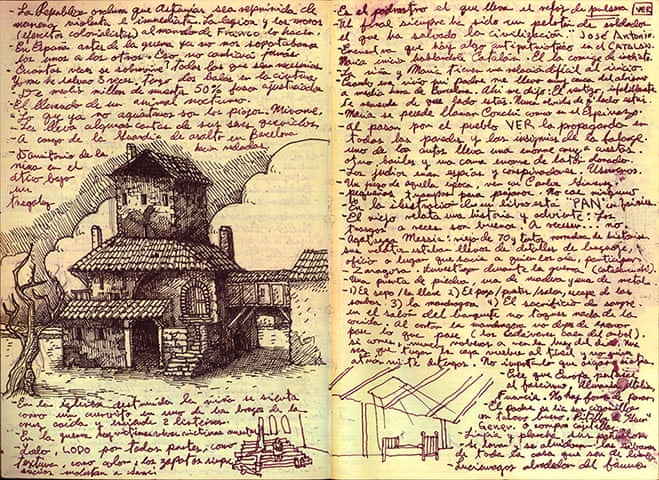
“In the end, perfection is just a concept – an impossibility we use to torture ourselves and that contradicts nature.”
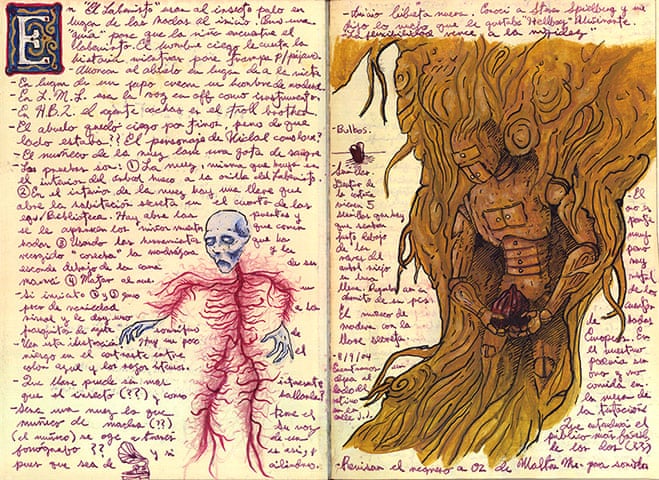
“In fairy tales, monsters exist to be a manifestation of something that we need to understand, not only a problem we need to overcome, but also they need to represent, much like angels represent the beautiful, pure, eternal side of the human spirit, monsters need to represent a more tangible, more mortal side of being human: aging, decay, darkness and so forth. And I believe that monsters originally, when we were cavemen and you know, sitting around a fire, we needed to explain the birth of the sun and the death of the moon and the phases of the moon and rain and thunder. And we invented creatures that made sense of the world: a serpent that ate the sun, a creature that ate the moon, a man in the moon living there, things like that. And as we became more and more sophisticated and created sort of a social structure, the real enigmas started not to be outside. The rain and the thunder were logical now. But the real enigmas became social. All those impulses that we were repressing: cannibalism, murder, these things needed an explanation. The sex drive, the need to hunt, the need to kill, these things then became personified in monsters. Werewolves, vampires, ogres, this and that. I feel that monsters are here in our world to help us understand it. They are an essential part of a fable.”
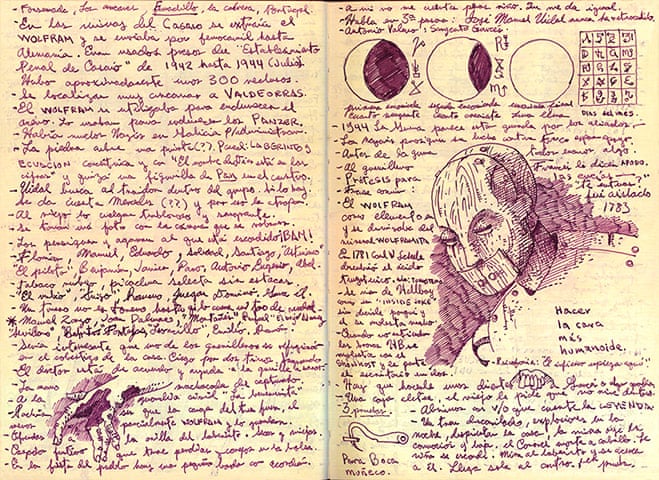
“On that December night at Bleak House, I noticed that del Toro had moved some of his journals from the bathroom safe to a shelf in the Rain Room. I asked to see early sketches for “Madness.” The notebook was from 1993. He turned the pages, stopped, and smiled. “Look!” he said. It was an image of one of the explorers falling into icy water. An inky creature lunging at him looked breathtakingly similar to the Shoggoth with symmetrical tentacles. Del Toro’s monsters had inhabited his mind for nearly two decades. From the beginning, del Toro had imagined that his creatures, unlike Lovecraft’s, would have a fatal vulnerability—one that explained why the horrible beasts had remained trapped in Antarctica. Salt water: it dissolved a Shoggoth like a slug. “
— Show The Monster, Guillermo del Toro’s quest to get amazing creatures onscreen
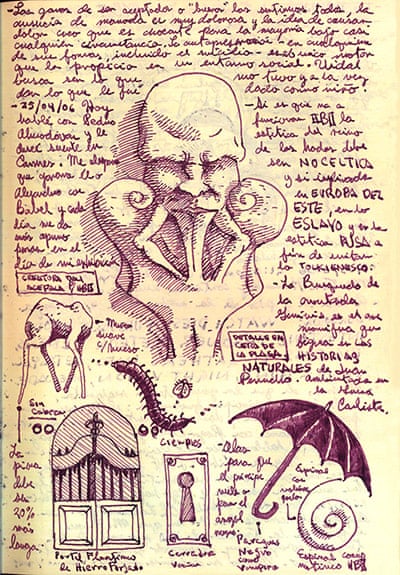
“Some ideas for one film end up getting used in another. Some pages are instructions for make-up artists, others are just Del Toro working out what looks cool and scary.”
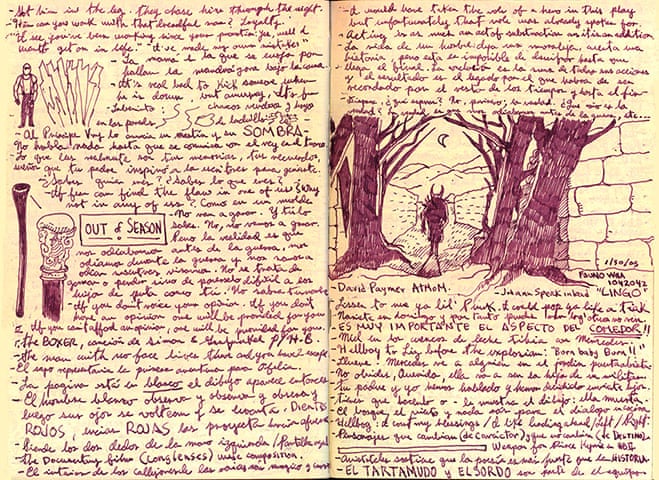
Images via.
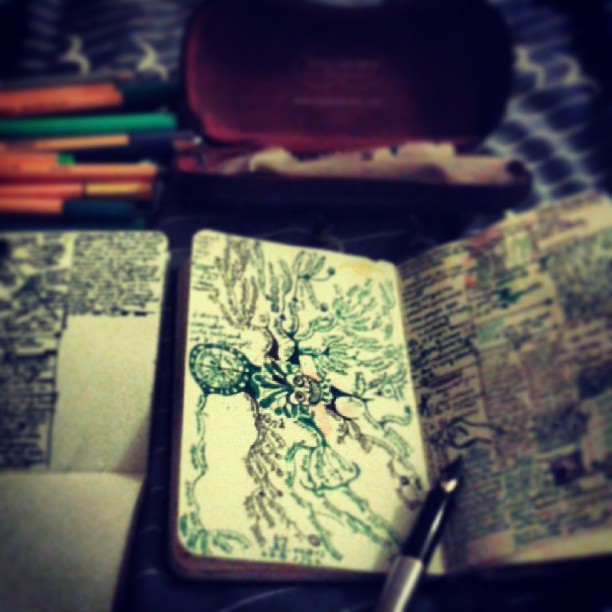
 Paul Greer