“Black Widow’s superpower is that she has to have her bottom shown before the rest of her”
– My nine year old daughter on why we need more women writing superhero stories.
(T)
“Black Widow’s superpower is that she has to have her bottom shown before the rest of her”
– My nine year old daughter on why we need more women writing superhero stories.
(T)
“The first thing to remember is that it’s not a graphic novel, it’s a comic. People are so afraid to say the word “comic”. It makes you think of a grown man with pimples, a ponytail and a big belly. Change it to “graphic novel” and that disappears. No: it’s all comics. Movies are all movies. Arnold Schwarzenegger, Orson Welles: one is shit, the other isn’t. But they’re all movies.”


more at Russian Culture.
via Ben Katchor

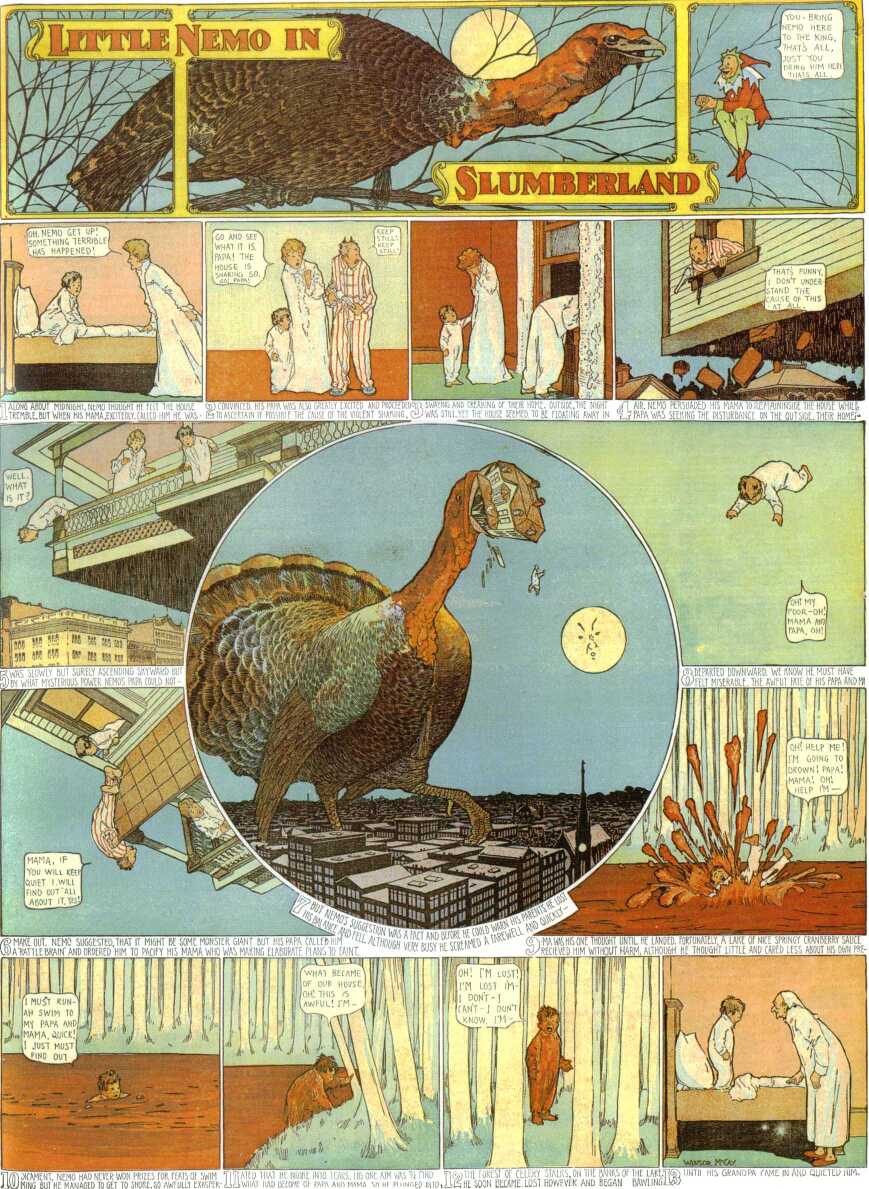
“As an undergraduate student and aspiring cartoonist, the book laid open most often on my drawing table was Blackbeard and Williams’ weighty Smithsonian Book of Newspaper Comics. For years I’d been led to believe by various comic book aficionados that the zenith of achievement for the medium were the EC comic books of the 1950s, but after discovering the Smithsonian book, it became all too clear to me that the real original geniuses of the medium were the pre-cinema cartoonists of the throwaway Sunday supplements of a half century prior. As a general history, the book evenly balanced a necessary all-inclusivity with an otherwise gently insistent esthetic sophistication, which was something of a virtuosic tightrope act of curation: covering everything while still allowing the greats to shine. Choosing a few representative examples of Krazy Kat and Little Nemo is hard enough, but what about introducing Gasoline Alley and Polly and Her Pals to a brand-new readership, to say nothing of uncovering the obscure efforts of George Luks and Lyonel Feininger? Even better, the strips were presented in a warm, large, full-color format which at the time must have been extraordinarily expensive, but allowed their complicated and intricate compositions to be truly re-appreciated; earlier histories of comics had tended towards text-clotted black-and-white tour schedules, amputating single panels and freeze-drying them in black and white as little more than passing souvenirs of an outmoded 19th and early 20th century naïveté. (As an aside, one of the deciding reasons I agreed to design the “Krazy and Ignatz” series was that Mr. Blackbeard was its acting editor, and I considered it a personal honor to be asked to contribute.) By devoting his life to the preservation and location of these near-extinct supplements and sections, Bill Blackbeard saved an American art from the certain peril of trash men, librarians and ultraviolet light so that we, the generations to come, could appreciate their unprepossessing, unpretentious and uproarious beauty. The comic strip may have been disposable, but Bill Blackbeard’s founding contribution to the understanding of it as an art was, and always will be, timeless.”
– Chris Ware
via Austin Kleon
“If Art Spiegelman’s MAUS had been filmed first, it would have had an audience of maybe three people at Sundance. Because the moment everyone trooped on wearing their mouse masks, any larger audience would have lost it and left giggling. Only in the space of cartooning could that conceit work. Not least because we’re already aware, when we come to cartooning, that we’re looking at someone’s processed and hermetic perception of the world. The great success of MAUS is that the mouse faces make us let our guard down, and so we’re hit by the horrible truth of that book from an unprotected angle.”
“..a curling, snarling Peter Kuper piece can sear the page with its anger in a way that no photorealistic artist will ever be able to communicate. A room drawn by Eddie Campbell will be more real than any snapshot, because his line is almost like handwriting, and has human breath upon it. Dash Shaw’s work may look rough on first look, but stay with it, look at how he conveys the essence of an idea in every panel, and you’ll realise how hard he sometimes works to evoke an entire world with so few elements.”
“This is a field that combines, on the one hand, the novel and the poem and the slogan and the news story, and on the other hand every stop from pointillism to cave painting. Understand comics as the marriage of word and picture, as simple as that, and you’ll get a sense of how broad the medium’s reach really is.”
 Paul Greer
