via motleyglue
creativity
Brian Eno on Art, Confidence, and How Attention Creates Value
“Stop thinking about art works as objects, and start thinking about them as triggers for experiences. (Roy Ascott’s phrase.) That solves a lot of problems: we don’t have to argue whether photographs are art, or whether performances are art, or whether Carl Andre’s bricks or Andrew Serranos’s piss or Little Richard’s ‘Long Tall Sally’ are art, because we say, ‘Art is something that happens, a process, not a quality, and all sorts of things can make it happen.’ … [W]hat makes a work of art ‘good’ for you is not something that is already ‘inside’ it, but something that happens inside you — so the value of the work lies in the degree to which it can help you have the kind of experience that you call art.”
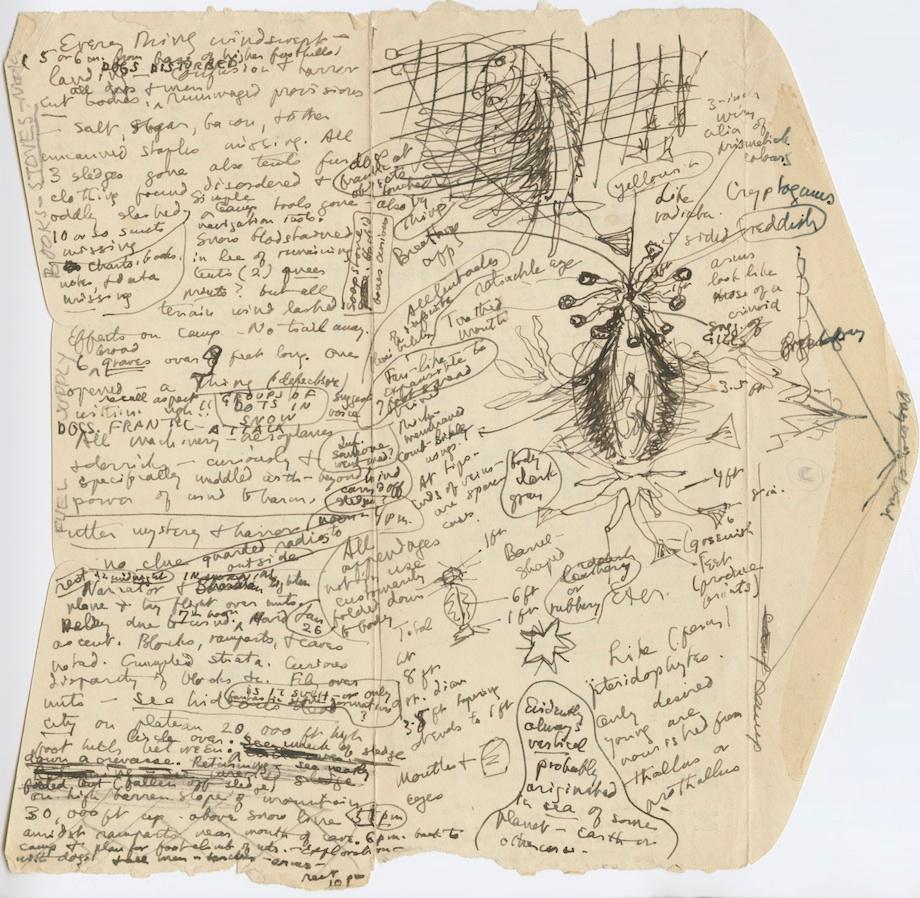
H.P. Lovecraft’s Monster Drawings: Cthulhu and “an open slice of howling fear”

“On March 23rd, the manuscript continued, Wilcox failed to appear; and inquiries at his quarters revealed that he had been stricken with an obscure sort of fever and taken to the home of his family in Waterman Street. He had cried out in the night, arousing several other artists in the building, and had manifested since then only alternations of unconsciousness and delirium.”

“Mountains featured several species of forgotten, intelligent beings, including the ‘Elder Things.’ The sketch on the right side of this page of notes (click here to view it in a larger format), with its annotations (‘body dark grey’; ‘all appendages not in use customarily folded down to body’; ‘leathery or rubbery’) represents Lovecraft working out the specifics of an Elder Thing’s anatomy.” That such things lurked in Lovecraft’s imagination have made his state of mind a subject of decades and decades of rich discussion among his enthusiasts. But just the body count racked up by Cthulhu, the Elder Things, and the other denizens of this unfathomable realm should make us thankful that Lovecraft saw them in his mind’s eye so we wouldn’t have to.”
from openculture
Patti Smith’s advice to young artists
“A writer or any artist can’t expect to be embraced by the people. I’ve done records where it seemed like no one listened to them. You write poetry books that maybe 50 people read. And you just keep doing your work because you have to, because it’s your calling.
But it’s beautiful to be embraced by the people.
Some people have said to me, “Well, don’t you think that kind of success spoils one as an artist? If you’re a punk rocker, you don’t want to have a hit record…”
And I say to them, “Fuck you!”
One does their work for the people. And the more people you can touch, the more wonderful it is. You don’t do your work and say, “I only want the cool people to read it.” You want everyone to be transported, or hopefully inspired by it.
When I was really young, William Burroughs told me, “Build a good name. Keep your name clean. Don’t make compromises. Don’t worry about making a bunch of money or being successful. Be concerned with doing good work. And make the right choices and protect your work. And if you can build a good name, eventually that name will be its own currency.”
via austinkleon
The 25 Greatest Quotes About Writing »
reblogging nevver:
-
“Writing is easy. All you have to do is cross out the wrong words.” — Mark Twain
-
“I only achieve simplicity with enormous effort.” — Clarice Lispector
-
“A woman must have money and a room of her own if she is to write fiction.” — Virginia Woolf
-
“I’ve put in so many enigmas and puzzles that it will keep the professors busy for centuries arguing over what I meant, and that’s the only way of insuring one’s immortality.” — James Joyce
-
“The first draft of anything is shit.” — Ernest Hemingway
-
“Always be a poet, even in prose.” — Charles Baudelaire
-
“Literature — creative literature — unconcerned with sex, is inconceivable.” — Gertrude Stein
-
“If you do not breathe through writing, if you do not cry out in writing, or sing in writing, then don’t write, because our culture has no use for it.” — Anaïs Nin
-
“One can be absolutely truthful and sincere even though admittedly the most outrageous liar. Fiction and invention are of the very fabric of life.” — Henry Miller
-
“Writers aren’t people exactly. Or, if they’re any good, they’re a whole lot of people trying so hard to be one person.” — F. Scott Fitzgerald
-
“The true writer has nothing to say. What counts is the way he says it.” — Alain Robbe-Grillet
-
“James Joyce was a synthesizer, trying to bring in as much as he could. I am an analyzer, trying to leave out as much as I can.” — Samuel Beckett
-
“Life is painful and disappointing. It is useless, therefore, to write new realistic novels. We generally know where we stand in relation to reality and don’t care to know any more.” — Michel Houellebecq
-
“Do you realize that all great literature is all about what a bummer it is to be a human being? Isn’t it such a relief to have somebody say that?” — Kurt Vonnegut
-
“Skill alone cannot teach or produce a great short story, which condenses the obsession of the creature; it is a hallucinatory presence manifest from the first sentence to fascinate the reader, to make him lose contact with the dull reality that surrounds him, submerging him in another that is more intense and compelling.” — Julio Cortázar
-
“Don’t bend; don’t water it down; don’t try to make it logical; don’t edit your own soul according to the fashion. Rather, follow your most intense obsessions mercilessly.” — Franz Kafka
-
“Reading is more important than writing.” — Roberto Bolaño
-
“The artist is always beginning. Any work of art which is not a beginning, an invention, a discovery is of little worth.” — Ezra Pound
-
“The next real literary “rebels” in this country might well emerge as some weird bunch of anti-rebels, born oglers who dare somehow to back away from ironic watching, who have the childish gall actually to endorse and instantiate single-entendre principles. Who treat of plain old untrendy human troubles and emotions in U.S. life with reverence and conviction. Who eschew self-consciousness and hip fatigue. These anti-rebels would be outdated, of course, before they even started. Dead on the page. Too sincere. Clearly repressed. Backward, quaint, naive, anachronistic. Maybe that’ll be the point. Maybe that’s why they’ll be the next real rebels. Real rebels, as far as I can see, risk disapproval. The old postmodern insurgents risked the gasp and squeal: shock, disgust, outrage, censorship, accusations of socialism, anarchism, nihilism. Today’s risks are different. The new rebels might be artists willing to risk the yawn, the rolled eyes, the cool smile, the nudged ribs, the parody of gifted ironists, the “Oh how banal.” To risk accusations of sentimentality, melodrama. Of overcredulity. Of softness. Of willingness to be suckered by a world of lurkers and starers who fear gaze and ridicule above imprisonment without law. Who knows.” — David Foster Wallace
-
“The person born with a talent they are meant to use will find their greatest happiness in using it.” — Johann Wolfgang von Goethe
-
“We live not only in a world of thoughts, but also in a world of things. Words without experience are meaningless.” — Vladimir Nabokov
-
“…Describe your sorrows and desires, the thoughts that pass through your mind and your belief in some kind of beauty – describe all these with heartfelt, silent, humble sincerity and, when you express yourself, use the Things around you, the images from your dreams, and the objects that you remember. If your everyday life seems poor, don’t blame it; blame yourself; admit to yourself that you are not enough of a poet to call forth its riches; because for the creator there is not poverty and no poor, indifferent place. And even if you found yourself in some prison, whose walls let in none of the world’s sounds – wouldn’t you still have your childhood, that jewel beyond all price, that treasure house of memories? Turn your attentions to it. Try to raise up the sunken feelings of this enormous past; your personality will grow stronger, your solitude will expand and become a place where you can live in the twilight, where the noise of other people passes by, far in the distance. — And if out of this turning-within, out of this immersion in your own world, poems come, then you will not think of asking anyone whether they are good or not. Nor will you try to interest magazines in these works: for you will see them as your dear natural possession, a piece of your life, a voice from it. A work of art is good if it has arisen out of necessity. That is the only way one can judge it.” — Rainer Maria Rilke
-
“The words of my book nothing, the drift of it everything.” — Walt Whitman
-
“All I know is what the words know, and dead things, and that makes a handsome little sum, with a beginning and a middle and an end, as in the well-built phrase and the long sonata of the dead.” — Samuel Beckett
-
“Do you know what I was smiling at? You wrote down that you were a writer by profession. It sounded to me like the loveliest euphemism I had ever heard. When was writing ever your profession? It’s never been anything but your religion. Never. I’m a little overexcited now. Since it is your religion, do you know what you will be asked when you die? But let me tell you first what you won’t be asked. You won’t be asked if you were working on a wonderful, moving piece of writing when you died. You won’t be asked if it was long or short, sad or funny, published or unpublished. You won’t be asked if you were in good or bad form while you were working on it. You won’t even be asked if it was the one piece of writing you would have been working on if you had known your time would be up when it was finished—I think only poor Soren K. will get asked that. I’m so sure you’ll only get asked two questions. Were most of your stars out? Were you busy writing your heart out? If only you knew how easy it would be for you to say yes to both questions. ” — J.D. Salinger
“I’ll just go ahead and do it anyway.”
“Unfortunately the little artists within us are choked to death before we get to fight against the oppressors of art. They get locked in. That’s our tragedy.
So what happens when little artists get locked in, banished or even killed? Our artistic desire doesn’t go away. We want to express, to reveal ourselves… The artistic impulses inside of us are suppressed but not gone.
They can often reveal themselves negatively in the form of jealously. You know the song, “I Would Love to be on TV”? Why would we love it?
TV is full of people who do what we wished to do but never got to. They dance, they act, the more they do the more they are praised. So we start to envy them. We become dictators with a remote and start to criticize the people on TV. “He just can’t act.” “You call that singing?” “She can’t hit the notes.”We easily say these sorts of things. We get jealous not because we are evil but because we have little artists pent up inside of us. That’s what I think. What should we do? Right now we need to start our own art. Right this minute. Turn off the TV. Log off the internet. Get up and start to do something….
… In my writing class I give students a special assignment. I have students like you in the class, many who don’t major in writing. Some major in art or music and think they can’t write so I give them a blank sheet of paper and a theme: Write about the most unfortunate experience in your childhood. There’s one condition. You must write like crazy. Like crazy! I walk around and encourage them. “Come on! Come on!” They have to write like crazy for an hour or two. They only get to think for the first five minutes.
The reason I make them write like crazy is because when you write slowly lots of thoughts cross your mind. The artistic devil creeps in. The devil will tell you hundreds of reasons why you can’t write. “People will laugh at you. This is not good writing. What kind of sentence is this? Look at your handwriting!” It will say a lot of things. You have to run so fast the devil can’t catch up.
The really good writing I’ve seen in my class was not from the assignments with a long deadline but from the 40 to 60 minutes they write without knowing what they are writing. And at this moment the nagging devil disappears.
So I can say this: It’s not the hundreds of reasons why one can’t be an artist, but rather the one reason one must be that makes us artists. Why we cannot be something is not important. Most artists become artists because of the one reason.
When we put the devil in our heart to sleep and start our own art enemies appear on the outside. Mostly they have the faces of our parents or our spouses. But they are devils. Devils. They come to earth briefly transformed to stop you from being artistic, from becoming artists. And they have a magic question: “What for?”
But art is not for anything. Art is the ultimate goal. It saves our souls and makes us live happily. So in response to such a pragmatic question, we need to be bold: “Well, just for the fun of it. Sorry to have fun without you.” that’s what you should say.
“I’ll just go ahead and do it anyway.”
Neil Gaiman’s New Year’s Wish…
“It’s a New Year and with it comes a fresh opportunity to shape our world.
So this is my wish, a wish for me as much as it is a wish for you: in the world to come, let us be brave – let us walk into the dark without fear, and step into the unknown with smiles on our faces, even if we’re faking them.
And whatever happens to us, whatever we make, whatever we learn, let us take joy in it. We can find joy in the world if it’s joy we’re looking for, we can take joy in the act of creation.
So that is my wish for you, and for me. Bravery and joy.”
— via
Mark Helprin on why he writes.
“My answer, then, as you may have guessed, is very simple. I write in service of illumination and memory. I write to reach into ‘the blind world where no one can help.’ I write because it is a way of glimpsing the truth. And I write to create something of beauty.”
— via theparisreview
The Gilbert and Jaime Hernandez Interview
“Well, anyway it was that. And I used to get pooh-poohed for that, but that’s how stuff’s created. It’s an image that you just work with from scratch. Dan Clowes does that all the time, you just draw somebody and … Wilson was just a drawing, he said, and then he did a whole book from there.”
 Paul Greer