drawing
/ˈdrɔː(r)ɪŋ/
noun
1. a picture or diagram made with a pencil, pen, or crayon rather than paint.
“a series of charcoal drawings on white paper”
synonyms: sketch, picture, illustration, representation, portrayal, delineation, depiction, composition, study, diagram, outline, design, plan, artist’s impression; tracing
“he did a pencil drawing of the house”
2. an instance of selecting the winner or winners in a lottery or raffle.
“entrants need not be present at the drawing”
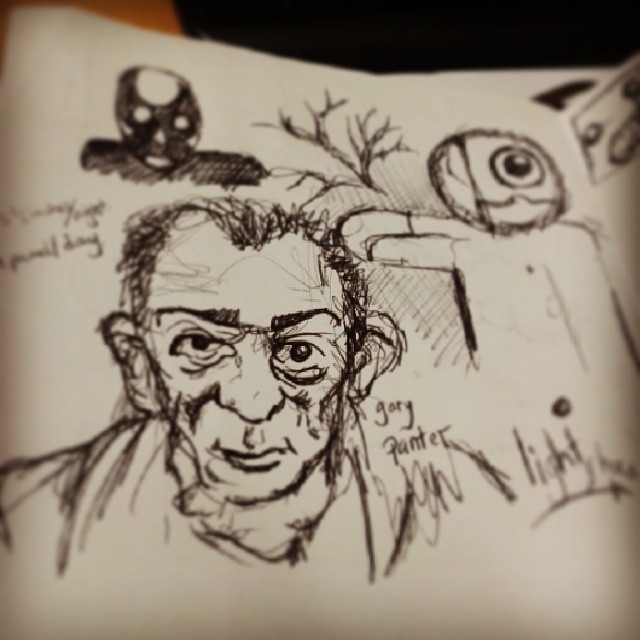
Bad drawing of Gary Panter.
Anatomical Drawing. Tashrih-i Mansuri, f.41r

“Colour illustration of the nervous system as seen in a copy of Mansur’s Anatomy, also known as Tashrih-i Mansuri. Written in both Persian and Arabic terms with seven sections: an introduction, five main chapters, and an appendix on the formation of the fetus and organs. Or.Ms 419 contians 100 folios with numerous illustrations. Not dated.”
The Bakemono Zukushi Scroll

“These wonderful images featured here are from a Japanese painted scroll known as the Bakemono zukushi. The artist and date is unknown, though its thought to hail from the Edo-period, sometime from the 18th or 19th century. Across it’s length are depicted a ghoulish array of “yokai” from Japanese folklore. In his The Book of Yokai, Michael Dylan Foster describes a yokai as:
‘a weird or mysterious creature, a monster or fantastic being, a spirit or a sprite … creatures of the borderlands, living on the edge of town, or in the mountains between villages, or in the eddies of a river running between two rice fields. They often appear at twilight, that gray time when the familiar seems strange and faces become indistinguishable. They haunt bridges and tunnels, entranceways and thresholds. They lurk at crossroads.’“

“The class of yokai characterised by an ability to shapeshift, and that featured in this scroll, is the bakemono (or obake), a word literally meaning “changing thing” or “thing that changes”. The founding father of minzokugaku (Japanese folklore studies), Yanagita Kuno (1875–1962), drew a distinction between yurei (ghosts) and bakemono: the former haunt people and are associated with the depth of night, whereas the latter haunt places and are seen by the dim light of dusk or dawn.”

“Amongst the bakemono monsters depicted in the scroll is the rokurokubi (ろくろくび), a long-necked woman whose name literally means “pulley neck”. Whether shown with a completely detachable head (more common in Chinese versions), or with head upon the end of a long threadlike neck as shown here, the head of the rokurokubi has the ability to fly about independently of the body. In his 1904 collection Kwaidan, Lafcadio Hearn provides the first extended discussion of this yokai in English, telling of a samurai-turned-travelling-priest who finds himself staying the night in a household of rokurokubi intent on eating their guest.”

more at Public Domain Review
sketchbook/notebook
“Some people use their sketchbook/notebooks to help them work things out. We use them to imagine things, figure out how to make something, help us see and listen, and to help us lay out certain problems we are wondering about in a way that lets us know more about them. I like this kind of sketchbook/workbook best the kind that’s more of a place to mess around than a place to make skillful pictures. Although it turns out that spending a certain amount of sincere time messing around in your notebook it just seems to lead to some beautiful pages anyway.”
Inside Guillermo Del Toro’s sketchbooks

“I like to say that we only make one movie in our lifetime, a movie made of all the images of all our movies.”
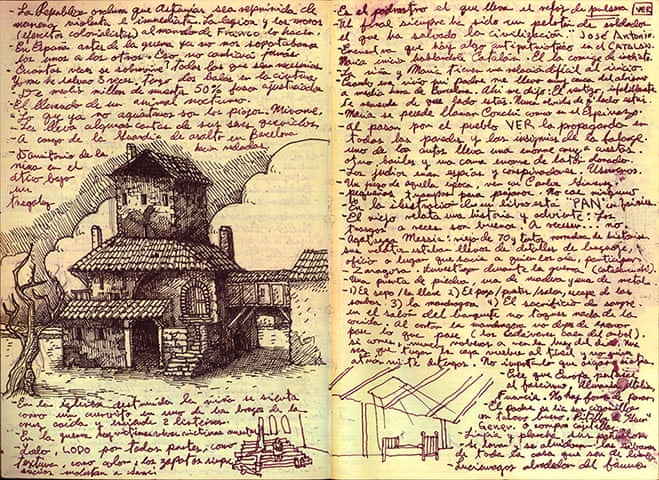
“In the end, perfection is just a concept – an impossibility we use to torture ourselves and that contradicts nature.”
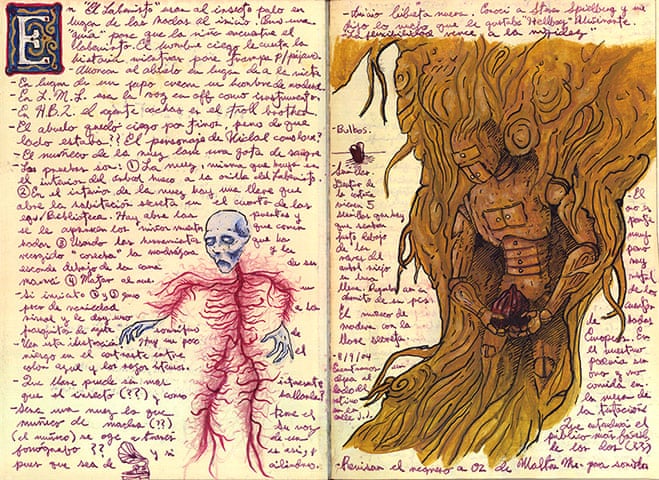
“In fairy tales, monsters exist to be a manifestation of something that we need to understand, not only a problem we need to overcome, but also they need to represent, much like angels represent the beautiful, pure, eternal side of the human spirit, monsters need to represent a more tangible, more mortal side of being human: aging, decay, darkness and so forth. And I believe that monsters originally, when we were cavemen and you know, sitting around a fire, we needed to explain the birth of the sun and the death of the moon and the phases of the moon and rain and thunder. And we invented creatures that made sense of the world: a serpent that ate the sun, a creature that ate the moon, a man in the moon living there, things like that. And as we became more and more sophisticated and created sort of a social structure, the real enigmas started not to be outside. The rain and the thunder were logical now. But the real enigmas became social. All those impulses that we were repressing: cannibalism, murder, these things needed an explanation. The sex drive, the need to hunt, the need to kill, these things then became personified in monsters. Werewolves, vampires, ogres, this and that. I feel that monsters are here in our world to help us understand it. They are an essential part of a fable.”
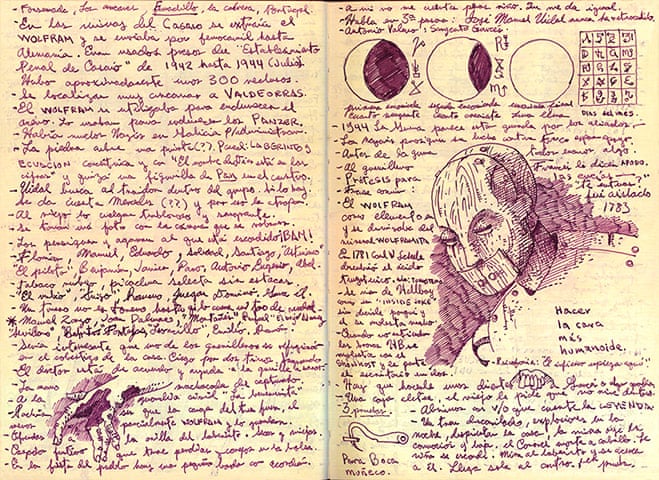
“On that December night at Bleak House, I noticed that del Toro had moved some of his journals from the bathroom safe to a shelf in the Rain Room. I asked to see early sketches for “Madness.” The notebook was from 1993. He turned the pages, stopped, and smiled. “Look!” he said. It was an image of one of the explorers falling into icy water. An inky creature lunging at him looked breathtakingly similar to the Shoggoth with symmetrical tentacles. Del Toro’s monsters had inhabited his mind for nearly two decades. From the beginning, del Toro had imagined that his creatures, unlike Lovecraft’s, would have a fatal vulnerability—one that explained why the horrible beasts had remained trapped in Antarctica. Salt water: it dissolved a Shoggoth like a slug. “
— Show The Monster, Guillermo del Toro’s quest to get amazing creatures onscreen
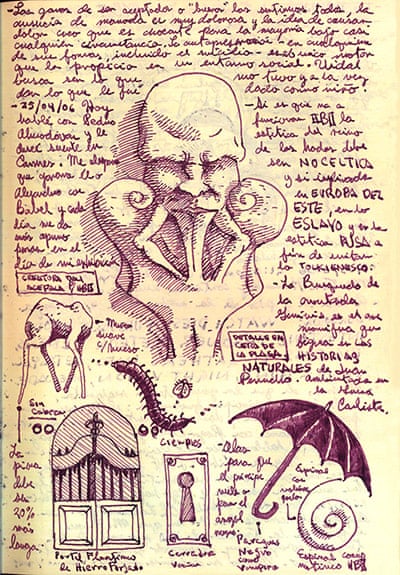
“Some ideas for one film end up getting used in another. Some pages are instructions for make-up artists, others are just Del Toro working out what looks cool and scary.”
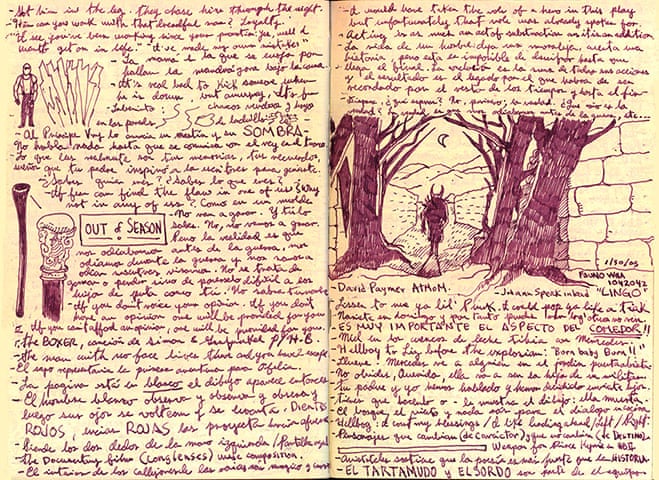
Images via.
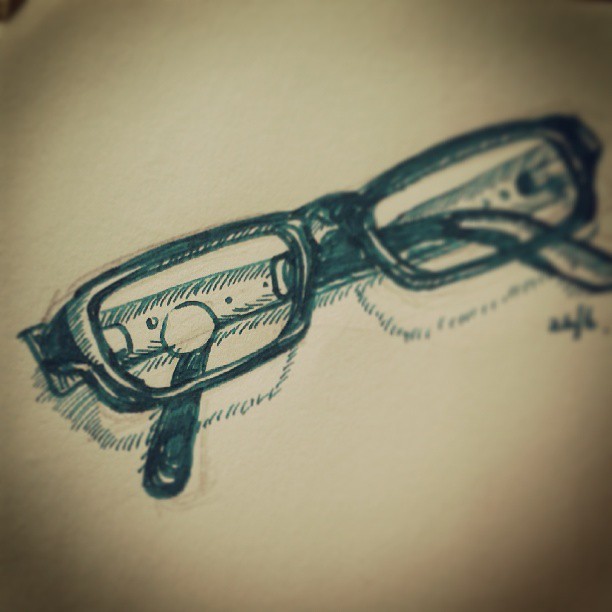
I took my glasses off so I could draw them.
Thoughts on Doodling
“…keep drawing, make A LOT of drawings, and don’t worry about making bad drawings.”
The Wizarding Way
“DRAW FROM LIFE. All the time. Draw naked people. Draw clothed people. Draw pets and buildings and teacups and trees and draw all of it all the time. Put it in a book that you keep in your pocket. Steal life from the realm of the living so that the worlds you create might also live.”
 Paul Greer