“City of Tiny Lites” – Frank Zappa (1979ish)

Just been introducing the younger folk at work to some old school claymation, the work of the mighty Bruce Bickford.

“Bickford was a Vietnam veteran whose love for animation sprung out his crude home movies. His earliest experiments involved toy cars, but a need to populate these rough little films led to the creation of tiny clay figures. Soon enough he was letting his imagination spill out with strange, ever-morphing stream of consciousness tales that seemed to revolve around demons and animal heads, hamburgers and pizzas, treacherous landscapes and excessive violence – “danger and weirdness”, in Bickford’s own words. Audiences were given an early taste when The Old Grey Whistle Test aired a portion of ‘City Of Tiny Lights’ with animated accompaniment in 1979. Baby Snakes made its debut during the Christmas of that year, containing more examples and a peak of behind-the-scenes amidst the concert footage.”

Anthony Nield

“The Paradise Destroyed by the Straight Line,”- Friedensreich Hundertwasser on Stamps and Lines

“The stamp is an important object. Although very small in format, it carries a message. Stamps are a measure of the culture of a country. This tiny, rectangular piece of paper links the hearts of the sender and receiver. It is a bridge between peoples and nations. The stamp knows no borders. It reaches us even in prisons, asylums, and hospitals, and wherever we may be on earth. Stamps should be ambassadors of art and life and not simply soulless proofs of postage paid. The stamp must experience its destiny. The stamp must once again fulfil its purpose, which means it must serve on letters. A true stamp must feel the tongue of the sender moistening its gum. A stamp must be stuck on a letter. A stamp must experience the dark depths of the post box. A stamp must suffer franking. A stamp must sense the hand of the postman handing the letter to the addressee….The stamp is the only work of art that everyone can own, young and old, rich and poor, healthy and sick, educated and ignorant, free or robbed of freedom…“

Hundertwasser, February 14, 1990


hunterwasser stamps


hunterwasser stamps


hunterwasser stamps


hunterwasser stamps


hunterwasser stamps

“In 1953 I realized that the straight line leads to the downfall of mankind. But the straight line has become an absolute tyranny. The straight line is something cowardly drawn with a rule, without thought or feeling; it is a line which does not exist in nature. And that the line is the rotten foundation of our doomed civilization. Even if there are certain places where it is recognized that this line is rapidly leading to perdition, its course continues to be plotted. The straight line is godless and immoral.

The straight line is the only uncreative line, the only line which does not suit man as the image of God. The straight line is the forbidden fruit. The straight line is the curse of our civilization. Any design undertaken with the straight line will be stillborn.

Today we are witnessing the triumph of rationalist knowhow and yet, at the same time, we find ourselves confronted with emptiness. An aesthetic void, desert of uniformity, criminal sterility, loss of creative power. Even creativity is prefabricated. We have become impotent. We are no longer able to create. That is our real illiteracy.”

Hunterwasser 1985


Dora Maar by Man Ray, 1936


"Dora

Henriette Theodora Markovitch (22 November 1907 – 16 July 1997), known as Dora Maar, was a French photographer, painter, and poet.”

Man Ray (born Emmanuel Radnitzky; August 27, 1890 – November 18, 1976) was an American visual artist who spent most of his career in France. He was a significant contributor to the Dada and Surrealist movements, although his ties to each were informal. He produced major works in a variety of media but considered himself a painter above all. He was best known for his photography, and he was a renowned fashion and portrait photographer. Man Ray is also noted for his work with photograms, which he called “rayographs” in reference to himself.”

the young women serious face, lit up by pale blue eyes which looked all the paler because of her thick eyebrows; a sensitive uneasy face, with light and shade passing alternately over it. She kept driving a small pointed pen-knife between her fingers into the wood of the table. Sometimes she missed and a drop of blood appeared between the roses embroidered on her black gloves… Picasso would ask Dora to give him the gloves and would lock them up in the showcase he kept for his mementos.”

Egon Schiele (1890 – 1918)

Death and The Maiden
“Death and the Woman,” painted in 1915.
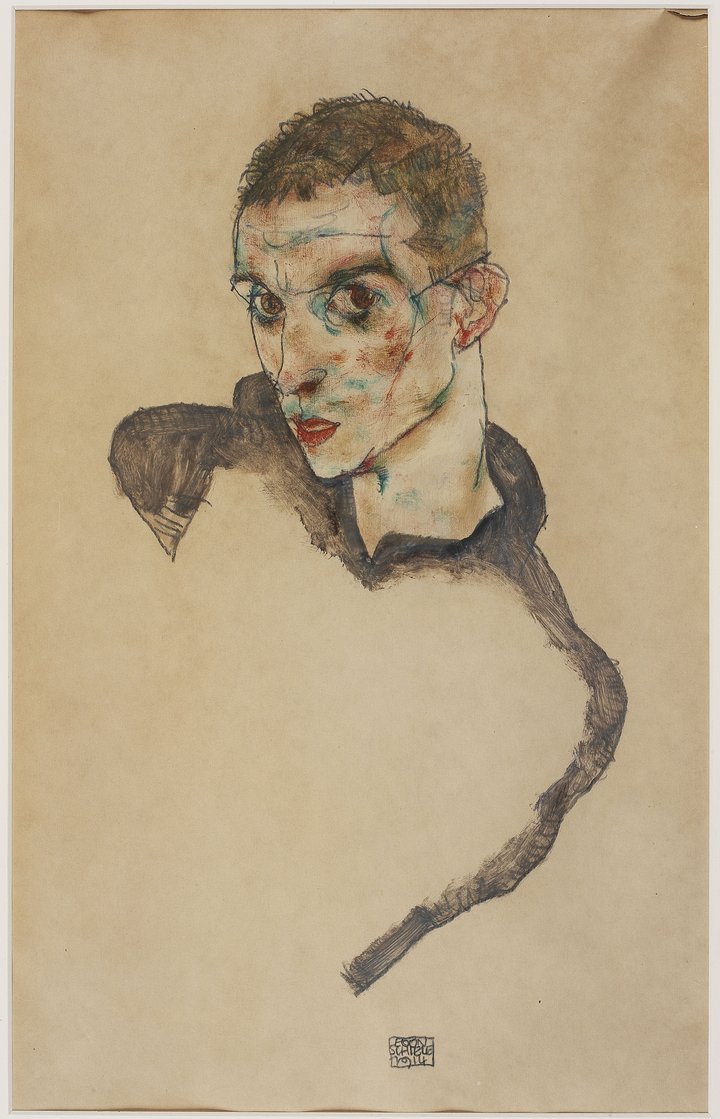
Self=portrait 1914.
Self portrait 1914.
Vier Bäume (Kastanienallee im Herbst)
Mutter mit zwei kindern II. Egon Schiele 1915. Leopold Museum, Wien
Sitzende Frau mit hochgezogenem Knie 1917
Häuser mit bunter Wäsche (Vorstadt II)
Heinrich Benesch and his son Otto 1913
Autumn Trees
Autumn Trees
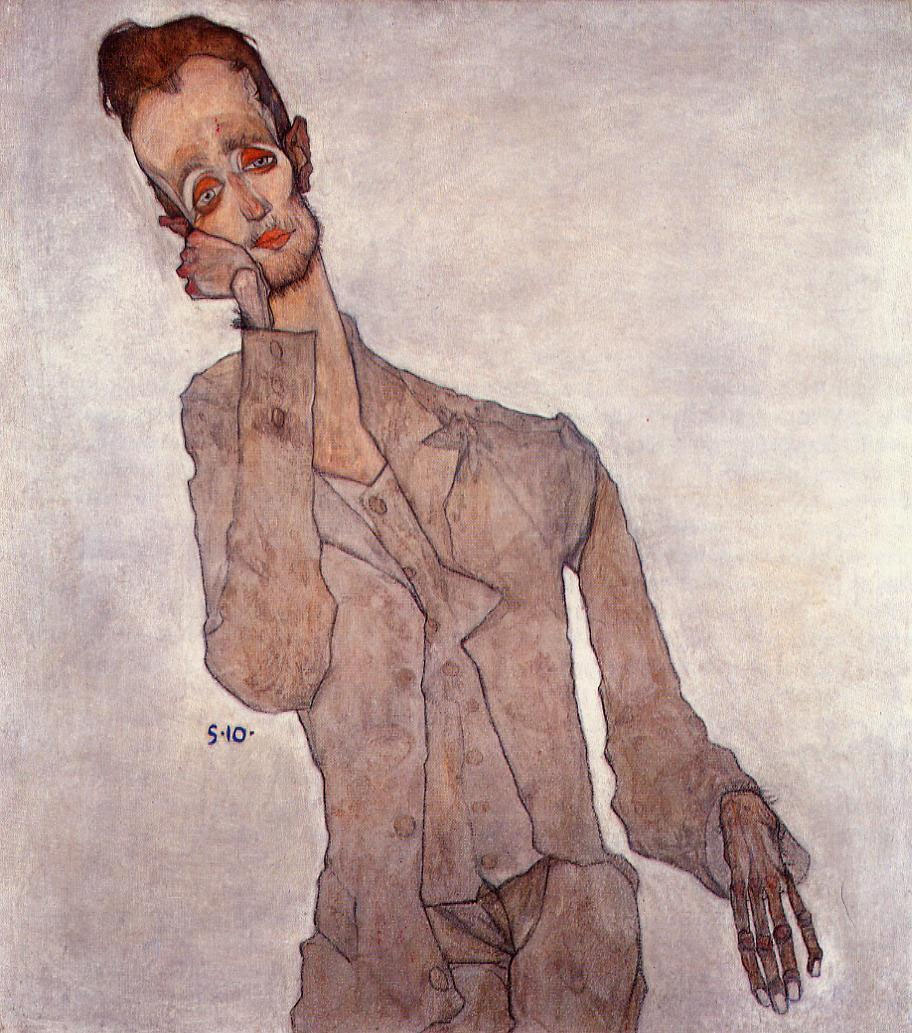
Portrait of Karl Zakousek
Self-portrait 1912
Self-portrait 1912