“I don’t have a clue. Ideas are simply starting points. I can rarely set them down as they come to my mind. As soon as I start to work, others well up in my pen. To know what you’re going to draw, you have to begin drawing… When I find myself facing a blank page, that’s always going through my head. What I capture in spite of myself interests me more than my own ideas.”
ideas
The Idea—the Origin of Everything
“Is the starting point of an animated film the time when the project is given the go-ahead and production begins? Is it at that point that you, as the animator, first go over your ideas for that story? No, that isn’t the starting point. Everything begins much earlier, perhaps before you even think of becoming an animator. The stories and original works—even initial project planning—are only triggers.
“Inspired by that trigger, what rushes forth from inside you is the world you have already drawn inside yourself, the many landscapes you have stored up, the thoughts and feelings that seek expression.
“When people speak of a beautiful sunset, do they hurriedly riffle through a book of photographs of sunsets or go in search of a sunset? No, you speak about the sunset by drawing on the many sunsets stored inside you—feelings deeply etched in the folds of your consciousness of the sunset you saw while carried on your mother’s back so long ago that the memory is nearly a dream; or the sunset-washed landscape you saw when, for the first time in your life, you were enchanted by the scene around you; or the sunsets you witnessed that were wrapped in loneliness, anguish, or warmth.
“You who want to become animators already have a lot of material for the stories you want to tell, the feelings you want to express, and the imaginary worlds you want to bring alive. At times these may be borrowed from a dream someone related, a fantasy, or an embarrassingly self-involved interior life. But everyone moves forward from this stage. In order for it not to remain merely egotistical, when you tell others about your dream you must turn it into a world unto itself. As you go through the process of sharpening your powers of imagination and technique, the material takes shape. If that shape is amorphous, you can start with a vague yearning. It all begins with having something that you want to express.
“Say a project has been decided on and you have been inspired by something. A certain sentiment, a slight sliver of emotion – whatever it is, it must be something you feel drawn to and that you want to depict. It cannot solely be something that others might find amusing, it must be something that you yourself would like to see. It is fine if, at times, the original starting point of a full-length feature film is the image of a girl tilting her head to the side.
“From within the confusion of your mind, you start to capture the hazy figure of what you want to express. And then you start to draw. It doesn’t matter if the story isn’t yet complete. The story will follow. Later still the characters take shape. You draw a picture that establishes the underlying tone for a specific world. Of course, what you have drawn will not be your final product. At times, your work may be rejected entirely. When I mentioned earlier that you must have the will to go to any length, this is what I meant. When you draw that first picture, it is only the beginning of an immense journey. This is the start of the preparation stage of the film.
“What kind of world, serious or comedic; what degree of distortion; what setting; what climate; what content; what period; whether there is one sun or three; what kinds of characters will appear; what is the main theme…? The answers to all of these questions gradually become clearer as you continue to draw. Don’t just follow a ready-made story. Rather, consider a possible development in the story, or whether a particular kind of character can be added. Make the tree trunk thicker, spread its branches further – or go to the tips of the small branches (this could be the starting point of the idea), and on to the leaves beyond as the branches grow and grow.
“Draw many pictures, as many as you can. Eventually a world is created. To create one world means to discard other inconsistent or clashing worlds. If something is very important to you, you can keep it carefully stored in your heart for use at another time. Those who have experienced an outpouring of an amazing number of pictures from inside themselves can feel it. They feel that the fragment of a picture they envisioned, the other trunk of a story that was thrown out while piecing together a narrative, the memory of pining for a girl, the knowledge about a subject gained as they delved deeply into a hobby – all of these play a role and become entwined into one thick strand. The scattered material within you has found its direction and started to flow.”
The Value of Literacy
“I generally have four or five books open around the house—I live alone; I can do this—and they are not books on the same subject. They don’t relate to each other in any particular way, and the ideas they present bounce off one another. And I like this effect. I also listen to audio-books, and I’ll go out for my morning walk with tapes from two very different audio-books, and let those ideas bounce off each other, simmer, reproduce in some odd way, so that I come up with ideas that I might not have come up with if I had simply stuck to one book until I was done with it and then gone and picked up another.”
(See also “This is how I read” and “the tyranny of belief in linear time.” (via robertogreco)
Inside Guillermo Del Toro’s sketchbooks

“I like to say that we only make one movie in our lifetime, a movie made of all the images of all our movies.”
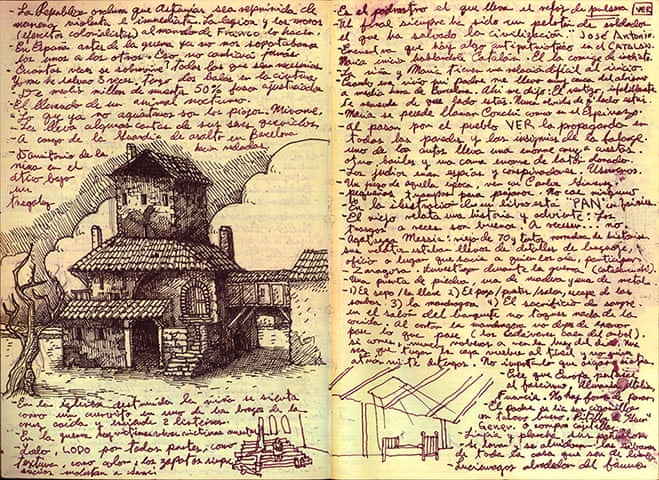
“In the end, perfection is just a concept – an impossibility we use to torture ourselves and that contradicts nature.”
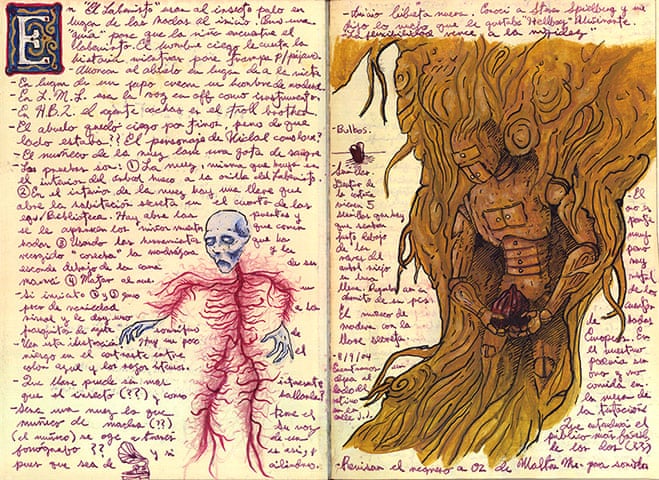
“In fairy tales, monsters exist to be a manifestation of something that we need to understand, not only a problem we need to overcome, but also they need to represent, much like angels represent the beautiful, pure, eternal side of the human spirit, monsters need to represent a more tangible, more mortal side of being human: aging, decay, darkness and so forth. And I believe that monsters originally, when we were cavemen and you know, sitting around a fire, we needed to explain the birth of the sun and the death of the moon and the phases of the moon and rain and thunder. And we invented creatures that made sense of the world: a serpent that ate the sun, a creature that ate the moon, a man in the moon living there, things like that. And as we became more and more sophisticated and created sort of a social structure, the real enigmas started not to be outside. The rain and the thunder were logical now. But the real enigmas became social. All those impulses that we were repressing: cannibalism, murder, these things needed an explanation. The sex drive, the need to hunt, the need to kill, these things then became personified in monsters. Werewolves, vampires, ogres, this and that. I feel that monsters are here in our world to help us understand it. They are an essential part of a fable.”
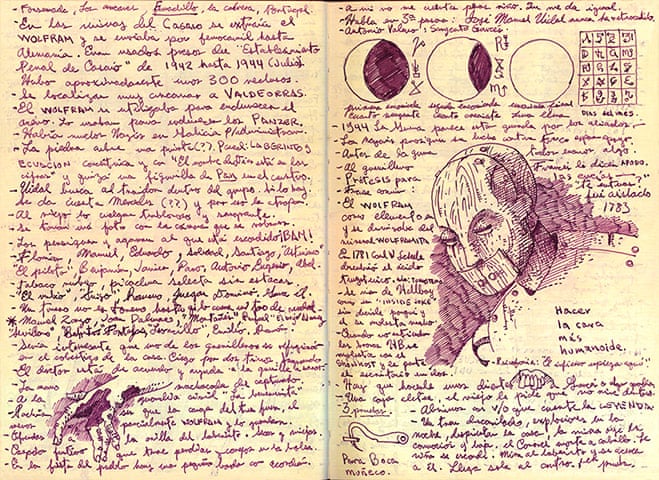
“On that December night at Bleak House, I noticed that del Toro had moved some of his journals from the bathroom safe to a shelf in the Rain Room. I asked to see early sketches for “Madness.” The notebook was from 1993. He turned the pages, stopped, and smiled. “Look!” he said. It was an image of one of the explorers falling into icy water. An inky creature lunging at him looked breathtakingly similar to the Shoggoth with symmetrical tentacles. Del Toro’s monsters had inhabited his mind for nearly two decades. From the beginning, del Toro had imagined that his creatures, unlike Lovecraft’s, would have a fatal vulnerability—one that explained why the horrible beasts had remained trapped in Antarctica. Salt water: it dissolved a Shoggoth like a slug. “
— Show The Monster, Guillermo del Toro’s quest to get amazing creatures onscreen
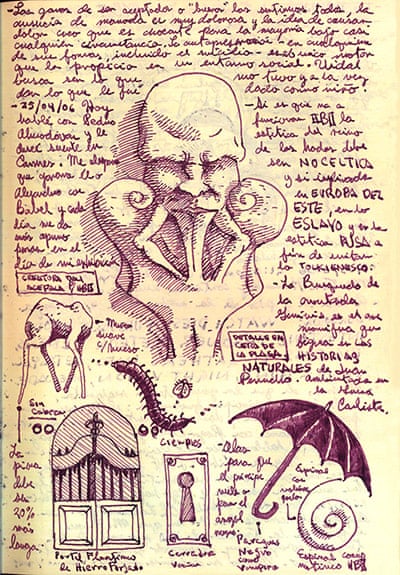
“Some ideas for one film end up getting used in another. Some pages are instructions for make-up artists, others are just Del Toro working out what looks cool and scary.”
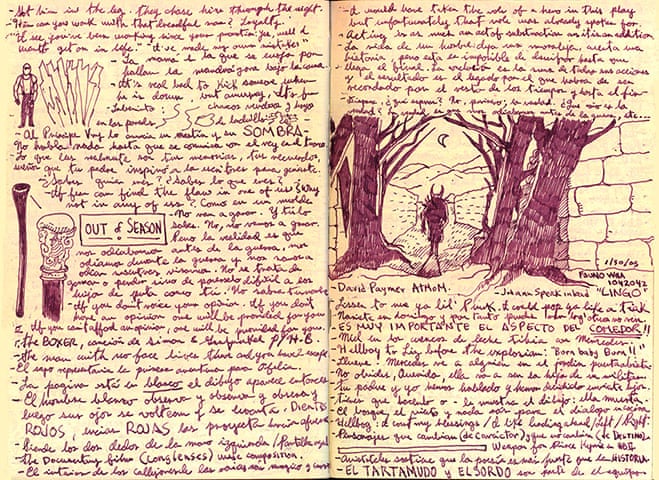
Images via.
“An impression—city in peril—dead city—equestrian statue—men in closed room—clattering of hooves heard from outside—marvel disclosed on looking out—doubtful ending”
- Demophon shivered when the sun shone upon him. (Lover of darkness = ignorance.)
- Inhabitants of Zinge, over whom the star Canopus rises every night, are always gay and without sorrow. [x]
- The shores of Attica respond in song to the waves of the Aegean. [x]
- Horror Story
Man dreams of falling—found on floor mangled as tho’ from falling from a vast height. [x]- Narrator walks along unfamiliar country road,—comes to strange region of the unreal.
- In Ld Dunsany’s “Idle Days on the Yann”
The inhabitants of the antient Astahan, on the Yann, do all things according to antient ceremony. Nothing new is found.- “Here we have fetter’d and manacled Time, who wou’d otherwise slay the Gods.” [x] Horror Story
The sculptured hand—or other artificial hand—which strangles its creator. [x]- Hor. Sto.
Man makes appt. with old enemy. Dies—body keeps appt.- Dr. Eben Spencer plot. [x]
- Dream of flying over city. [Celephaïs]
 Paul Greer