‘Ezo-shi’ by Arai Hakuseki (1720)


'Ezo-shi' by Arai Hakuseki (1720)

The Ainu are generally considered to be the indigenous population of Japan. But, like all cultures on earth, the history of the Ainu is much more complex than any one label. The 20,000 to 60,000 people who presently identify themselves as Ainu are concentrated on Japan’s northern island of Hokkaido, but the Ainu culture once stretched up to the southern part of Sakhalin Island and the Kurile Islands (now part of Russia).”

from BibliOdyssey

Hokusai Manga (early 19th century)


Hokusai

“The Hokusai Manga (北斎漫画, “Hokusai’s Sketches”) is a collection of sketches of various subjects by the Japanese artist Hokusai. Subjects of the sketches include landscapes, flora and fauna, everyday life and the supernatural. The word manga in the title does not refer to the contemporary story-telling manga, as the sketches in the work are not connected to each other. Block-printed in three colours (black, gray and pale flesh), the Manga comprise literally thousands of images in 15 volumes, the first published in 1814, when the artist was 55. The final three volumes were published posthumously, two of them assembled by their publisher from previously unpublished material. The final volume was made up of previously published works, some not even by Hokusai, and is not considered authentic by art historians.”


Hokusai

“The first volume of ‘Manga‘ (Defined by Hokusai as ‘Brush gone wild’), was an art instruction book published to aid his troubled finances. Shortly after he removed the text and republished it.The Manga evidence a dedication to artistic realism in portrayal of people and the natural world. The work was an immediate success, and the subsequent volumes soon followed. The work became known to the West since Philipp Franz von Siebold’s lithographed paraphrases of some of the sketches appeared in his Nippon: Archiv Zur Beschreibung von Japon in 1831. The work began to circulate in the West soon after Matthew C. Perry’s entry into Japan in 1854.”

19th-century ghost scrolls

“Every August, as Japanese spirits return en masse from the otherworld, Tokyo’s Zenshoan temple (map) exhibits a spine-chilling collection of 19th-century ghost scroll paintings.”

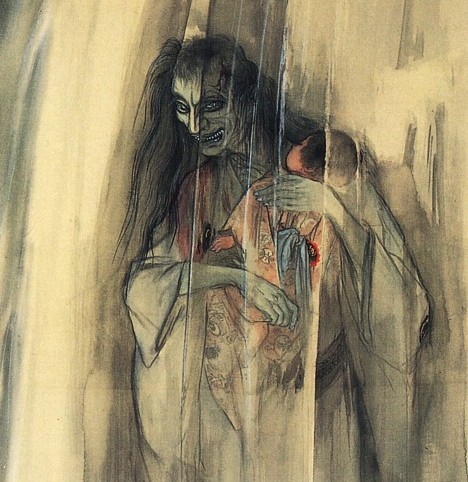
Kaidan Chibusa Enoki: The Ghostly Tale of the Wet Nurse Tree


“This painting by Ito Seiu, the godfather of Japanese bondage (kinbaku), depicts a scene from Kaidan Chibusa Enoki, an old horror story in which the ghost of a dead painter returns to protect his baby from his murderer, a wandering samurai who fell in love with his wife while he was away painting. This scroll shows the ghost holding the baby while standing under a waterfall at Juniso (where Tokyo’s Shinjuku Chuo Park is now located).”

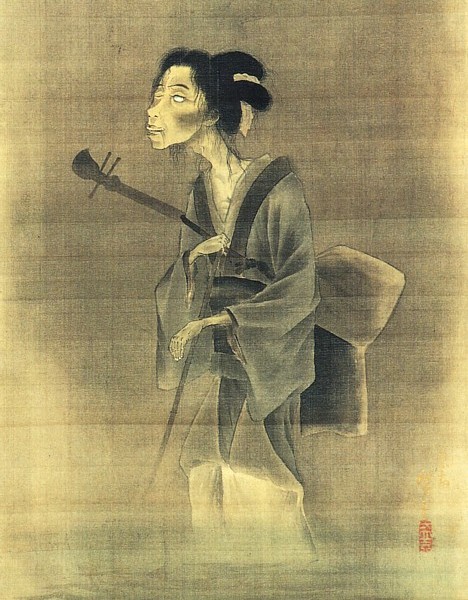
The Ghost of a Blind Female Street Singer

“Utagawa Hiroshige’s “Ghost of a Blind Female Street Singer” portrays the restless spirit of a street performer, one white unseeing eye wide open, carrying a shamisen as she drifts above the surface of a river on the way to her next performance.”

More on Pink Tentacle

Urashima Leaving the Palace Under the Sea

Ogata Gekko (1859 – 1920) Urashima Leaving the Palace Under the Sea, from Gekko’s Miscellaneous Drawings, 1894. Oban.

“Urashima Taro was a fisherman of the fifteenth century who rescued a young turtle from some bullying children. The following day a huge turtle approaches him and tells him he has saved the daughter of the Emperor of the Sea. As a reward the fisherman is gifted magical gills and taken to the palace beneath the waves. Whilst there he is given a beautiful box and told never to open it.
On his return three days later he finds that three hundred years have elapsed and everyone he knew has died. In distress he opens the box and instantly withers and dies in a pile of dust, the voice of the sea princess saying to him: “I said never to open the box; inside it is your old age”. Incidentally, the hair of the turtle is actually a long fronded algae that grows on the backs of turtles’ shells off the coast of Japan.”