“I think the enemy of creativity in the world today is that so much thinking is done for you. The environment is so full of television, party political broadcasts and advertising campaigns, you hardly need to do anything. We’re just drowning under manufactured fiction, which satisfies our need for fiction – you scarcely need to go and read a novel.”

“Cyril Connolly, the 50s critic and writer, said that the greatest enemy of creativity is the pram in the hall, but I think that was completely wrong. It was the enemy of a certain kind of dilettante life that he aspired to, the man of letters, but for the real novelist the pram in the hall is the greatest ally – it brings you up sharp and you realise what reality is all about. My children were a huge inspiration for me. Watching three young minds creating their separate worlds was a very enriching experience.”

–- JG Ballard (via austinkleon)

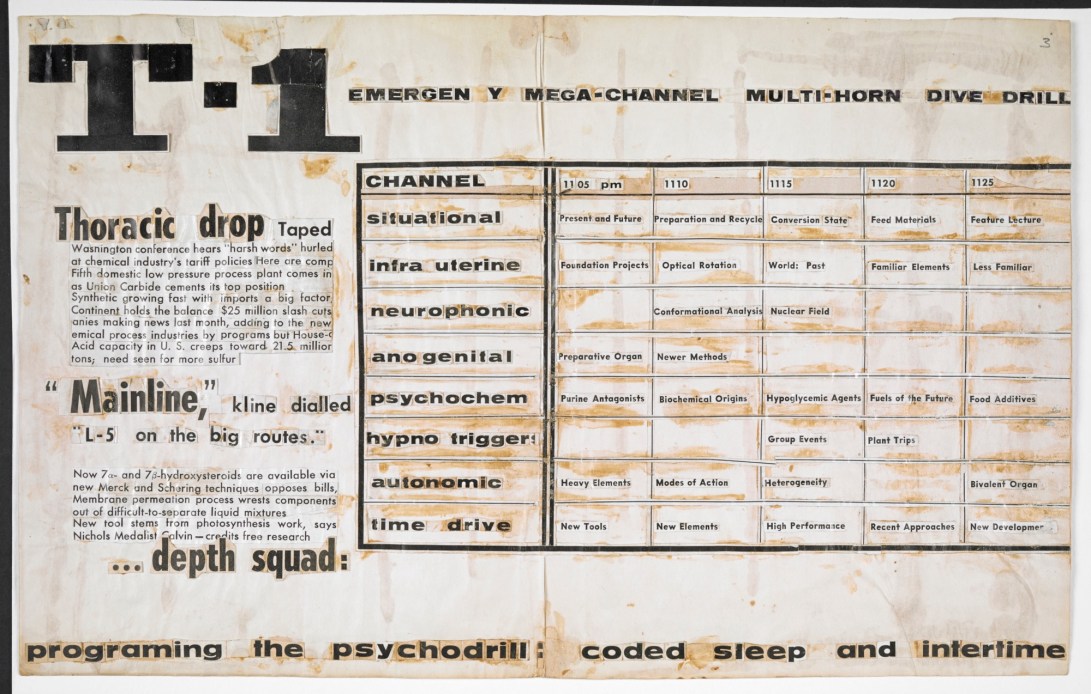
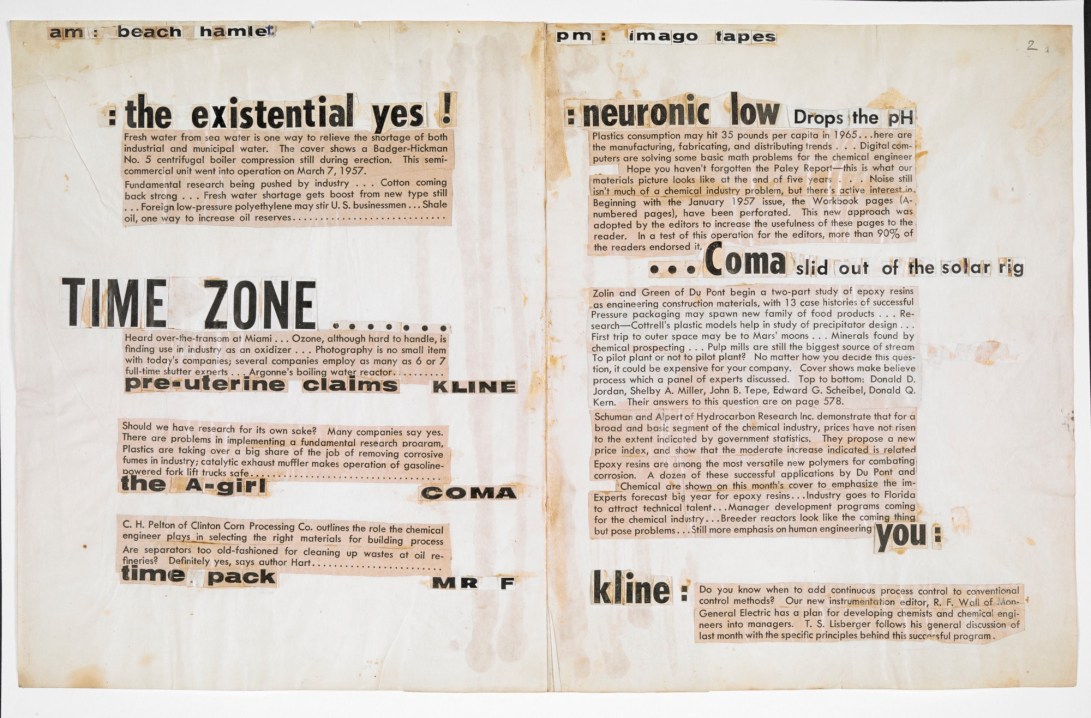
Ballard.Text.Collage.c.1958

Ballard formed the ‘novel’ from scientific and technical material cut from professional literature such as Chemical and Engineering News (Ballard then worked for the journal of the Society of Chemical Industry). Letters, words and sentence fragments are pasted onto backing sheets with glue. Their design visually references everyday media, with headlines, body text and double-page spreads suggesting a magazine layout. Originally Ballard planned to display the work on billboards, as if it was a public advertisement.

From the British Library.

Found via @derekbeaulieu & @johnbrissenden.

“…like “Rite of Spring” in Disney’s Fantasia … our internal devils may destroy and renew us through the technological overload we’ve invoked.”

“Electronic aids, particularly domestic computers, will help the inner migration, the opting out of reality. Reality is no longer going to be the stuff out there, but the stuff inside your head. It’s going to be commercial and nasty at the same time.”

J.G.Ballard (April 1982)

“Actually, there’s no secret. One simply pulls the cork out of the bottle, waits three minutes, and two thousand or more years of Scottish craftsmanship does the rest.”

  • INTERVIEWER: Let’s start with obsession. You seem to have an obsessive way of repeatedly playing out permutations of a certain set of emblems and concerns. Things like the winding down of time, car crashes, birds and flying, drained swimming pools, airports, abandoned buildings, Ronald Reagan . . .
  • BALLARD: I think you’re completely right. I would say that I quite consciously rely on my obsessions in all my work, that I deliberately set up an obsessional frame of mind. In a paradoxical way, this leaves one free of the subject of the obsession. It’s like picking up an ashtray and staring so hard at it that one becomes obsessed by its contours, angles, texture, et cetera, and forgets that it is an ashtray—a glass dish for stubbing out cigarettes.
  • INTERVIEWER: So you rely on the magnetism of an obsession as a way of proceeding?
  • BALLARD: Yes, so the unity of the enterprise is forever there. A whole universe can be bounded in a nutshell. Of course, why one chooses certain topics as the subject for one’s obsessions is a different matter. Why was I obsessed by car crashes? It’s such a peculiar idea.
  • INTERVIEWER: Yes, why were you?
  • BALLARD: Presumably all obsessions are extreme metaphors waiting to be born. That whole private mythology, in which I believe totally, is a collaboration between one’s conscious mind and those obsessions that, one by one, present themselves as stepping-stones.

from the Paris Review

via

Crash

“We live in a world ruled by fictions of every kind—mass merchandising, advertising, politics conducted as a branch of advertising, the instant translation of science and technology into popular imagery, the increasing blurring and intermingling of identities within the realm of consumer goods, the preempting of any free or original imaginative response to experience by the television screen. We live inside an enormous novel. For the writer in particular it is less and less necessary for him to invent the fictional content of his novel. The fiction is already there. The writer’s task is to invent the reality.”

J.G. Ballard