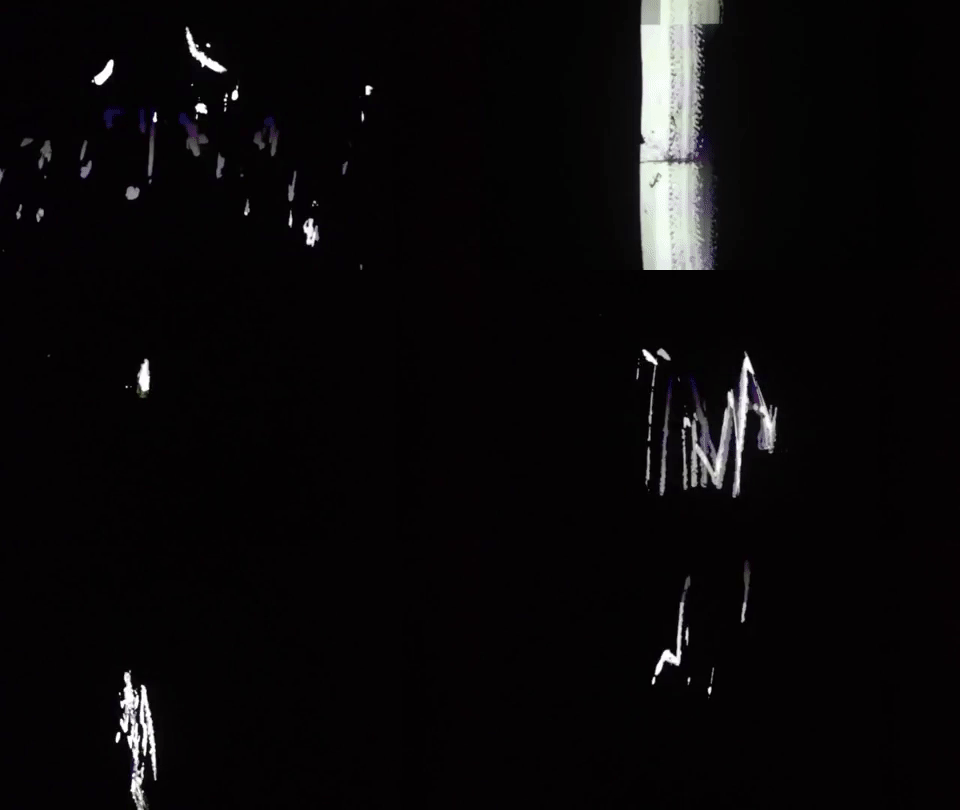
Len Lye – “A COlour Box” (1932″

“The first of Lye’s ‘direct films’ to receive a public screening. Promoted by Sidney Bernstein’s Granada chain of cinemas, it eventually came to be seen “by a larger public than any experimental film before it, and most since” (as the film historian David Curtis has pointed out). Its soundtrack is a beguine – a dance popular in France during the 1930s. A Colour Box won a Medal of Honour at the 1935 International Cinema Festival in Brussels. Having no suitable category in which to award the film, the jury simply invented a new one.”

“As its title suggests, A Colour Box was also notable for being a colour film. Lye used the process of Dufaycolor at a time when colour film was still in an experimental phase. This gave the film a novelty value when first shown. A Colour Box eventually secured quite a wide theatrical release and became popular with both general audiences and critics. Because it was colourful and dynamic, with a catchy musical score, it was more accessible than many abstract films of the period.”

screenonline

see also

“Free Radicals” by Len Lye (1958)

“Created in 1958, Free Radicals is arguably one of American avant-garde artist Len Lye’s greatest film works. ‘Every film [I made], I tried to interest myself in it by doing something not previously done in film technique’, said Lye. Working across the mediums of painting, poetry, and film, Lye was a prolific and important kinetic artist. With a maverick character and obsession with movement, Lye pioneered experimental film and animation techniques with his influential invention of direct (camera-less) film-making as early as the 1930s. Though never associated solely with one movement, Lye’s work merged aspects of Surrealism, Futurism, Constructivism and Abstract Expressionism into his own breed of moving art.”

Sophie Pinchetti

Watch here.

“I, myself, eventually came to look at the way things moved mainly to try to feel movement, and only feel it. This is what dancers do; but instead, I wanted to put the feeling of a figure of motion outside of myself to see what I’d got. … I didn’t know the term ‘empathy’ – that is, the psychological trick of unconsciously feeling oneself into the shoes of another person – but I was certainly practising it. I got so that I could feel myself into the shoes of anything that moved, from a grasshopper to a hawk, a fish to a yacht, from a cloud to the shimmering rustle of ivy leaves on a brick wall. Such shoes were around in profusion. …”

Len Lye


see also:

Swinging the Lambeth Walk

An Ingenious Abstract Colour Film Interpreting a Famous Dance Tune on the Screen in the Form of Moving Patterns
‘In this film coloured designs convey in simple visual form the rhythm of “The Lambeth Walk.” Patterns move and mingle in time to the music. The sounds of the various musical instruments are interpreted in as simple and direct way as possible, and each note was studied for its individual characteristics before it was drawn and coloured. Double-bass notes are conceived as thick cords of colour vibrating vertically on the screen, while the notes of the guitar are shown as separate horizontal lines. The different sound qualities are indicated by the extent of vibration, and the pitch of the notes by their position high or low on the screen.
The music is composed of excerpts from recordings by popular dance bands. Len Lye, a New Zealander, who developed this original film technique, chose the excerpts for their orchestration of the original tune, and aimed at capturing the emotional spontaneity of good jazz, rather than at creating an intellectual exercise in visual accompaniment.’
(Films of Britain – British Council Film Department Catalogue – 1940)

A memo from the 1945 British Council Film Department lists the reasons for films being withdrawn from circulation. It states that “Swinging the Lambeth Walk, a colour cartoon film made by Len Lye, is a failure in that no theatrical manager will show it. A sneak preview of this film was given at the Cosmo Cinema, Glasgow, but the audience howled it off the screen and the manager had to take it off before the reel finished.”