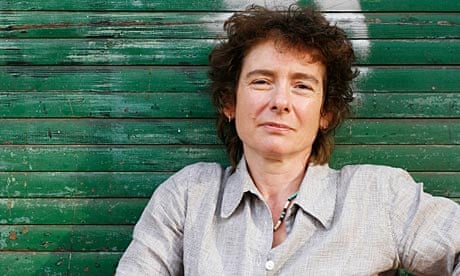
Literary Birthday – Jeanette Winterson, born 27 August 1959


jeanette

reblogging  Amanda Patterson for Writers Write

Literary Birthday – 27 August

Jeanette Winterson, born 27 August 1959

Seven Quotes

1. Language is what stops the heart exploding.
2. It’s not the one thing nor the other that leads to madness, but the space in between.
3.Everything in writing begins with language. Language begins with listening.
4. When people say that poetry is merely a luxury for the educated middle classes, or that it shouldn’t be read much at school because it is irrelevant, or any of the strange and stupid things that are said about poetry and its place in our lives, I suspect that the people doing the saying have had things pretty easy. A tough life needs a tough language – and that is what poetry is. That is what literature offers – a language powerful enough to say how it is.
5. What you risk reveals what you value.
6. So from the very first, if I was hurt in some way, then I would take a book — which was very difficult for me to buy when I was little — and I would go up into the hills, and that is how I would assuage my hurt.
7. Always in my books, I like to throw that rogue element into a stable situation and then see what happens.

Jeanette Winterson’s 10 Rules for Writing

1. Turn up for work. Discipline allows creative freedom. No discipline equals no freedom.
2. Never stop when you are stuck. You may not be able to solve the problem, but turn aside and write something else. Do not stop altogether.
3.Love what you do.
4. Be honest with yourself. If you are no good, accept it. If the work you are ­doing is no good, accept it.
5. Don’t hold on to poor work. If it was bad when it went in the drawer it will be just as bad when it comes out.
6. Take no notice of anyone you don’t respect.
7. Take no notice of anyone with a ­gender agenda. A lot of men still think that women lack imagination of the fiery kind.
8. Be ambitious for the work and not for the reward.
9. Trust your creativity.
10. Enjoy this work!
Winterson is a British writer who was awarded an OBE for services to literature. Oranges Are Not the Only Fruit won the 1985 Whitbread Prize for a First Novel, and was adapted for television by Winterson in 1990. She has won various awards around the world for her fiction and adaptations, including the Whitbread Prize, UK, and the Prix d’argent, Cannes Film Festival. She writes regularly for various UK newspapers.
Source for 10 Rules

Source for Image

“10 Things I’ve Learned In The 2 Years Since I Graduated From Art School”

reblogging samspratt:

“I graduated from art school 2 years ago, here are some things I think I’ve learned. In the words of my current client, Donald Glover: “I’m not saying this thing is true or not, I’m just saying it’s what I learned.”

  1. Creativity Is Recession Proof” were the words plastered over the novelty T-shirt I bought in college, and it turned out to be the most honest piece of clothing I have ever, and likely will ever own. Sadly… it also shows my nipples.

  2. The Internet is the world’s most powerful tool. With great power, comes… you know the rest… or maybe you don’t, since you’re scrolling through facebook or tumblr. The way you share creations is almost as important as the creations themselves.

  3. Advertising is worth the shame. My first illustration job out of college paid 20 dollars an image – a feeling not unlike getting mugged by a paraplegic sloth – yet every time those 20 dollars filled an empty wallet, my name and sites were sent off into the ether to hundreds of thousands, if not millions, of people. Now some of those people pay me 100x-1000x that for illustrations. Why? Maybe because I make nice things, but more likely? Because with every underpaid image I made, I made someone, somewhere, remember my name.

  4. Don’t “fuck the haters”, embrace the hivemind. The “haters” will come in many forms: sometimes with criticism based on personal preference, sometimes with nonsensical attacks that seem like youtube commenter vomit, and sometimes with actual advice disguised as “hate”, saying what you’re doing wrong and what you could be doing better. Not everyone is a sage, not everyone is right, but they areworth listening to, if only to put a pin in to see if you hear something like that again. You will literally never be above improvement. There is no plateau, keep climbing, and pay attention to what’s around you, even the guy shouting through a megaphone while jackhammering directly underneath a potential avalanche.

  5. Waiting for inspiration is like waiting at the DMV: It lasts forever and if you don’t know enough, you’ll probably still fail at the end. Nike your problems away by just doing it… “it” being something. You can wait and wait for good ideas, you can consume books, magazines, websites, and music by the truckload, desperate for something to trigger some sort of eureka moment, but if you just write your shitty lyric down, lay your shitty brush stroke down, or take your shitty photo, you’re on the right to track to actually making something good. I have made many terrible things, some of which remain terrible but served as stepping stones to better things, some I transformed into rather nice things, and I learned more about myself, the world, my work, technique, appeal, and a million other tiny factors from simply doing something, even when it failed.

  6. Work to play. Be an idiot when you’re young, like… college-young. I was quite an idiot in college but I could have been even more of one and probably have been just fine. However, when you leave… leave the party there. If you give up a lot when you leave your childhood behind, and put your all into boring grown-up things like “work”, “money”, and “responsibility”, it genuinely doesn’t take much time to get the freedom you had in college back. The only difference is that instead of keeping the party going to distract yourself from a job you hate and rent you can barely pay, you can kick back and enjoy the party when you choose to on your own terms, if you even care about doing so at all. In other words: Stop it with this YOLO nonsense, why you are taking a filthy-rich, diamond-selling recording artist who was on a Canadian TV show’s acronym of wisdom to mean: “be an idiot always and forever because fuck it, I’m young”, is beyond me. He worked hard to be able to wear $6000 socks, he didn’t “You Only Live Once” his way to them.

  7. There are a lot of people more talented than you, that’s something you should know, but never accept. I’m regularly embarrassed by the quality of my work when I look at the hordes of artists superior to me, but you have time to spend, knowledge to gain, and skills to practice for the rest of your life. Your place amongst the world has no finality to it, you can always be more.

  8. A friend who will stab you with a knife in the front is worth your weight in unicorn blood. Friends will back pat and backstab, occasionally becoming bloat and baggage, but if you should be so lucky as to find a person who cares about your success enough that they will outwardly knock you down a peg or ten with the truth so that you can better yourself, don’t toss them for the easier friend. Even lone-wolf-alpha-dog-max-payne-type people need a little help along the way.

  9. Karma is a pretty damn good business model. I have hunted for clients before. I have barked up their trees, aggressive and hungry for work, failing to get it every time. I have also done a lot of personal work, just for fun, but executed seriously. Many of these would be labelled as “fan art” – depictions of pop-culture icons with my own odd twist that I put out into the world – some of which I pour dozens of hours into. Traditionally, when I finish work with a client, I ask: “So, how did you find me?” almost every time the answer is: work of mine they saw on the web that I did for shits and giggles. I put good in, and in time (thanks to item #2), I get good out. There is no science or stability to this beyond the notion that if you work hard enough and if you can make your work seen, you will be rewarded. These are the naive musings of a 23 year-old, remember?

  10. “Art” is a shitty word that people will tack on to anything these days. Just focus on creating, whatever that may be, however that may be, do it well, and do it because you love it.”

(Source: samspratt)

via adullblog

The 25 Greatest Quotes About Writing »

reblogging nevver:

  1. “Writing is easy. All you have to do is cross out the wrong words.” — Mark Twain

  2. “I only achieve simplicity with enormous effort.” — Clarice Lispector

  3. “A woman must have money and a room of her own if she is to write fiction.” — Virginia Woolf

  4. “I’ve put in so many enigmas and puzzles that it will keep the professors busy for centuries arguing over what I meant, and that’s the only way of insuring one’s immortality.” — James Joyce

  5. “The first draft of anything is shit.” — Ernest Hemingway

  6. “Always be a poet, even in prose.” — Charles Baudelaire

  7. “Literature — creative literature — unconcerned with sex, is inconceivable.” — Gertrude Stein

  8. “If you do not breathe through writing, if you do not cry out in writing, or sing in writing, then don’t write, because our culture has no use for it.” — Anaïs Nin

  9. “One can be absolutely truthful and sincere even though admittedly the most outrageous liar. Fiction and invention are of the very fabric of life.” — Henry Miller

  10. “Writers aren’t people exactly. Or, if they’re any good, they’re a whole lot of people trying so hard to be one person.” — F. Scott Fitzgerald

  11. “The true writer has nothing to say. What counts is the way he says it.” — Alain Robbe-Grillet

  12. “James Joyce was a synthesizer, trying to bring in as much as he could. I am an analyzer, trying to leave out as much as I can.” — Samuel Beckett

  13. “Life is painful and disappointing. It is useless, therefore, to write new realistic novels. We generally know where we stand in relation to reality and don’t care to know any more.” — Michel Houellebecq

  14. “Do you realize that all great literature is all about what a bummer it is to be a human being? Isn’t it such a relief to have somebody say that?” — Kurt Vonnegut

  15. “Skill alone cannot teach or produce a great short story, which condenses the obsession of the creature; it is a hallucinatory presence manifest from the first sentence to fascinate the reader, to make him lose contact with the dull reality that surrounds him, submerging him in another that is more intense and compelling.” — Julio Cortázar

  16. “Don’t bend; don’t water it down; don’t try to make it logical; don’t edit your own soul according to the fashion. Rather, follow your most intense obsessions mercilessly.” — Franz Kafka

  17. “Reading is more important than writing.” — Roberto Bolaño

  18. “The artist is always beginning. Any work of art which is not a beginning, an invention, a discovery is of little worth.” — Ezra Pound

  19. “The next real literary “rebels” in this country might well emerge as some weird bunch of anti-rebels, born oglers who dare somehow to back away from ironic watching, who have the childish gall actually to endorse and instantiate single-entendre principles. Who treat of plain old untrendy human troubles and emotions in U.S. life with reverence and conviction. Who eschew self-consciousness and hip fatigue. These anti-rebels would be outdated, of course, before they even started. Dead on the page. Too sincere. Clearly repressed. Backward, quaint, naive, anachronistic. Maybe that’ll be the point. Maybe that’s why they’ll be the next real rebels. Real rebels, as far as I can see, risk disapproval. The old postmodern insurgents risked the gasp and squeal: shock, disgust, outrage, censorship, accusations of socialism, anarchism, nihilism. Today’s risks are different. The new rebels might be artists willing to risk the yawn, the rolled eyes, the cool smile, the nudged ribs, the parody of gifted ironists, the “Oh how banal.” To risk accusations of sentimentality, melodrama. Of overcredulity. Of softness. Of willingness to be suckered by a world of lurkers and starers who fear gaze and ridicule above imprisonment without law. Who knows.” — David Foster Wallace

  20. “The person born with a talent they are meant to use will find their greatest happiness in using it.” — Johann Wolfgang von Goethe

  21. “We live not only in a world of thoughts, but also in a world of things. Words without experience are meaningless.” — Vladimir Nabokov

  22. “…Describe your sorrows and desires, the thoughts that pass through your mind and your belief in some kind of beauty – describe all these with heartfelt, silent, humble sincerity and, when you express yourself, use the Things around you, the images from your dreams, and the objects that you remember. If your everyday life seems poor, don’t blame it; blame yourself; admit to yourself that you are not enough of a poet to call forth its riches; because for the creator there is not poverty and no poor, indifferent place. And even if you found yourself in some prison, whose walls let in none of the world’s sounds – wouldn’t you still have your childhood, that jewel beyond all price, that treasure house of memories? Turn your attentions to it. Try to raise up the sunken feelings of this enormous past; your personality will grow stronger, your solitude will expand and become a place where you can live in the twilight, where the noise of other people passes by, far in the distance. — And if out of this turning-within, out of this immersion in your own world, poems come, then you will not think of asking anyone whether they are good or not. Nor will you try to interest magazines in these works: for you will see them as your dear natural possession, a piece of your life, a voice from it. A work of art is good if it has arisen out of necessity. That is the only way one can judge it.” — Rainer Maria Rilke

  23. “The words of my book nothing, the drift of it everything.” — Walt Whitman

  24. “All I know is what the words know, and dead things, and that makes a handsome little sum, with a beginning and a middle and an end, as in the well-built phrase and the long sonata of the dead.” — Samuel Beckett

  25. “Do you know what I was smiling at? You wrote down that you were a writer by profession. It sounded to me like the loveliest euphemism I had ever heard. When was writing ever your profession? It’s never been anything but your religion. Never. I’m a little overexcited now. Since it is your religion, do you know what you will be asked when you die? But let me tell you first what you won’t be asked. You won’t be asked if you were working on a wonderful, moving piece of writing when you died. You won’t be asked if it was long or short, sad or funny, published or unpublished. You won’t be asked if you were in good or bad form while you were working on it. You won’t even be asked if it was the one piece of writing you would have been working on if you had known your time would be up when it was finished—I think only poor Soren K. will get asked that. I’m so sure you’ll only get asked two questions. Were most of your stars out? Were you busy writing your heart out? If only you knew how easy it would be for you to say yes to both questions. ” — J.D. Salinger

    From Though Catalogue

A Liberal Decalogue: Bertrand Russell’s 10 Commandments of Teaching

“Perhaps the essence of the Liberal outlook could be summed up in a new decalogue, not intended to replace the old one but only to supplement it. The Ten Commandments that, as a teacher, I should wish to promulgate, might be set forth as follows:
1.  Do not feel absolutely certain of anything.
2.  Do not think it worth while to proceed by concealing evidence, for the evidence is sure to come to light.
3.  Never try to discourage thinking for you are sure to succeed.
4.  When you meet with opposition, even if it should be from your husband or your children, endeavor to overcome it by argument and not by authority, for a victory dependent upon authority is unreal and illusory.
5. Have no respect for the authority of others, for there are always contrary authorities to be found.
6. Do not use power to suppress opinions you think pernicious, for if you do the opinions will suppress you.
7. Do not fear to be eccentric in opinion, for every opinion now accepted was once eccentric.
8.  Find more pleasure in intelligent dissent than in passive agreement, for, if you value intelligence as you should, the former implies a deeper agreement than the latter.
9.  Be scrupulously truthful, even if the truth is inconvenient, for it is more inconvenient when you try to conceal it.
10.  Do not feel envious of the happiness of those who live in a fool’s paradise, for only a fool will think that it is happiness.”

— via BrainPickings

thenearsightedmonkey:”Drawing tips from the great GARY PANTER!”

reblogging thenearsightedmonkey:

From the “Unbored” website: Drawing tips from the great GARY PANTER!

INTRODUCTION

Get a book-size (or paperback-size)d sketchbook. Write your name and date on an early page and maybe think of a name for it — and if you want, write the book’s name there at the front. Make it into your little painful pal. The pain goes away slowly page by page. Fill it up and do another one. It can be hard to get started. Don’t flunk yourself before you get the ball rolling.

You might want to draw more realistically or in perspective or so it looks slick — that’s is possible and there are tricks and procedures for drawing with more realism if you desire it. But drawing very realistically with great finesse can sometimes produce dead uninteresting drawings — relative, that is, to a drawing with heart and charm and effort but no great finesse.

You can make all kinds of rules for your art making, but for starting in a sketchbook, you need to jump in and get over the intimidation part — by messing up a few pages, ripping them out if need be. Waste all the pages you want by drawing a tic tac toe schematic or something, painting them black, just doodle. Every drawing will make you a little better. Every little attempt is a step in the direction of drawing becoming a part of your life.

TIPS

1. Quickly subdivide a page into a bunch of boxes by drawing a set of generally equidistant vertical lines, then a set of horizontal lines so that you have between 6 and 12 boxes or so on the page. In each box, in turn, in the simplest way possible, name every object you can think of and draw each thing in a box, not repeating. If it is fun, keep doing this on following pages until you get tired or can’t think of more nouns. Now you see that you have some kind of ability to typify the objects in your world and that in some sense you can draw anything.

2. Choose one of the objects that came to mind that you drew and devote one page to drawing that object with your eyes closed, starting at the “nose” of the object (in outline or silhouette might be good) and following the contour you see in your mind’s eye, describing to yourself in minute detail what you know about the object. You can use your free hand to keep track of the edge of the paper and ideally your starting point so that you can work your way back to the designated nose. Don’t worry about proportion or good drawing this is all about memory and moving your hand to find the shapes you are remembering. The drawing will be a mess, but if you take your time, you will see that you know a lot more about the object than you thought.

3. Trace some drawings you like to see better what the artist’s pencil or pen is doing. Tracing helps you observe closer. Copy art you like — it can’t hurt.

4. Most people (even your favorite artists) don’t like their drawings as much as they want to. Why? Because it is easy to imagine something better. This is only ambition, which is not a bad thing — but if you can accept what you are doing, of course you will progress quicker to a more satisfying level and also accidentally make perfectly charming drawings even if they embarrass you.

5. Draw a bunch more boxes and walk down a sidewalk or two documenting where the cracks and gum and splotches and leaves and mowed grass bits are on the square. Do a bunch of those. That is how nature arranges and composes stuff. Remember these ideas — they are in your sketchbook.

6. Sit somewhere and draw fast little drawings of people who are far away enough that you can only see the big simple shapes of their coats and bags and arms and hats and feet. Draw a lot of them. People are alike yet not — reduce them to simple and achievable shapes.

7. To get better with figure drawing, get someone to pose — or use photos — and do slow drawing of hands, feet, elbows, knees, and ankles. Drawing all the bones in a skeleton is also good, because it will help you see how the bones in the arms and legs cross each other and affect the arms’ and legs’ exterior shapes. When you draw a head from the side make sure you indicate enough room behind the ears for the brain case.

8. Do line drawings looking for the big shapes, and tonal drawing observing the light situation of your subject — that is, where the light is coming from and where it makes shapes in shade on the form, and where light reflects back onto the dark areas sometimes.

9. To draw the scene in front of you, choose the middle thing in your drawing and put it in the middle of your page — then add on to the drawing from the center of the page out.

10. Don’t worry about a style. It will creep up on you and eventually you will have to undo it in order to go further. Be like a river and accept everything.

Thanks to our pal, M.A.G. for bringing this to our attention