Codex Mendoza (1542)


Codex Mendoza (1542)


Codex Mendoza (1542)

Codex Mendoza (1542)

Codex Mendoza (1542)


Codex Mendoza (1542)


Codex Mendoza (1542)

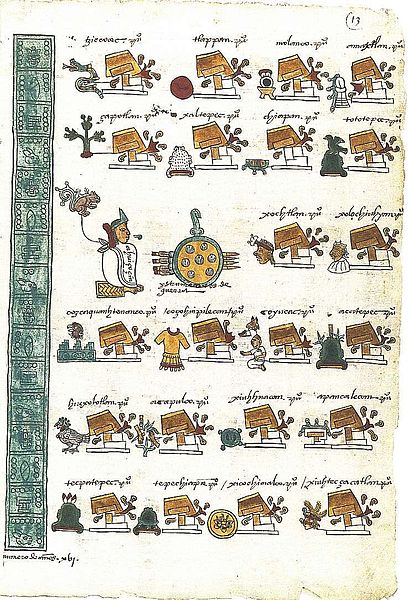
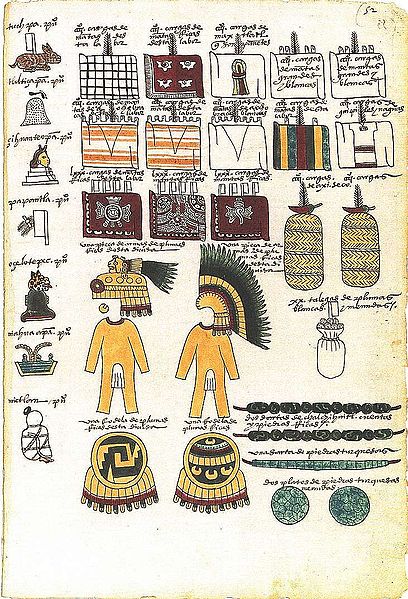
“The Codex Mendoza is an Aztec codex, created about twenty years after the Spanish conquest of Mexico with the intent that it be seen by Charles V, the Holy Roman Emperor and King of Spain. It contains a history of the Aztec rulers and their conquests, a list of the tribute paid by the conquered, and a description of daily Aztec life, in traditional Aztec pictograms with Spanish explanations and commentary. It is named after Antonio de Mendoza, then the viceroy of New Spain, who may have commissioned it. After creation in Mexico City, it was sent by ship to Spain. The fleet, however, was attacked by French privateers, and the codex, along with the rest of the booty, was taken to France. There it came into the possession of André Thévet, cosmographer to King Henry II of France. Thévet wrote his name in five places on the codex, twice with the date 1553. It was later bought by the Englishman Richard Hakluyt for 20 French francs. Some time after 1616 it was passed to Samuel Purchase, then to his son, and then to John Selden. The codex was deposited into the Bodleian Library at Oxford University in 1659, 5 years after Selden’s death, where it remained in obscurity until 1831, when it was rediscovered by Viscount Kingsborough and brought to the attention of scholars.”

from Wikipedia and ThePublicDomainReview

via Radimus


Codex Fejérváry-Mayer (Tezcatlipoca)


Codex Fejérváry-Mayer

The Codex Fejérváry-Mayer is an Aztec Codex of central Mexico. It is one of the rare pre-Hispanic manuscripts that have survived the Spanish conquest of Mexico. As a typical calendar codex tonalamatl dealing with the sacred Aztec calendar – the tonalpohualli – it is placed in the Borgia Group. It is a divinatory almanac in 17 sections.Its elaboration is typically pre-Columbian: it is made on deerskin parchment folded accordion-style into 23 pages. It measures 16.2 centimetres by 17.2 centimetres and is 3.85 metres long”


Codex Fejérváry-Mayer

The earliest history of the codex is unknown. It is named after Gabriel Fejérváry (1780–1851), a Hungarian collector, and Joseph Mayer (1803–1886), an English antiquarian who bought the codex from Fejérváry. In 2004 Maarten Jansen and Gabina Aurora Pérez Jiménez proposed that it be given the indigenous name Codex Tezcatlipoca, from the Nahuatl name of the god Tezcatlipoca (who is shown, with black-and-yellow facial striping, in the centre of its first page), although it is not certain that its creators were Nahuas.
It is currently kept in the World Museum Liverpool in Liverpool, England, having as its catalogue # 12014 M. It is published in Volume 26 of the series Codices Selecti of the Akademische Druck – u. Verlagsanstalt – Graz. It is believed to have originated specifically in Veracruz.”


Codex Fejérváry-Mayer

Codex Fejérváry-Mayer is an important cultural artifact from the pre-Cortes destruction of the Aztec capital Tenochtitlan. An Aztec Code from Central Mexico, it is one of very few manuscripts to survive the Spanish conquest. A typical calendar code (onalamatl), including an Aztec world calendar (tonalpohualli) – both part of a larger series of codes called Code Borgija – it’s design is characterized by pre-colombian influence. It’s made of parchment and chamois, and folded like an accordion, stretching over twelve feet long when unfurled.”


Codex Fejérváry-Mayer

The earliest history of the code is wrapped in darkness, it became known as Codex Fejérváry-Mayer after the Hungarian collector (Fejervaryju) and benefactor from Liverpool (Mayer) who acquired the piece. Most experts agree the true name was probably Code Tezcatlipoca, the name of the Nahuatl people’s god.”


Codex Fejérváry-Mayer

Codex Fejérváry-Mayer

Codex Fejérváry-Mayer

Codex Fejérváry-Mayer

Codex Fejérváry-Mayer

Codex Fejérváry-Mayer

Codex Fejérváry-Mayer

Codex Fejérváry-Mayer

via MagicTransistor

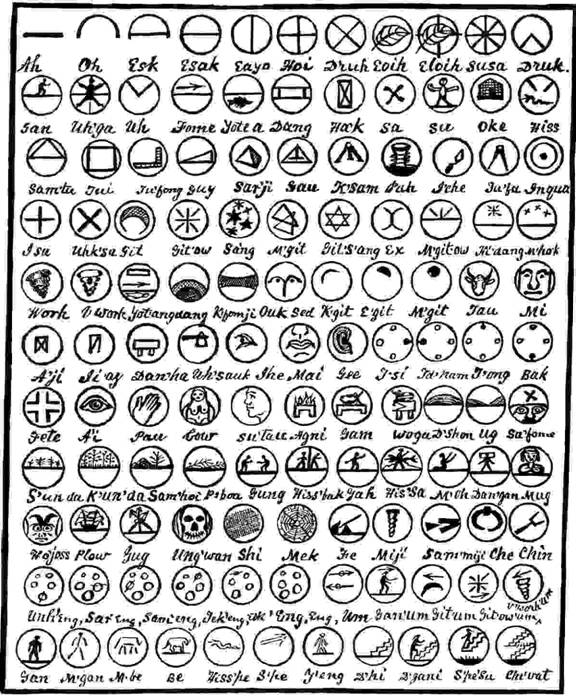
‘Se’moin’ from the Tablet of Fonece (Oahspe ‘primordial language’ also known as Panic, from the name Pan), John Ballou Newbrough, d. 1891.


‘Se'moin’ from the Tablet of Fonece (Oahspe 'primordial language’ also known as Panic, from the name Pan), John Ballou Newbrough, d. 1891.

“i033 Tablet of Se’moin. Panic language means earth-language; things were named after the sounds they uttered; thus, the soul of each thing spoke, and that which was voiced was called the Panic language. Panic was the first language on earth but was not written until Se’moin, given in the time of Sethantes, being the first written language given to I’hins. As such, Se’moin represents the first explanation of creation ever given to man.”

more here

via

from “Sentences and Paragraphs.” (1931)

“Sentences are made wonderfully one at a time. Who makes them. Nobody can make them because nobody can what ever they do see.

All this makes sentences so clear I know how I like them.

What is a sentence mostly what is a sentence. With them a sentence is with us about us all about us we will be willing with what a sentence is. A sentence is that they cannot be carefully there is a doubt about it.

The great question is can you think a sentence. What is a sentence. He thought a sentence. Who calls him to come which he did.

…What is a sentence. A sentence is a duplicate. An exact duplicate is depreciated. Why is a duplicated sentence not depreciated. Because it is a witness. No witnesses are without value.”

Gertrude Stein

Detailed Cross-section of the Kowloon Walled City by Japanese researchers led by anthropologist Kani Hioraki

HTML tutorial

Kowloon Walled City was a largely ungoverned, densely populated settlement in Kowloon City in Hong Kong. Originally a Chinese military fort, the Walled City became an enclave after the New Territories were leased to Britain by China in 1898. Its population increased dramatically following the Japanese occupation of Hong Kong during World War II. By 1990, the Walled City contained 50,000 residents[1][2] within its 2.6-hectare (6.4-acre) borders. From the 1950s to the 1970s, it was controlled by local triads and had high rates of prostitution, gambling and drug abuse.”

detailed view of the cross-section illustrates a mahjong parlor, a strip club and a plastics factory

The Kowloon Walled City in Hong Kong was once the most densely populated place on earth. And without a single architect or any oversight whatsoever, the ungoverned hive of interlinking buildings became a haven for drugs, crime and prostitution. This is perhaps why the surreal, M.C. Escher-like structure, where one couldn’t even begin to imagine what life was like, captured the interest of the Japanese.”

detailed view of the cross-section illustrates a cafeteria and a tunneled passageway that’s always leaking rain water

(link fixed 2014)