“I’ve come to regard comics as something like a song.”

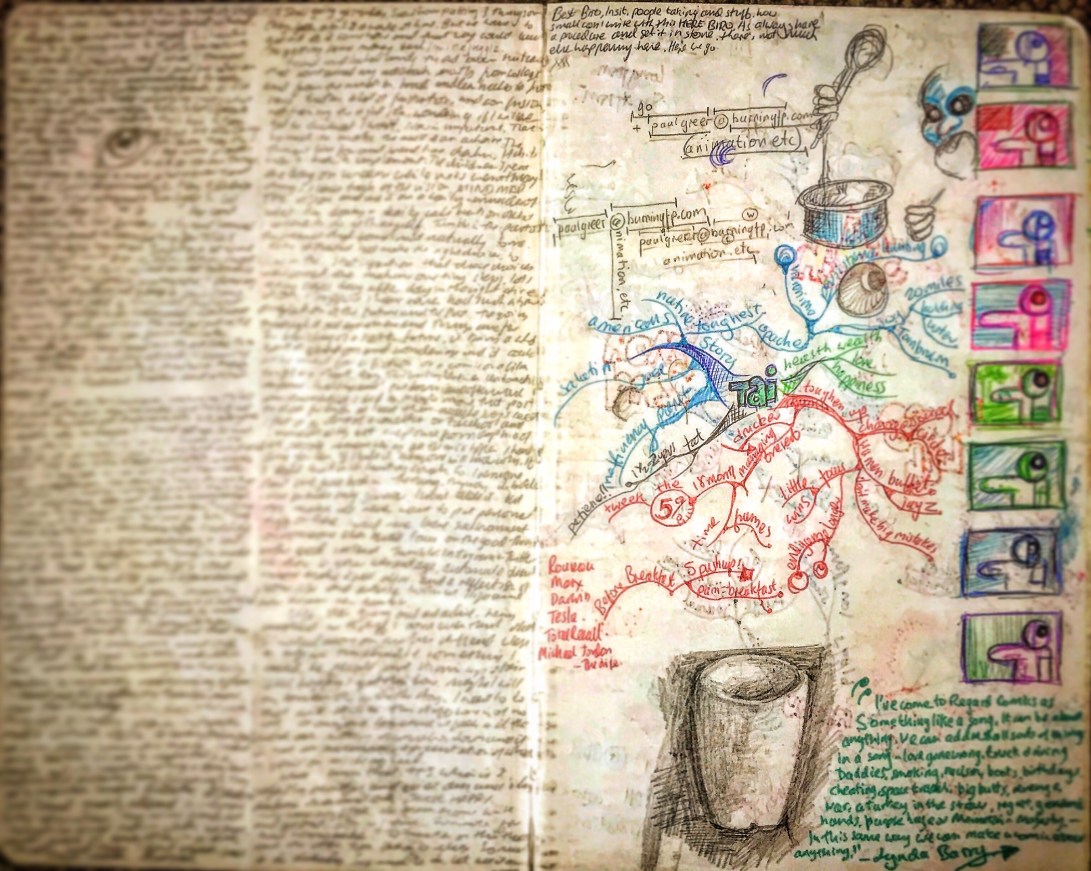
Notebook: Ethel
Spread 2.
First drafts, mug drawing, rough mind map, comics and a quote from Lynda Barry.
It’s along the lines of:

“I’ve come to regard comics as something like a song. It can be about anything. We can address all sorts of things in a song, love gone wrong, truck driving, Daddies, smoking, boots, birthdays, cheating, space travel, big butts, revenge, war, a turkey in the straw, regret, genders, hands, purple haze . We can this way we can make comics about anything.”

– Although I did write it down in a hurry!

Ichabod Ending

Notebook Ichabod is nearing the end. Serendipitously started on the 1st January 2017, it’s mostly filled with technical notes, stories, garbage, mind maps, schemes and some drawing, but not enough. I’m currently transitioning to two books next, standard and a smaller size in the hope I will carry the smaller one with me more often in an everyday carry type way and feel less inhibited about drawing in public.

Here’s to Notebooks Gilbert and Beto!

📓

Coltrane’s Circle of Fifths

From Open Culture:

Physicist and saxophonist Stephon Alexander has argued in his many public lectures and his book The Jazz of Physics that Albert Einstein and John Coltrane had quite a lot in common. Alexander in particular draws our attention to the so-called “Coltrane circle,” which resembles what any musician will recognize as the “Circle of Fifths,” but incorporates Coltrane’s own innovations. Coltrane gave the drawing to saxophonist and professor Yusef Lateef in 1967, who included it in his seminal text, Repository of Scales and Melodic Patterns. Where Lateef, as he writes in his autobiography, sees Coltrane’s music as a “spiritual journey” that “embraced the concerns of a rich tradition of autophysiopsychic music,” Alexander sees “the same geometric principle that motivated Einstein’s” quantum theory.

Neither description seems out of place. Musician and blogger Roel Hollander notes, “Thelonious Monk once said ‘All musicians are subconsciously mathematicians.’ Musicians like John Coltrane though have been very much aware of the mathematics of music and consciously applied it to his works.”

“The Amphitheater of Eternal Knowledge,” Hamburg, 1595.


“The Amphitheater of Eternal Knowledge,” Hamburg, 1595.


“The Amphitheater of Eternal Knowledge,” Hamburg, 1595.


“The Amphitheater of Eternal Knowledge,” Hamburg, 1595.


“The Amphitheater of Eternal Knowledge,” Hamburg, 1595.

“The images, in other words, invite the viewer to engage in a meditation on the nature of the universe and on the links between the earthly and the divine, the corporeal and the spiritual. Of course, such a statement would be equally true of many other instances of early modern alchemical and Hermetic symbolism. I suspect that a lot of the meaning in these images and the text that accompanies them has actually been lost, due to the fact that alchemical practice depended upon face-to-face interactions (like the one between John Dee and Khunrath) which were never recorded. And this was precisely what was intended – the true secrets of early modern alchemy were intended for a small number of the “elect” and were elaborately concealed in complex and often inscrutable language when they were allowed into printed works.”

Benjamin Breen

see more on his excellent blog post.

Athanasius Kircher’s Mundus Subterraneus, 1665.


Athanasius Kircher’s Mundus Subterraneus, 1665.

“Athanasius Kircher’s diagrams of the interconnectedness of fire (above) and water (below) in Earth. The diagrams are just a piece of his large, multi-volume work Mundus Subterraneus, published in 1665.”

via


Athanasius Kircher’s Mundus Subterraneus, 1665.

“On a visit to southern Italy in 1638, the ever-curious Kircher was lowered into the crater of Vesuvius, then on the brink of eruption, to examine its interior. He was also intrigued by the subterranean rumbling which he heard at the Strait of Messina. His geological and geographical investigations culminated in his Mundus Subterraneus of 1664, in which he suggested that the tides were caused by water moving to and from a subterranean ocean.
“Kircher was also puzzled by fossils. He understood that fossils were the remains of animals. He ascribed large bones to giant races of humans.[24] Not all the objects which he was attempting to explain were in fact fossils, hence the diversity of explanations. He interpreted mountain ranges as the Earth’s skeletal structures exposed by weathering.
“Kircher’s map of Atlantis, oriented with south at the top, from Mundus Subterraneus.
Mundus Subterraneus includes several pages about the legendary island of Atlantis including a map with the Latin caption “Situs Insulae Atlantidis, a Mari olim absorpte ex mente Egyptiorum et Platonis descriptio.” translating as “Site of the island of Atlantis, in the sea, from Egyptian sources and Plato’s description.”