“A video of Slavoj Zizek discussing Orpheus and Eurydice, Zizek has been removed digitally and his gestures are traced in white on a black screen.”
mind maps
Learning from Lombardi

“…In Lombardi’s case, even his early scribbles on a project are more informative, because they show a fundamentally human thought process, of trying to draw the story out of the mass of data he had collected. This is the opposite of many computational approaches that begin with a mass of data, followed by an often failed attempt to simplify it.
As part of the research for his drawings, Lombardi assembled some 14,000 index cards, which are now part of the permanent collection at the Museum of Modern Art in New York. Each 3 by 5 inch card referenced a person or other entity. In the computational pieces that I just showed, it’s as if we’re looking at all 14,000 index cards at once. Having completed the research and data collection process, Mark knew that he must first synthesize that information into something useful. Too often, we try to make the machines synthesize for us, but in fact, synthesis—from the Greek and then Latin meaning “to place together”—is a fundamentally human task. It’s what separates us from Google…”
— Ben Fry
selection by ekstasis
“flight patterns” by Charlie McCarthy (2010)
The Astrolabe of Simeon De Witt – 1780

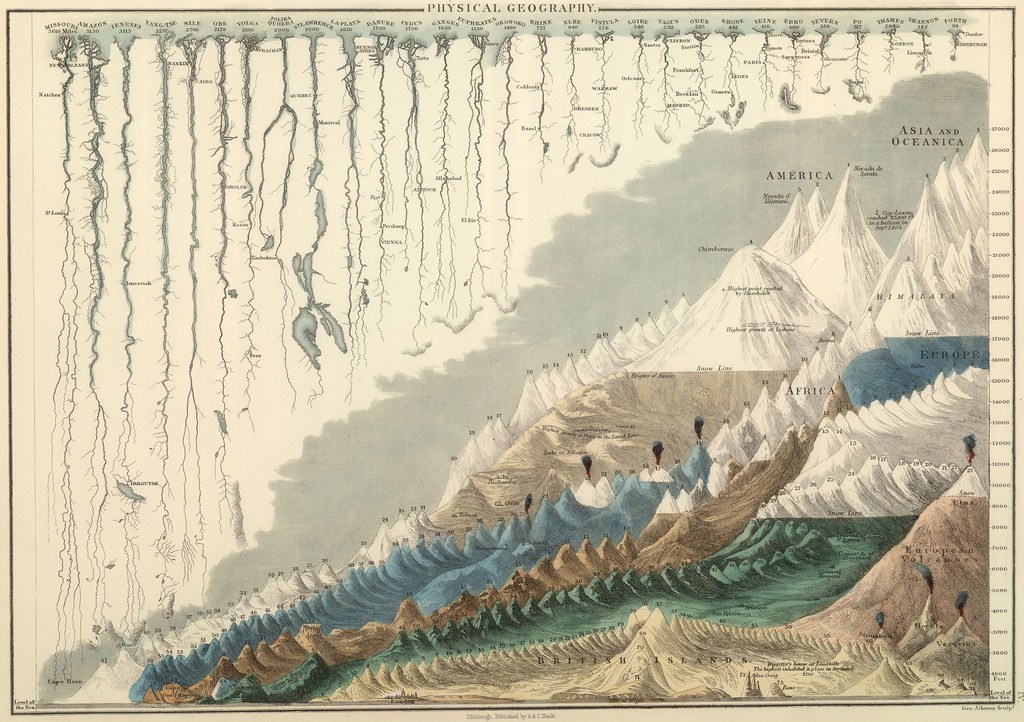
“Tinted drawing showing the comparative lengths of rivers and heights of mountains worldwide. “
Notebook Pages Maps and That
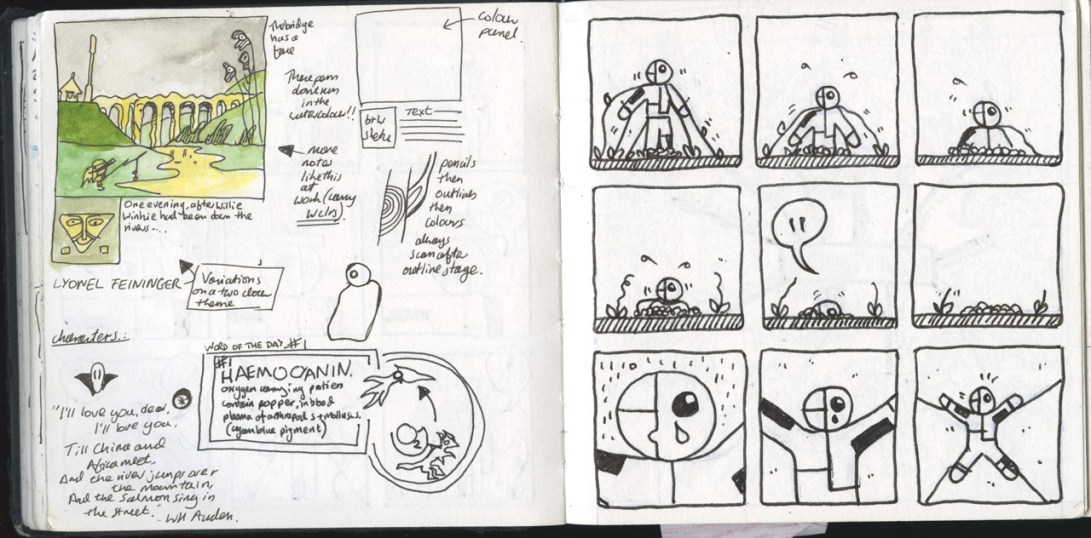


Some Old Scribbling
It was Hourly Comics Day a month or so (or three) back, this was my submission:


(old lady after Durer)

How to Look at Modern Art by Ad Reinhardt
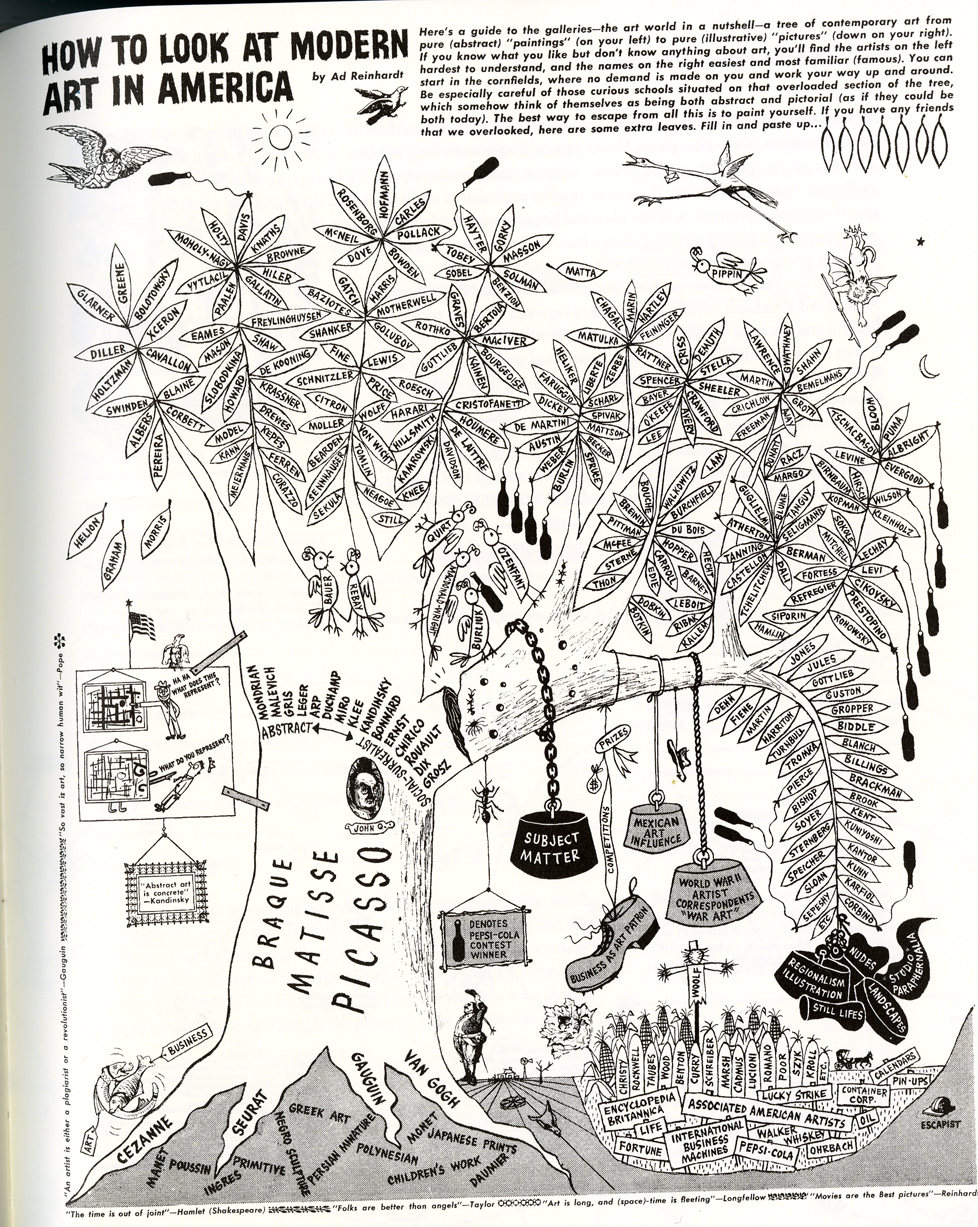
“In this famous cartoon of 1946 Ad Reinhardt tried to encapsulate the essence of the artistic modernism with its history and inherent conflicts within the American context. The tree of modern art has its roots deep in history – the Greeks are here, and so are Persian miniatures and Japanese prints. The roots represent the four pillars of Post-Impressionism: Vincent Van Gogh, George Seurat, Paul Cezanne, and Paul Gauguin. The tree is burdened by the weights of “subject matter” and “business as art patron,” and a cartoon within the cartoon mocks the perpetual debate of representation versus abstraction. By juxtaposing business and art, Reinhardt aptly comments on the situation of the avant-garde in the United States, where the public and, more importantly, the patrons were rather biased against the abstract art, often calling it “degenerate” and “subversive.””
— (via)
Anatomical illustration showing the veins, from a medical miscellany. England; 13th century,

 Paul Greer