from “Fossil Angels” »

“…We could, if we desired it, have things otherwise. Rather than magic that’s in thrall to a fondly imagined golden past, or else to some luridly-fantasized Elder God theme-park affair of a future, we could try instead a magic adequate and relevant to its own extraordinary times. We could, were we to so decide, ensure that current occultism be remembered in the history of magic as a fanfare peak rather than as a fading sigh; as an embarrassed, dying mumble; not even a whimper. We could make this parched terrain a teeming paradise, a tropic where each thought might blossom into art. Under the altar lies the studio, the beach. We could insist upon it, were we truly what we say we are. We could achieve it not by scrawling sigils but by crafting stories, paintings, symphonies. We could allow our art to spread its holy psychedelic scarab wings across society once more, perhaps in doing so allow some light or grace to fall upon that pained, benighted organism. We could be made afresh in our fresh undergrowth, stand reinvented at a true dawn of our Craft within a morning world, our paint still wet, just-hatched and gummy-eyed in Eden. Newborn in Creation.”

Alan Moore

via ekstasis

“What I’m Talking About When I Talk About Magic”

“…What I’m suggesting is that feng shui and an awful lot of other things are precisely of that kind of problem. There are all sorts of things we know how to do, but don’t necessarily know what we do, we just do them. Go back to the issue of how you figure out how a room or a house should be designed, and instead of going through all the business of trying to work out the angles and trying to digest which genuine architectural principles you may want to take out of what may be a passing architectural fad, just ask yourself, ‘How would a dragon live here?’ We are used to thinking in terms of organic creatures; an organic creature may consist of an enormous complexity of all sorts of different variables that are beyond our ability to resolve, but we know how organic creatures live. We’ve never seen a dragon, but we’ve all got an idea of what a dragon is like, so we can say, ‘Well, if a dragon went through here, he’d get stuck just here and a little bit cross over there because he couldn’t see that and he’d wave his tail and knock that vase over.’ You figure out how the dragon’s going to be happy here, and lo and behold, you’ve suddenly got a place that makes sense for other organic creatures, such as ourselves, to live in.

So my argument is that as we become more and more scientifically literate, it’s worth remembering that the fictions with which we previously populated our world may have some function that it’s worth trying to understand and preserve the essential components of, rather than throwing out the baby with the bath water; because even though we may not accept the reasons given for them being here in the first place, it may well be that there are good practical reasons for them, or something like them, to be there. I suspect that as we move farther and farther into the field of digital or artificial life, we will find more and more unexpected properties begin to emerge out of what we see happening and that this is a precise parallel to the entities we create around ourselves to inform and shape our lives and enable us to work and live together. Therefore, I would argue that though there isn’t an actual God, there is an artificial God, and we should probably bear that in mind…”

— Douglas Adams, “Is There an Artifical God?” (Extemporaneous speech given at Digital Biota 2: Cambridge, SEPTEMBER 1998)

via ekstasis

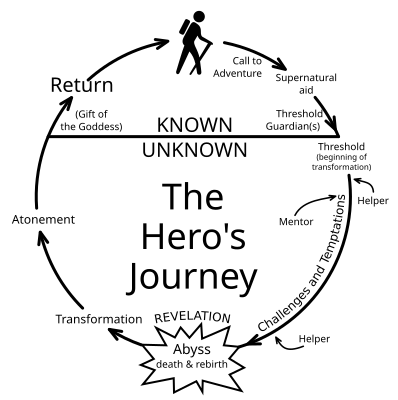
Monomyth / Hero’s Journey

By scan from an unknown publication by an anonymous poster, in a thread, gave permission to use it. Re-drawn by User:Slashme - 4chan.org, thread about monomyths, AKA the hero's journey, Public Domain, https://commons.wikimedia.org/w/index.php?curid=10284342
By scan from an unknown publication by an anonymous poster, in a thread, gave permission to use it. Re-drawn by User:Slashme – 4chan.org, thread about monomyths, AKA the hero’s journey, Public Domain, https://commons.wikimedia.org/w/index.php?curid=10284342


“The study of hero myth narratives started in 1871 with anthropologist Edward Taylor’s observations of common patterns in plots of hero’s journeys. Later on, others introduced various theories on hero myth narratives such as Otto Rank and his Freudian psychoanalytic approach to myth, Lord Raglan’s unification of myth and rituals, and eventually hero myth pattern studies were popularized by Joseph Campbell, who was influenced by Carl Jung’s view of myth. In his 1949 work The Hero with a Thousand Faces, Campbell described the basic narrative pattern as follows:

‘A hero ventures forth from the world of common day into a region of supernatural wonder: fabulous forces are there encountered and a decisive victory is won: the hero comes back from this mysterious adventure with the power to bestow boons on his fellow man.'”

via

Leabhar Bhaile an Mhóta 1390-1391

fol. 170r of the Book of Ballymote (AD 1390), part of the Auraicept na n-Éces, explaining the Ogham script. the page shows varianst of Ogham, nrs. 43 to 77 of 92 in total, including shield ogham (nr. 73). image via Ancient History Encyclopedia


The Book of Ballymote was compiled towards the end of the 14th century at the castle of Ballymote for Tonnaltagh McDonagh, who was then in occupation of the castle. The chief compiler was Manus O’Duignan, one of a family who were ollavs and scribes to the McDonagh and the McDermots. Other scribes of the book were Solomon O’Droma, a member of a famous Co. Fermanagh family, and a Robert McSheedy. The book is a compilation of older works, mostly loose manuscripts and valuable documents handed down from antiquity that came into possession of McDonagh.”

Crow

“When God, disgusted with man, Turned towards heaven, And man, disgusted with God, Turned towards Eve, Things looked like falling apart. But Crow Crow
Crow nailed them together, Nailing heaven and earth together-”

Ted Hughes

Karoo Ashevak

Karoo Ashevak

Karoo Ashevak, (Fantasy) Figure with Birds, 1972

Karoo Ashevak (1940 – October 19, 1974) was an Inuit sculptor who lived a nomadic hunting life in the Kitimeot, central Arctic region before moving into Spence Bay in 1960. His career as an artist started in 1968 by participating in a government-funded carving program. Working with the primary medium of fossilized whalebone, Ashevak created approximately 250 sculptures in his lifetime, and explored themes of shamanism and Inuit spirituality through playful depictions of human figures, shamans, spirits, and arctic wildlife