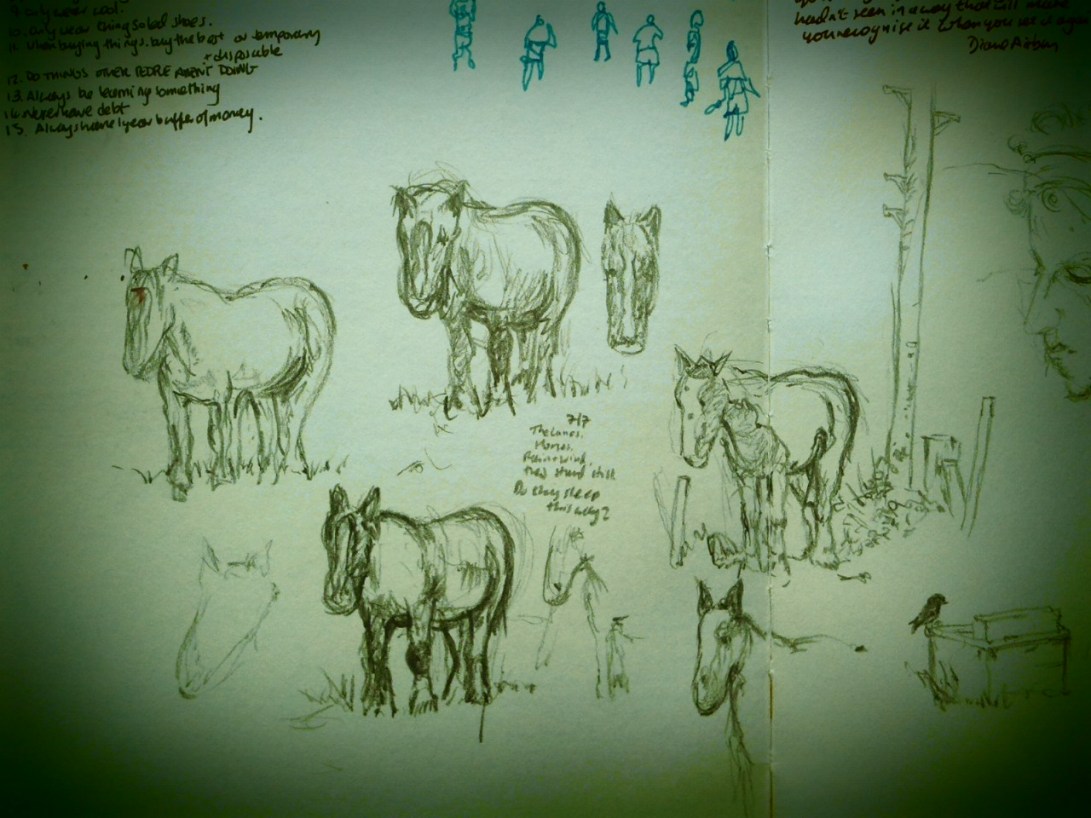
They’re standing nice n’ still though.
They’re standing nice n’ still though.

“The painting is much changed and far more advanced that when you last saw it. One day I was dissatisfied with it and dashed a tone of light rose over the former gloomy background. I turned the painting upside down, retired to the other end of the studio and looked at it under my arm. Vast improvement.”
— via 3liza
“I always felt that my work hadn’t much to do with art; my admirations for other art had very little room to show themselves in my work because I hoped that if I concentrated enough the intensity of scrutiny alone would force life into the pictures. I ignored the fact that art, after all, derives from art. Now I realize that this is the case.”

“This rare chart of comets, star clusters and nebula was engraved W. G. Evans of New York for Burritt’s Atlas to Illustrate the Geography of the Heavens . Notes several important comets recorded in the previous 300 years including the Comet of 1689, the Comet of 1744, The Great Comet of 1680, the Great Comet of 1811, Halley’s Cement, the Great Comet of 119 and the Comet of 1843. Also shows several well known nebulas including the Horse Shoe Nebula, the Spiral Nebula and the Dumb Bell Nebula. This unusual chart appeared in the 1856 edition of Burritt’s Atlas and was not present in earlier edition.”

Looking at a rapidly flowing stream or a thunderstorm leaves a strong visual impression, but many aspects of what is actually happening remain hidden from or are simply beyond the reach of observation, either by the naked eye or instruments. They have to be inferred from what can be observed, and this is a matter of interpretation, of imagination. It is very much the method Albert Einstein used in developing his theories of Relativity, because he could not directly observe objects moving close to the speed of light, or the movements of stars in interstellar space. In science it is called making a hypothesis, and the application of this method took modern physics far beyond empiricism (Newton had proudly claimed, “I make no hypotheses”), which was based strictly on what could be observed. Da Vinci, in this way as in others, anticipated future developments—he created hypothetical worlds that revealed the hidden structures of nature. These, in turn, helped him create paintings of great originality that are imbued with a lasting aura of conceptual power.


more here
“The artist is a receptacle for emotions that come from all over the place: from the sky, from the earth, from a scrap of paper, from a passing shape, from a spider’s web. That is why we must not discriminate between things. Where things are concerned there are no class distinctions. We must pick out what is good for us where we can find it – except from our own works. ”

by Keri Smith
(via)
 Paul Greer