“Venus has an eight-year rhythm, which formed the subject of the world’s oldest astrological text, a Venus-tablet from Nineveh. It was part of a series called Enuma Anu Enlil, the ‘Book of the Gods of Heaven and Earth’, and was dated to the 17th century BC. It effectively recorded the five synodic periods of Venus, giving a series of ten omens over the eight-year cycle through the pattern of Venus’s appearance and disappearance from view.
“To the astronomer Johannes Kepler, the musical interval generated by Venus and Earth was a ‘sixth’, given by dividing a string in the fraction 5/8. He said the relation was a ‘marital’ one and varied between the ‘masculine sixth’ G# – E and the ‘feminine’ one of Gb – E. This ratio of 5 to 8 is the key to the pattern traced by Venus against the stars.
“Venus traces a pentagon shape in the sky over ten meetings with the Sun; it does this by moving, between each ‘inferior’ conjunction, exactly 1.6 times around the zodiac, and the time it takes to do this, 584 days, is its synodic period. The pentagon shape is traced around the zodiac in five such synodic periods, which is 7.993 years or 8 years to a fraction of a day. Venus returns to the same portion of the zodiac after ten solar conjunctions, over a period of exactly 8 years.
“The rotation rate of Venus on its own axis was not discovered until 1967 by means of radar. This was able to peer through the dense mists surrounding the planet, and find a rotation period of precisely two-thirds of an Earth-year, or 243 days. Strangely enough, it was in the opposite direction to its rotation around the Sun. This meant that, in an eight-year period, Venus revolves exactly twelve times on its own axis. The numbers 5, 8 and 12 are here interacting. “
patterns
“Learning to See: Gloomy SUnday” by Memo Atken (2018)
“A deep neural network making predictions on live camera input, trying to make sense of what it sees, in context of what it’s seen before. It can see only what it already knows, just like us.
“(not ‘style transfer’!)
“memo.tv/learning-to-see-you-are-what-you-see/
“Music: Diamanda Galas – ‘Gloomy Sunday’
“code based on (but more evolved version of)
github.com/memo/webcam-pix2pix-tensorflow“model (ie training + inference) based on
github.com/affinelayer/pix2pix-tensorflow“In turn based on
phillipi.github.io/pix2pix/
arxiv.org/abs/1611.07004“In turn based on
arxiv.org/abs/1406.2661“and
github.com/Newmu/dcgan_code
arxiv.org/abs/1511.06434“In turn based on
github.com/goodfeli/adversarial
arxiv.org/abs/1406.2661“In turn based on
people.idsia.ch/~juergen/deep-learning-overview.html
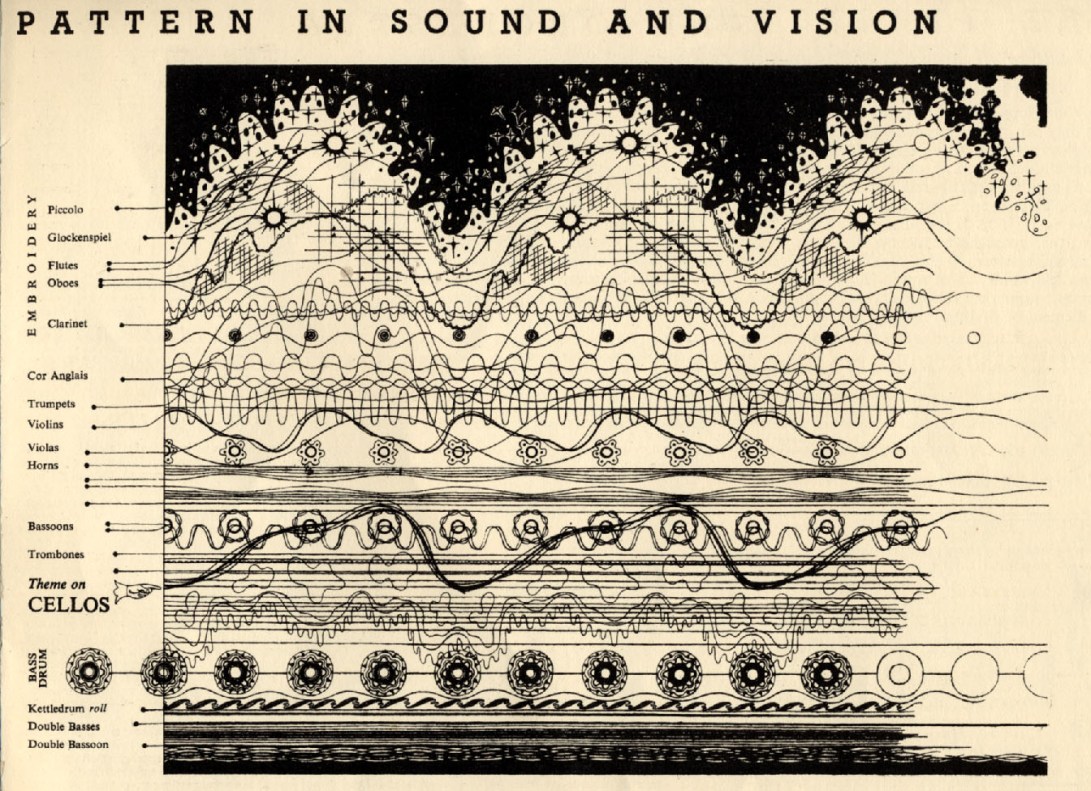
A Pattern In Sound and Vision

On Mind Maps and Dyslexia
Why do I need mind-maps?
“There are a few things you need to know:
First, I am lucky enough to have a number of positive impacts of dyslexia. One of those is that once I have acquired new information I can process it very rapidly and often have multiple thoughts at once. That often means that I can solve the most complex problems faster than others.
Second, I have a problem writing and thinking at the same time. I believe it is to do with short-term memory. However, the bottom line is that I keep forgetting where I am in the overall flow of the thing that I am writing. As a result, my writing meanders and needs to be edited (by me) again and again until it finally expresses what I mean.
Thirdly, I see patterns in things – often before others. I use that to form and then set out compelling arguments and explanations that become very clear to readers.
Finally, I have a fairly precise use of language and so – whilst not finding it easy to write – am a fierce critic of my own work. So that means the editing can take a very long time.”
Boy with The Incredible Brain
“…One is like bright light. Two is a movement from left to right. Five is like a clap of thunder or the sound of a wave against a rock.”
Daniel Tammet is known as an “autistic savant” and has often written about his life with high-functioning autism and savant syndrome, this film aimed to illustrate his mental process and synaesthetic mental process with numbers.
“Daniel can do calculations to 100 decimal places in his head, and learn a language in a week. ‘The Boy With The Incredible Brain’ follows Daniel as he travels to America to meet the scientists who are convinced he may hold the key to unlocking similar
abilities in everyone. He also meets the world’s most famous savant, KIm Peek, the man who inspired Dustin Hoffman’s character in the Oscar winning film ‘Rain Man’”
At BDH we were challenged to find a visual language to illustrate Daniel’s thought patterns for this, and my contribution were the numbers themselves.
