Lanthimos on Tarkovsky

Yorgos Lanthimos’ “The Favourite” was definitely my favourite from the recent awards season’s batch of films.

I truly had never seen a film like it, all the performances were incredible, the story was amazing, the cinematography, Olivia Coleman, everything.

I just listened to Lanthimos’ interview on Marc Marin’a podcast. He has this today about watching Tarkovsky:

“During the summer in Greece there’s a lot of open air cinemas, beautiful open air cinemas in a lot of neighbourhoods. You have a little table outside surrounded by apartment buildings, and you watch films.

So they would do retrospectives of his <Tarkovsky> films and John Cassevetes.

It was the first time seeing a different medium, seeing something new, like how an image can affect you in a different way, it doesn’t have to be a fast narrative, how poetic it can be, and how you can lose yourself in it, engage, but with your own personality. There’s an openness to it, you can bring your own stuff, and see things and understand things, maybe in a different way from how the person sitting next to you is experiencing the same thing at the same time.

It feels realistic but transcends that and you enter a different space. “

Yorgos Lanthimos, WTF podcast.

It’s definitely worth listening to the whole thing.

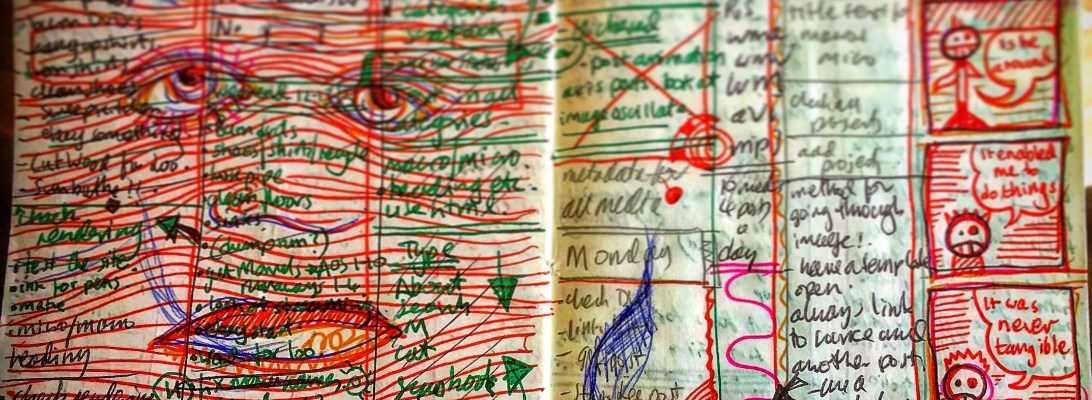
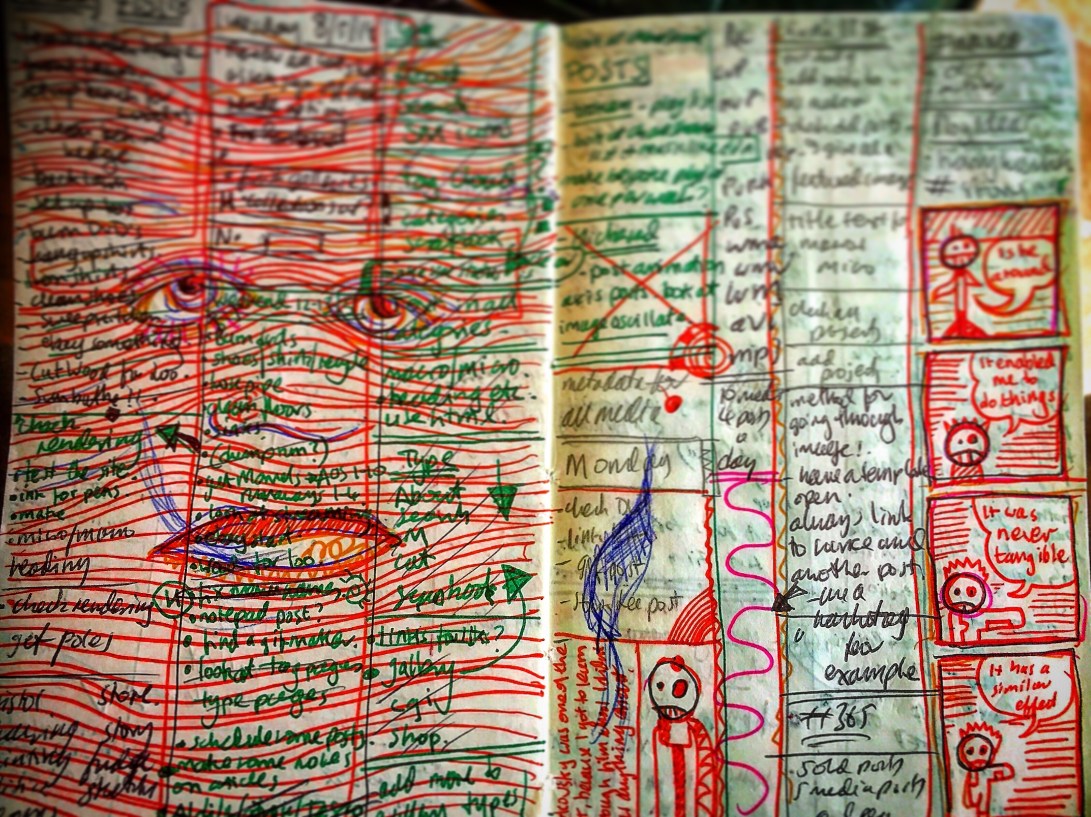
Here’s a notebook page of some drawing I did over some lists whilst I listened to it.
Here is the much viewed video of the wonderful Olivia Coleman accepting the Oscar for her role as Queen Mary.

‘He was one of the hanging judges of art.’

“My aim is to be understood by everyone. I reject the ‘depth’ that people demand nowadays, into which you can never descend without a diving bell crammed with cabbalistic bullshit and intellectual metaphysics. This expressionistic anarchy has got to stop … A day will come when the artist will no longer be this bohemian, puffed-up anarchist but a healthy man working in clarity within a collectivist society.”

George Grosz

via Daily Omnivore

to “all those who of set purpose choose to walk alone, who know the special grace attaching to it”

Nature’s particular gift to the walker, through the semi-mechanical act of walking — a gift no other form of exercise seems to transmit in the same high degree — is to set the mind jogging, to make it garrulous, exalted, a little mad maybe — certainly creative and suprasensitive, until at last it really seems to be outside of you and as if it were talking to you whilst you are talking back to it. Then everything gradually seems to join in, sun and the wind, the white road and the dusty hedges, the spirit of the season, whichever that may be, the friendly old earth that is pushing life firth of every sort under your feet or spell-bound in a death-like winter trance, till you walk in the midst of a blessed company, immersed in a dream-talk far transcending any possible human conversation. Time enough, later, for that…; here and now, the mind has shaken off its harness, is snorting and kicking up heels like a colt in a meadow.

Kenneth Grahame

nobody-but-yourself

A poet is somebody who feels, and who expresses his feelings through words.

This may sound easy. It isn’t.

A lot of people think or believe or know they feel — but that’s thinking or believing or knowing; not feeling. And poetry is feeling — not knowing or believing or thinking.

Almost anybody can learn to think or believe or know, but not a single human being can be taught to feel. Why? Because whenever you think or you believe or you know, you’re a lot of other people: but the moment you feel, you’re nobody-but-yourself.

To be nobody-but-yourself — in a world which is doing its best, night and day, to make you everybody else — means to fight the hardest battle which any human being can fight; and never stop fighting.

e.e.cummings

“I’ll be there” – The Final Speech of Tom Joad

“I want to put a tag of shame on the greedy bastards who are responsible for this.”

I just finished reading The Grapes of Wrath by John Steinbeck.  I have always known of this book but never read it or even knew very much about what is was about.

I really wasn’t prepared by how relevant it was to so many situations occurring globally at the moment. The mass migration of populations due to climate changes, infrastructure collapse and economics, the refusal of a system to help and indeed the full demonisation of those in transit.

The language is beautifully simple and yet says so much about strength, sadness, suffering, perseverance and dignity.

Continue reading

The future, in fiction, is a metaphor.

“All fiction is metaphor. Science fiction is metaphor. What sets it apart from older forms of fiction seems to be its use of new metaphors, drawn from certain great dominants of our contemporary life—science, all the sciences, and technology, and the relativistic and the historical outlook, among them. Space travel is one of these metaphors; so is an alternative society, an alternative biology; the future is another. The future, in fiction, is a metaphor.

A metaphor for what?

If I could have said it non-metaphorically, I would not have written all these words, this novel…”

 –  Ursula K. Le Guin, 1976 Foreword to The Left Hand of Darkness (via Nearlya)