
Pinter in 1978 – 02.05.16


I dated this because there probably’ll be more than one.

There was a recent rescreening of 1978 interview.

This on writing his first play

I wrote that play totally without calculation. In other words, I started at the top and at a certain point There was a knock at the door and someone came in, and I had absolutely no idea who he was, who he might be, what he might say, and I let it run. I let it happen, and found that he did have a voice, that he was the Landlord, in fact. That was the first chapter.

The two visitors arrived, and I didn’t know what they were on about really, or what they wanted. They were just part of the whole atmosphere.

This on starting:

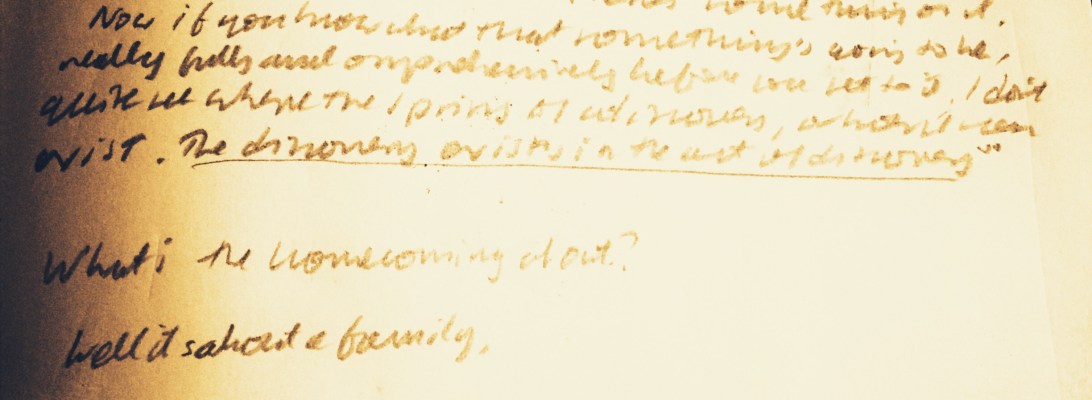
It remains the essential joy of writing, I think. You’ve got a blank page, one moment, there’s nothing on it, and the next moment there’s something on it.

Now if you know what that something’s going to be, really, fully and comprehensively before you get to it, I don’t quite see where the spring of discovery can exist.

The discovery exists in the act of discovery.

On Gwangi


Amongst the methonal fumes, corduroy flares and taste of cresta in the pre-star wars seventies there was relatively little of the fantastic to occupy the day dreaming mind of the under 10s. There was occasional Saturday morning Godzilla, there was Flash Gordon and various other assorted grand ideas fitting into a budget.

Valley of Gwangi crashed into my world during this time. At Gran’s house, A creepy pre title, the very western theme music with crashing timpani (by Jerome Morross of Big Country (not that one that one), the promise of cowboys vs dinosaurs. A playfulness of genre unusual until the age when comic books finally took over cinema.

Gwangi was conceived by Willis O’Brien, prime animator of the original King Kong. It was Part of a set of ideas featuring Cowboys and monsters (including Mighty Joe Young and the xxxxx). O’Brien was unable to finish the project and handed it to his apprentice, Ray Harryhausen, who had by then completed many multi creature films which were mostly better t.

The Allosaurus in gwangi was fast moving, tail constantly curling, in a candid moment it scratched it’s nose. It was alive. Many books at that time were still telling us that dinosaurs were sluggish, slow moving cold blooded creatures. But Harryhuasen looked at them with the eye of an animator, seeing how they neeed to move. Consequently he was ahead of many paleantologists and he produced a level of dynamism unmatched until Speilberg got his hands in the Train Set 23 years later.

Showing my children a film such as this is a recipe for heartbreak. They’re raised on hi end 21st century cgi, it’s meaning is lost to them because they don’t get the history and it’s just too old. Sometimes it’s equally devastating revisiting a treasure of childhood, one sees the flaws not perceived at such a young age. Gwangi carries some of that, yet the magic still carries me away.

I had the privilege of meeting Harryhausen about twenty years ago. I managed to mumble about how much I loved the film and had gone through the lasso sequence frame by frame enough times to degrade a VHS. He smiled and told me the story of how they had taken a jeep with a pole, the stunt riders lassoed the pole and the jeep accelerated back and forth pulling the riders off the horses, and then by the “magic of cinema” (his words) they removed the pole and put Gwangi in. I nodded gratefully and crawled back under my stone.

As mentioned The Valley of Gwangi is being shown as an open air screening in  Victoria Square, Bedminster, Bristol on August 8th as part of the Bristol Bad Film Club (wtf?) (oh wait, they apologise). I am unable to attend and have nothing but cold, hard envy for all of you who can.

“The Paradise Destroyed by the Straight Line,”- Friedensreich Hundertwasser on Stamps and Lines

“The stamp is an important object. Although very small in format, it carries a message. Stamps are a measure of the culture of a country. This tiny, rectangular piece of paper links the hearts of the sender and receiver. It is a bridge between peoples and nations. The stamp knows no borders. It reaches us even in prisons, asylums, and hospitals, and wherever we may be on earth. Stamps should be ambassadors of art and life and not simply soulless proofs of postage paid. The stamp must experience its destiny. The stamp must once again fulfil its purpose, which means it must serve on letters. A true stamp must feel the tongue of the sender moistening its gum. A stamp must be stuck on a letter. A stamp must experience the dark depths of the post box. A stamp must suffer franking. A stamp must sense the hand of the postman handing the letter to the addressee….The stamp is the only work of art that everyone can own, young and old, rich and poor, healthy and sick, educated and ignorant, free or robbed of freedom…“

Hundertwasser, February 14, 1990


hunterwasser stamps


hunterwasser stamps


hunterwasser stamps


hunterwasser stamps


hunterwasser stamps

“In 1953 I realized that the straight line leads to the downfall of mankind. But the straight line has become an absolute tyranny. The straight line is something cowardly drawn with a rule, without thought or feeling; it is a line which does not exist in nature. And that the line is the rotten foundation of our doomed civilization. Even if there are certain places where it is recognized that this line is rapidly leading to perdition, its course continues to be plotted. The straight line is godless and immoral.

The straight line is the only uncreative line, the only line which does not suit man as the image of God. The straight line is the forbidden fruit. The straight line is the curse of our civilization. Any design undertaken with the straight line will be stillborn.

Today we are witnessing the triumph of rationalist knowhow and yet, at the same time, we find ourselves confronted with emptiness. An aesthetic void, desert of uniformity, criminal sterility, loss of creative power. Even creativity is prefabricated. We have become impotent. We are no longer able to create. That is our real illiteracy.”

Hunterwasser 1985