sound
“The qualities of different vowel sounds, and their transformations for the various notes…are beautifully depicted.”

Audio AR/VR
I still think that a purely audio version of AR and VR has the potential to become a huge deal, way more than current tracking seems to suggest.
Imagine having the audio of this working whilst you walk around the modern city, and it interacting as you move
“Reinventing The Wheel” by United Visual Artists (2013)
“Free Radicals” by Len Lye (1958)
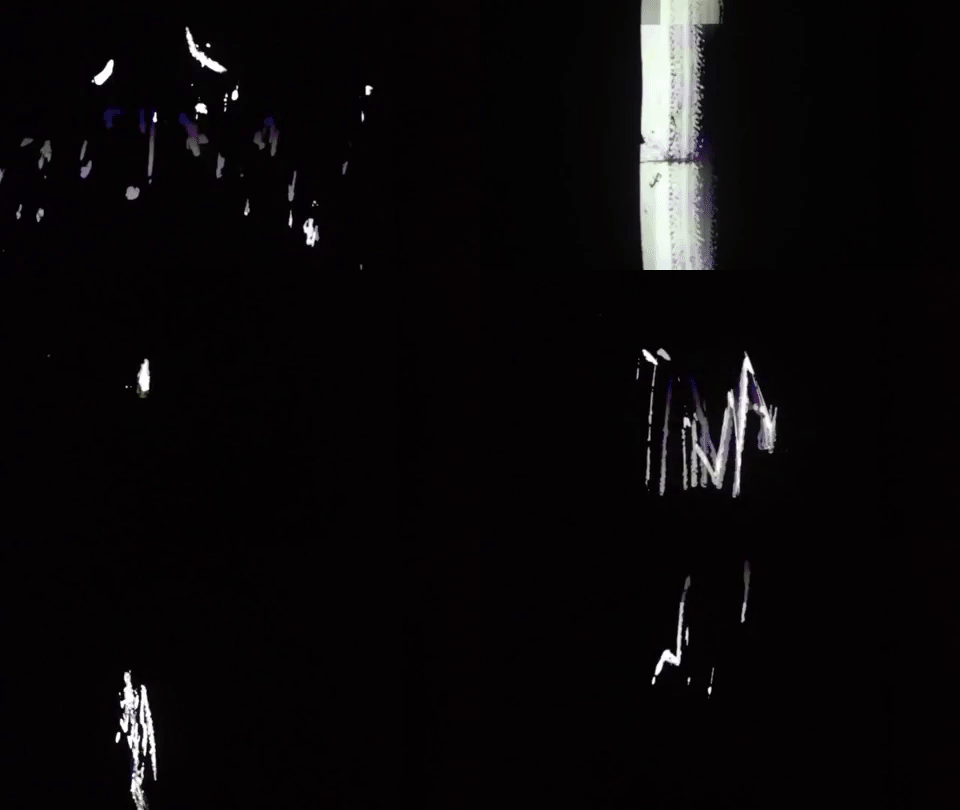
“Created in 1958, Free Radicals is arguably one of American avant-garde artist Len Lye’s greatest film works. ‘Every film [I made], I tried to interest myself in it by doing something not previously done in film technique’, said Lye. Working across the mediums of painting, poetry, and film, Lye was a prolific and important kinetic artist. With a maverick character and obsession with movement, Lye pioneered experimental film and animation techniques with his influential invention of direct (camera-less) film-making as early as the 1930s. Though never associated solely with one movement, Lye’s work merged aspects of Surrealism, Futurism, Constructivism and Abstract Expressionism into his own breed of moving art.”
Watch here.
“I, myself, eventually came to look at the way things moved mainly to try to feel movement, and only feel it. This is what dancers do; but instead, I wanted to put the feeling of a figure of motion outside of myself to see what I’d got. … I didn’t know the term ‘empathy’ – that is, the psychological trick of unconsciously feeling oneself into the shoes of another person – but I was certainly practising it. I got so that I could feel myself into the shoes of anything that moved, from a grasshopper to a hawk, a fish to a yacht, from a cloud to the shimmering rustle of ivy leaves on a brick wall. Such shoes were around in profusion. …”
— Len Lye
see also:
“Listening Wind” by Talking Heads (1980)
“Regular John” by Queens Of The Stone Age (1998)
According to LastFM, I listened to this song more than anything else in 2011.
“Everything” by Micachu and the Shapes with the London Sinfonietta (2011)
Newton’s colour circle
“In a mixture of primary colours, the quantity and quality of each being given, to know the colour of the compound.”

from wiki – Throughout Opticks, Newton compared colours in the spectrum to a run of musical notes. To this purpose, he used a Dorian mode, similar to a white-note scale on the piano, starting at D. He divided his colour wheel in musical proportions round the circumference, in the arcs from DE to CD. Each segment was given a spectral colour, starting from red at DE, through orange, yellow, green, blew [sic], indigo, to violet in CD. (The colours are commonly known as ROY G BIV.)
The middle of the colours—their ‘centres of gravity’—are shown by p, q, r, s, t, u, and x. The centre of the circle, at O, was presumed to be white. Newton went on to describe how a non-spectral colour, such as z, could be described by its distance from O and the corresponding spectral colour, Y.
 Paul Greer