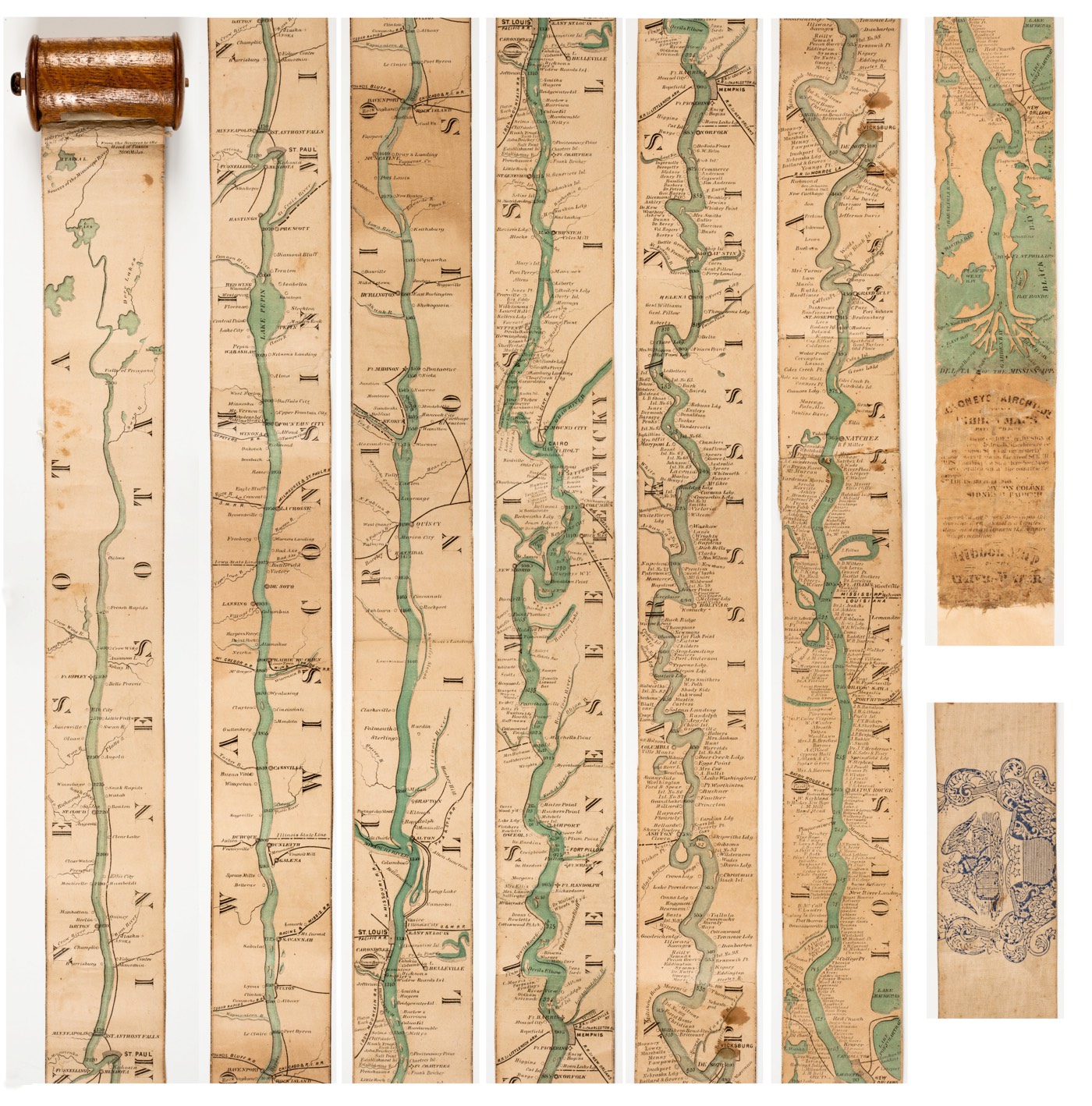
A Mississippi Roll: Coloney & Fairchild’s Ribbon Map of the Father of Waters (1866)

found via Kottke

“Coloney and Fairchild’s patented apparatus required that the single sheet be cut into strips, attached end-to-end, mounted on linen, and then rolled inside a wooden, metal, or paper spool (fig. 4). The resulting portability of the map was crucial because, as advertisements indicated, it was intended for business travelers, steamboat navigators, and tourists. Of this form, the Newberry Library and the Minnesota Historical Society Library hold what seems to be a first edition, while nearly a dozen archives around the U.S. hold an updated second version. With the addition of hundreds of towns, mile markers, islands, landings, landowner and plantation names, and significant Civil War locations, the Lower Mississippi appears to be a settled and thriving commercial space.”

Nenette Luarca-Shoaf

Larger versions of the image can be found here.
 

18th November 2016

Write down what you value; what standards you hold for yourself and for others. Write about your dreams for the future and your hopes for your children. Write about the struggle of your ancestors and how the hardship they overcame shaped the person you are today.
Write your biography, write down your memories. Because if you do not do it now, you may forget.
Write a list of things you would never do. Because it is possible that in the next year, you will do them.
Write a list of things you would never believe. Because it is possible that in the next year, you will either believe them or be forced to say you believe them.

This is how to be your own light

The Corps of Discovery carried out this order with all due diligence. Not only did Captains Lewis and Clark keep notebooks on their observations, but the other soldiers did as well, producing in all more than one million words during their travels.

“Lewis and Clark kept 18 of what Jefferson called their “traveling pocket journals;” 13 were larger notebooks bound in red morocco leather, 4 were smaller and bound in paper board, and one was Clark’s field notebook bound in elkskin. Clark carried this elkskin field book during times of inclement weather or while canoeing down a river in order not to risk damage to one of the larger red notebooks. He would then copy his field notes into the red notebooks later on. When all the notebooks were not in use they were kept protected in tin cases. When their pages had been completely filled, the notebooks were sealed safely shut inside the cases for a safe return to Washington.”

The Pocket Notebooks of 20 Famous Men

US Tumblrs, if you want to see what I do for a day job, check out the globes on the Frozen Planet currently showing on Discovery. Sorry I’m on the road so I got no links.