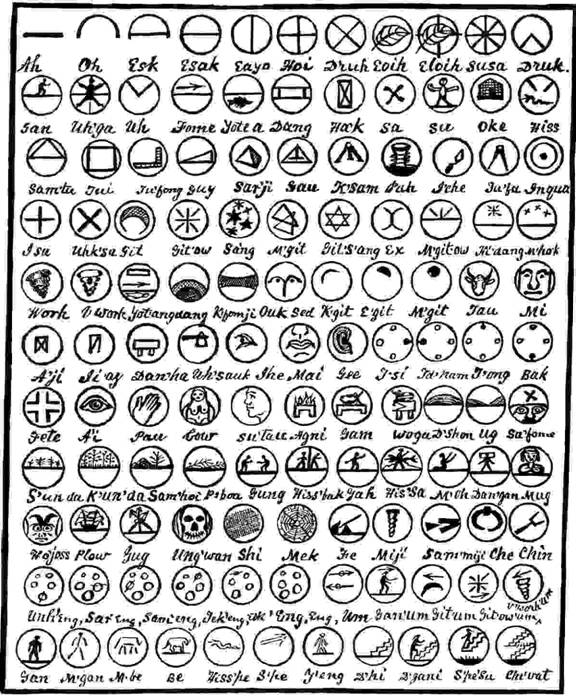
“i033 Tablet of Se’moin. Panic language means earth-language; things were named after the sounds they uttered; thus, the soul of each thing spoke, and that which was voiced was called the Panic language. Panic was the first language on earth but was not written until Se’moin, given in the time of Sethantes, being the first written language given to I’hins. As such, Se’moin represents the first explanation of creation ever given to man.”
writing
/ˈrʌɪtɪŋ/
noun
1. the activity or skill of writing.
“parents want schools to concentrate on reading, writing, and arithmetic”
2. the activity or occupation of composing text for publication.
“she made a decent living from writing”
“For now, just get the words out. Get the story down however you can get it down, then fix it.’
“For me, it’s always been a process of trying to convince myself that what I’m doing in a first draft isn’t important. One way you get through the wall is by convincing yourself that it doesn’t matter. No one is ever going to see your first draft. Nobody cares about your first draft. And that’s the thing that you may be agonizing over, but honestly, whatever you’re doing can be fixed.”
on List-Making
“Conjure the nouns, alert the secret self, taste the darkness … speak softly, and write any old word that wants to jump out of your nerves onto the page…”
The dumbest generation? No, Twitter is making kids smarter
“It used to be that students did comparatively little writing out of school; even if you were in university, there was little call for it, and few vehicles to showcase your writing. But now, as Prof. Lunsford’s research has found, 40 per cent of all writing is done outside the classroom – it’s “life writing,” stuff students do socially, or just for fun. And it includes everything from penning TV recaps to long e-mail conversations to arguments on discussion boards.
“They’re writing more than any generation before,” she says. The members of “dumbest generation” aren’t just passively consuming media any more. They’re talking back to it.”
“But technology doesn’t just make students better writers or more fluent. Digital tools also let them communicate easily with others – their peers, their friends and the world at large. And this, it turns out, can make them even more powerfully motivated to become genuinely (and wittily) literate.”
— via eush
Two Eyes and New Glasses.
Back at work with new glasses. They’re so good I can see that idea you just had.
Your second eye of the day.
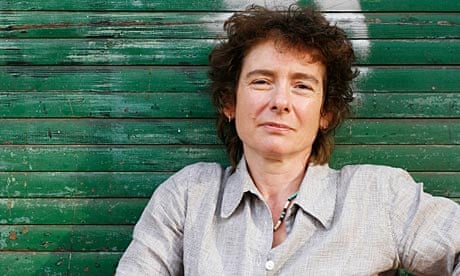
Literary Birthday – Jeanette Winterson, born 27 August 1959

reblogging Amanda Patterson for Writers Write
Literary Birthday – 27 August
Jeanette Winterson, born 27 August 1959
Seven Quotes
1. Language is what stops the heart exploding.
2. It’s not the one thing nor the other that leads to madness, but the space in between.
3.Everything in writing begins with language. Language begins with listening.
4. When people say that poetry is merely a luxury for the educated middle classes, or that it shouldn’t be read much at school because it is irrelevant, or any of the strange and stupid things that are said about poetry and its place in our lives, I suspect that the people doing the saying have had things pretty easy. A tough life needs a tough language – and that is what poetry is. That is what literature offers – a language powerful enough to say how it is.
5. What you risk reveals what you value.
6. So from the very first, if I was hurt in some way, then I would take a book — which was very difficult for me to buy when I was little — and I would go up into the hills, and that is how I would assuage my hurt.
7. Always in my books, I like to throw that rogue element into a stable situation and then see what happens.Jeanette Winterson’s 10 Rules for Writing
1. Turn up for work. Discipline allows creative freedom. No discipline equals no freedom.
2. Never stop when you are stuck. You may not be able to solve the problem, but turn aside and write something else. Do not stop altogether.
3.Love what you do.
4. Be honest with yourself. If you are no good, accept it. If the work you are doing is no good, accept it.
5. Don’t hold on to poor work. If it was bad when it went in the drawer it will be just as bad when it comes out.
6. Take no notice of anyone you don’t respect.
7. Take no notice of anyone with a gender agenda. A lot of men still think that women lack imagination of the fiery kind.
8. Be ambitious for the work and not for the reward.
9. Trust your creativity.
10. Enjoy this work!
Winterson is a British writer who was awarded an OBE for services to literature. Oranges Are Not the Only Fruit won the 1985 Whitbread Prize for a First Novel, and was adapted for television by Winterson in 1990. She has won various awards around the world for her fiction and adaptations, including the Whitbread Prize, UK, and the Prix d’argent, Cannes Film Festival. She writes regularly for various UK newspapers.
Inside Guillermo Del Toro’s sketchbooks
“I like to say that we only make one movie in our lifetime, a movie made of all the images of all our movies.”
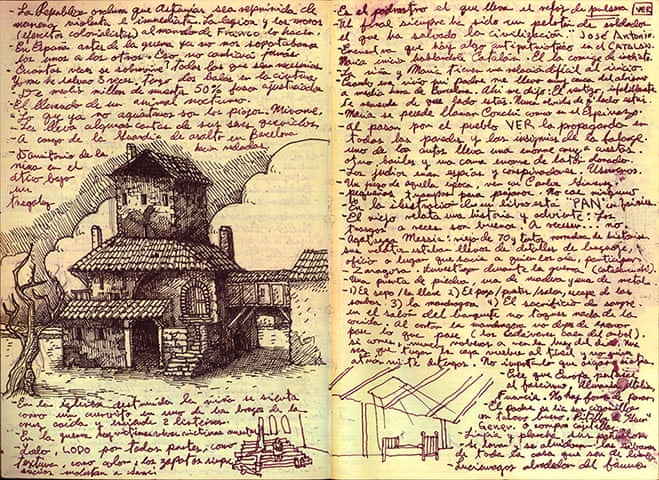
“In the end, perfection is just a concept – an impossibility we use to torture ourselves and that contradicts nature.”
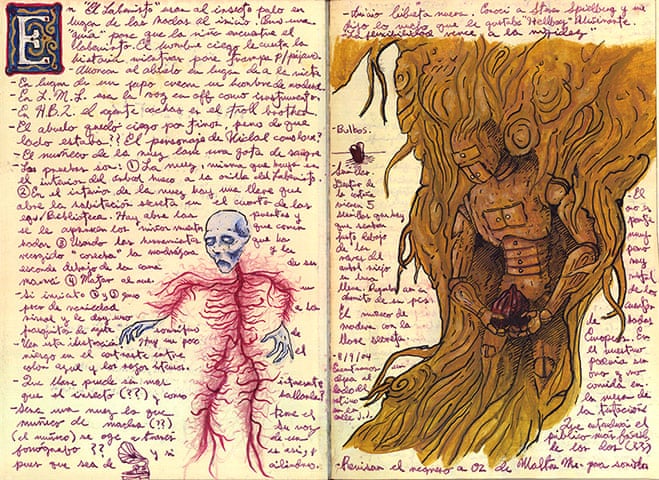
“In fairy tales, monsters exist to be a manifestation of something that we need to understand, not only a problem we need to overcome, but also they need to represent, much like angels represent the beautiful, pure, eternal side of the human spirit, monsters need to represent a more tangible, more mortal side of being human: aging, decay, darkness and so forth. And I believe that monsters originally, when we were cavemen and you know, sitting around a fire, we needed to explain the birth of the sun and the death of the moon and the phases of the moon and rain and thunder. And we invented creatures that made sense of the world: a serpent that ate the sun, a creature that ate the moon, a man in the moon living there, things like that. And as we became more and more sophisticated and created sort of a social structure, the real enigmas started not to be outside. The rain and the thunder were logical now. But the real enigmas became social. All those impulses that we were repressing: cannibalism, murder, these things needed an explanation. The sex drive, the need to hunt, the need to kill, these things then became personified in monsters. Werewolves, vampires, ogres, this and that. I feel that monsters are here in our world to help us understand it. They are an essential part of a fable.”
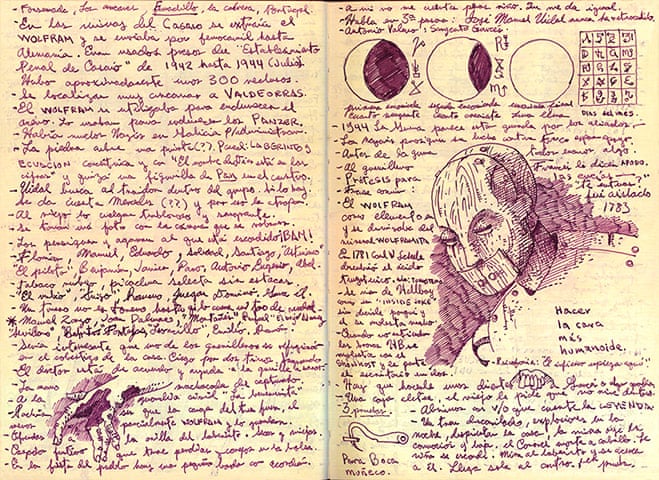
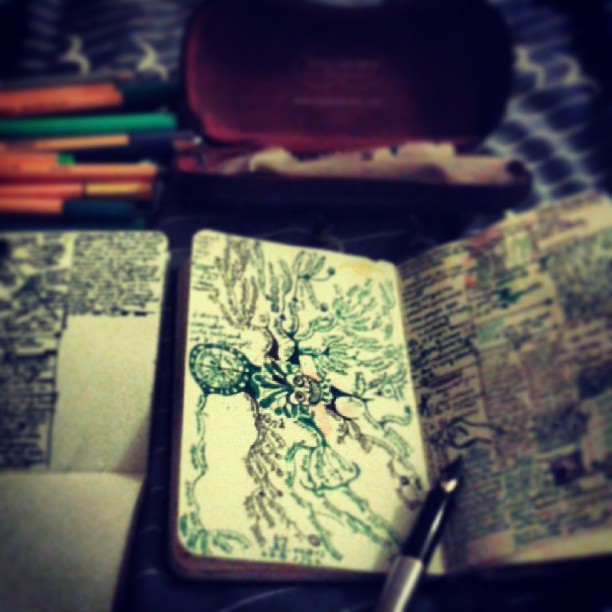
“On that December night at Bleak House, I noticed that del Toro had moved some of his journals from the bathroom safe to a shelf in the Rain Room. I asked to see early sketches for “Madness.” The notebook was from 1993. He turned the pages, stopped, and smiled. “Look!” he said. It was an image of one of the explorers falling into icy water. An inky creature lunging at him looked breathtakingly similar to the Shoggoth with symmetrical tentacles. Del Toro’s monsters had inhabited his mind for nearly two decades. From the beginning, del Toro had imagined that his creatures, unlike Lovecraft’s, would have a fatal vulnerability—one that explained why the horrible beasts had remained trapped in Antarctica. Salt water: it dissolved a Shoggoth like a slug. “
— Show The Monster, Guillermo del Toro’s quest to get amazing creatures onscreen
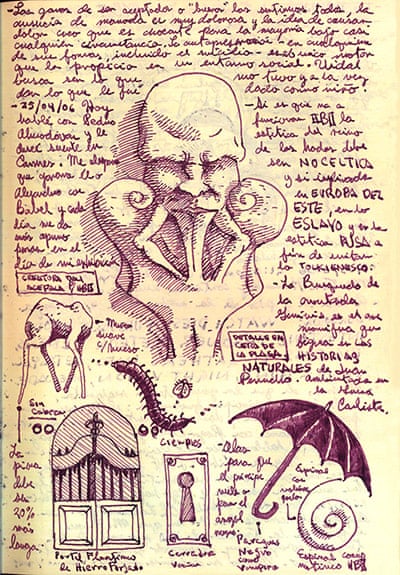
“Some ideas for one film end up getting used in another. Some pages are instructions for make-up artists, others are just Del Toro working out what looks cool and scary.”
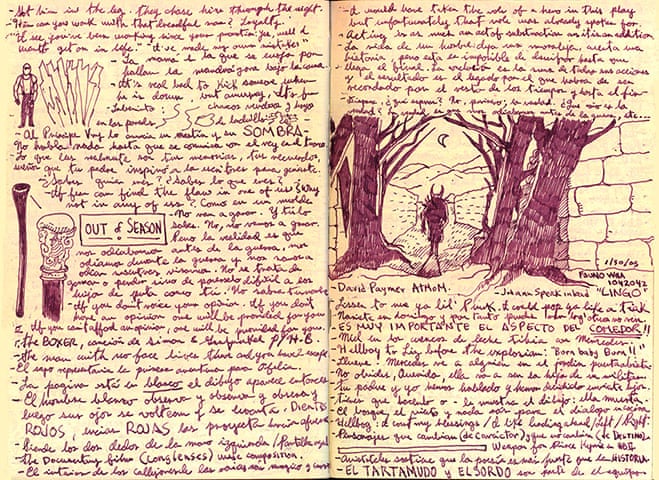
Images via.
How to Build a Universe
“Because today we live in a society in which spurious realities are manufactured by the media, by governments, by big corporations, by religious groups, political groups… So I ask, in my writing, What is real? Because unceasingly we are bombarded with pseudo-realities manufactured by very sophisticated people using very sophisticated electronic mechanisms. I do not distrust their motives; I distrust their power. They have a lot of it. And it is an astonishing power: that of creating whole universes, universes of the mind. I ought to know. I do the same thing.”