(purchase)
Author: Paul Greer
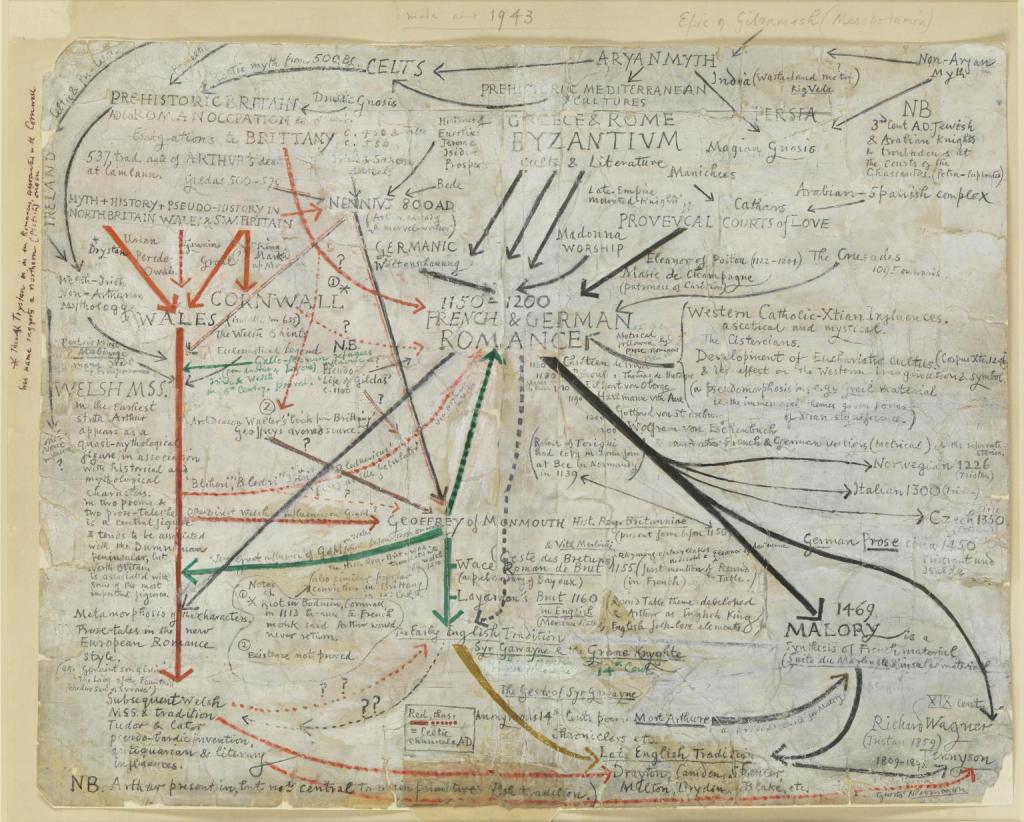
“Chart of sources for Arthurian legends” – Graphite text with ink on paper – David Jones (1949)
“Piloot – Gyre” by Florian Guibert (2019)
Great use of Houdini, combining dynamics and audio driven keys.
Mesmerising & inspirational.
“The starting point of the idea for GYRE was to make a music video for the upcoming album of my band Piloot. Thus I was both the musician and the 3D artist. Being part of the creative process of the music itself, I have a close relationship with it. The interaction between music and image has always been a center of interest for my creative process. I see images when I hear music. Using that music as a guideline is something I’ve been experimenting with since the beginning of my graphic practice.”
More in #soundtolight:
NOTEPAD 2019 WEEK 15-16
SCROLLING:
- This is good on capitalism, #ClimateBreakdown and systemic change, with @AnnPettifor and @GeorgeMonbiot. Worth a listen
- Resources for Living a More Ethical Life Online
“Ethical.net has compiled a list of resources for “discovering ethical alternatives to stuff”.”
- 27 incredibly useful Google Sheets tips
“There’s much more to Google Sheets than meets the eye. Unlock these advanced options–and watch your productivity soar.”
- 5 Benefits Of Taking Online Classes With CG Spectrum
“While traditional study can be effective for some, an online animation/vfx/game design school offers students the freedom and flexibility to study in a way that works for them, while tapping into an international network of experts from the comfort of their home.”
- Make your mark: the enduring joy of drawing | Art and design | The Guardian
“Drawing is democracy. Everyone does it. You doodle in the margins of this newspaper. I sketch the view while hanging on the phone. We draw on our hands, on walls, on the back of envelopes (like Monet), on office notepaper (like Van Gogh), on restaurant napkins (like Picasso and Warhol). We draw to pass the time, to catch the moment, to remind ourselves what we saw, felt or thought. We draw to see what life looks like in two dimensions. We draw because we can – and everyone can – and because we’re trying to improve. We draw to see what we can make of the world, or for the sheer joy of it; to show something to somebody else – here, this is what it looked like. We draw to make a map, with a couple of decorative trees; to see if our two-circle cat looks anything like the real thing; to play games with each other, show the police what we witnessed, send a message to someone else; to give each other something particular, something special, to say something that cannot otherwise be said. We all do it. And we do it from the first.”
- Moving Towards web3.0 Using Blockchain as Core Tech – ReadWrite
“The invention of Bitcoin and blockchain technology sets the foundations for the next generations of web applications. The applications which will run on peer to peer network model with existing networking and routing protocols. The applications where centralized Servers would be obsolete and data will be controlled by the entity whom it belongs, i.e., the User.”
- Astronomers discover third planet in the Kepler-47 circumbinary system
“Astronomers have discovered a third planet in the Kepler-47 system, securing the system’s title as the most interesting of the binary-star worlds. Using data from NASA’s Kepler space telescope, a team of researchers, led by astronomers at San Diego State University, detected the new Neptune-to-Saturn-size planet orbiting between two previously known planets.”
- Niall Ferguson isn’t upset about free speech. He’s upset about being challenged | Dawn Foster | Opinion | The Guardian
“This can be uncomfortable for anyone accustomed to unquestioned status and veneration: but that’s life, if you believe speech should be free. For years, privileged men have been able to frame themselves as agents provocateurs – often spouting the kind of opinions a roaring, angry drunk on the night bus might, but with a plummy accent, an Oxford degree, and an overreliance on antiquated vocabulary – in columns in national newspapers. Their fury is not that they have been silenced – they have not – but that their victims have argued back, and they have been forced to bear responsibility for their words”
(MORE LINKS)
SEEING:
- 🖼 Né le 20 avril 1893 Juan Miró, peintre, sculpteur, graveur et céramiste espagnol. #Mirò @dfweb75 – “The waggon tracks” (1918).
- 📷 @chyna.tene
- 📓 Lynda Barry on Instagram: “First page of new book. DIG IT! #lyndabarry #comics”
- 🖼 The art of Maurice Wade, 1917–1991
(ME ON PINTEREST)
WATCHING:
(CURRENT STATUS)
READING:

Finally got the birthday Fire Pit going.
🎉👍🔥❤️
Hans Bellmer – “The Doll”, c. 1934
“I want to reveal what is usually kept hidden – it is no game – I tried to open peoples eyes to new realities: it is as true of the doll photographs as it is of Petit Traite de la Morale. The anagram is the key to my work. This allies me to the Surrealists and I am glad to be considered part of that movement, although I have less concern than some Surrealists with the subconscious, because my works are carefully thought out and controlled. If my work is found to scandalise, that is because for me the world is scandalous.”
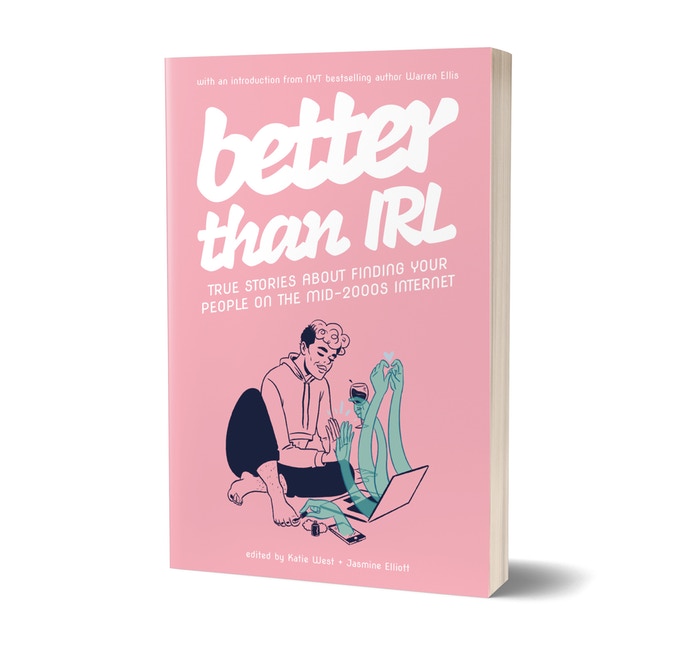
Better than IRL: “Finding your people on the internet of the mid-2000s.”
Having small children is an incredible experience, it can take in your whole world. Years fly by and you can be so very focused on our family and work that, unfortunately, you can lose track of a lot of friends, and your social life pretty much disappears.
When we got to put our heads above ground again in the mid-2000s, I found Tumblr (via Sussanah Breslin) and it really helped me to put my cultural self back together. Sharing work, art and ideas, meeting so many amazing people, (and I didn’t even need to go outside!) it really was an incredibly important time for me and I am very grateful to all of those who made that happen. I suppose the GDSP project was one of the many high points of that.
I left Tumblr behind when they brought in the censorship rules in because it seemed it was leaving the people who made it cool and essential behind, but I have been working hard on keeping my internet positive and fulfilling in that tradition.
It is the history of this spirit and time that Katie West, photographer, writer and publisher is documenting in her new book project “Better than IRL” currently open to pre orders on Kickstarter.
“Better Than IRL is a collection of true stories about the years when the internet first started gaining traction as a place to build connections and community. With 20 essays written by pioneers and participants from online communities, this paperback (or digital book!) looks at how this specific time on the internet changed us, and how we can take the elements that made it so much better than IRL with us into the future.”
“The book will be personal and hopeful. It won’t be nostalgic moaning about how the internet isn’t what it once was—it will discuss how it made us into who we are now and how we can take the lessons we learned about inclusion and belonging to be better people going forward. With talented authors from Canada, South Africa, Pakistan, USA, Singapore, UK, and Liberia, the book covers a wide array of experiences with the beginnings of the Web 2.0.”
Katie began a chat group on Instagram upon the launch of the Kickstarter, last week, and invited many of us who found each other then and it has really brought back many special memories and friendships.
I really hope the book gets funded, I urge you to consider backing the project, and sharing with anyone else you know who might be interested. The money doesn’t go out of you account until the project is fully funded, if that helps.
“A Message From the Future With Alexandria Ocasio-Cortez”
“My Baby Likes To Boogaloo” by Don Gardner (1966)
via @levannamclean


