My old college friend and prolific animator and mentor, Chris Shepherd made this short film last year about the political issue currently dominating British politics at the expense of literally everything else.
Wherever you fall on the debate it’s pretty funny. I was lucky enough to see it last autumn at the Encounters film festival, but it is currently available on YouTube.
Yorgos Lanthimos’ “The Favourite” was definitely my favourite from the recent awards season’s batch of films.
I truly had never seen a film like it, all the performances were incredible, the story was amazing, the cinematography, Olivia Coleman, everything.
I just listened to Lanthimos’ interview on Marc Marin’a podcast. He has this today about watching Tarkovsky:
“During the summer in Greece there’s a lot of open air cinemas, beautiful open air cinemas in a lot of neighbourhoods. You have a little table outside surrounded by apartment buildings, and you watch films.
So they would do retrospectives of his <Tarkovsky> films and John Cassevetes.
It was the first time seeing a different medium, seeing something new, like how an image can affect you in a different way, it doesn’t have to be a fast narrative, how poetic it can be, and how you can lose yourself in it, engage, but with your own personality. There’s an openness to it, you can bring your own stuff, and see things and understand things, maybe in a different way from how the person sitting next to you is experiencing the same thing at the same time.
…
It feels realistic but transcends that and you enter a different space. “
“The Schrift-Landschaften drawings are composed of a single text-fragment, written in Herbert Pföstl’s distinctly small script, inscribed upon a page from a nautical traverse table. One is reminded of the particularities of calligraphic expression and the meditative processes required to create needlework samplers, chronological tables, weather diaries, or even telegraphic code. Pföstl’s landscapes of script, however, come from a deep reading of and reliance upon literature; these lines are fragments from books gathered over many years and transformed into a landscape of incantations for the artist. What at first appears a wilderness of words on paper soon resolves into a garland of vows concealed within the text. These works are a meditation on the artist’s abiding interest in the liminal space which often exists between drawing and writing.”
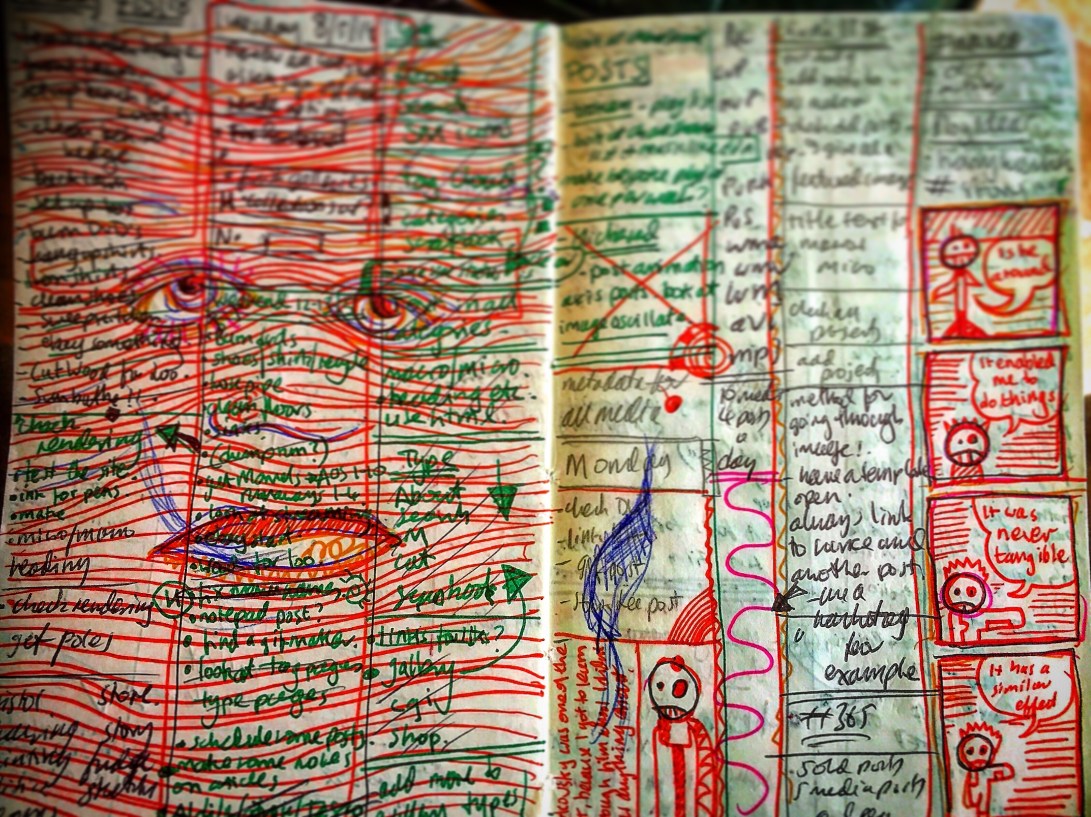
“Indeed, Dostoevsky was not content to “write” and “take notes” in the process of creative thinking, he moved in the space and time of the particular artistic universe of his notebook, where the meaning and significance of words interact reciprocally with other meanings expressed through visual images, a method of work specific to the writer.”
represent that key moment when the accumulated proto-novel crystallized into a text. Like many of us, Dostoevsky doodled hardest when the words came slowest.” Some of Dostoevsky’s character descriptions, argues scholar Konstantin Barsht, “are actually the descriptions of doodled portraits he kept reworking until they were right.”
“She exhibited with Mackintosh at the 1900 Vienna Secession, where she was an influence on the Secessionists Gustav Klimt and Josef Hoffmann. They continued to be popular in the Viennese art scene, both exhibiting at the Viennese International Art Exhibit in 1909.”
“Mackintosh did not keep sketchbooks, which reflects her reliance on imagination rather than on nature. A few sources provided significant inspiration for her works, including the Bible, the Odyssey, poems by Morris and Rossetti, and the works of Maurice Maeterlinck. Her works, along with those works of her often collaborating sister, defied her contemporaries’ conceptions of art. Gleeson White wrote, “With a delightfully innocent air these two sisters disclaim any attempt to acknowledge that Egyptian decoration has interested them specially. ‘We have no basis.’ Nor do they advance any theory.” The beginning of her artistic career reflects broad strokes of experimentation. Largely drawing from her imagination, she reinterpreted traditional themes, allegories, and symbols in inventive ways. For instance, immediately following the 1896 opening of her Glasgow studio with her sister, she transformed broad ideas such as “Time” and “Summer” into highly stylized human forms. Many of her works incorporate muted natural tones, elongated nude human forms, and a subtle interplay between geometric and natural motifs. Above all, her designs demonstrated a type of originality that distinguishes her from other artists of her time.”


 Paul Greer