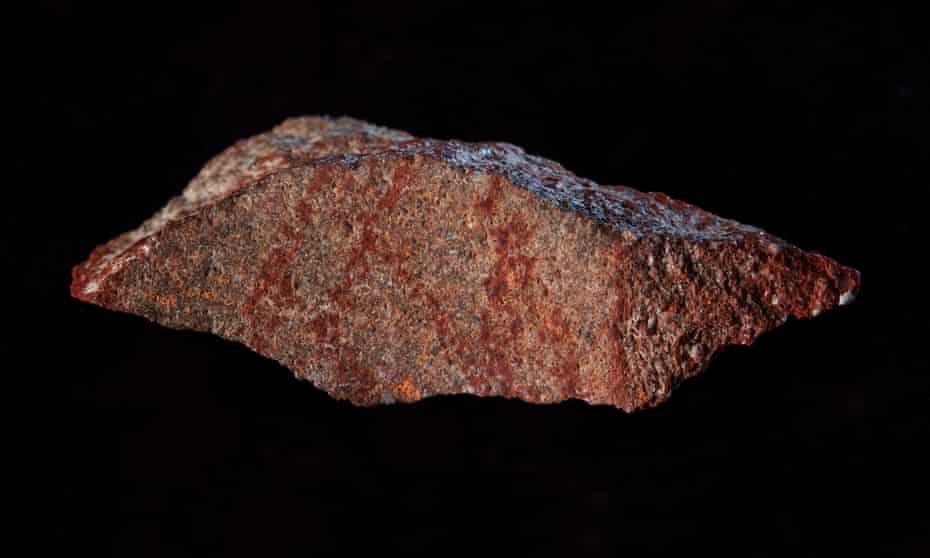
Earliest known drawing found on rock in South African cave

Researchers believe the pattern on the fragment of rock is 73,000 years old, but are perplexed as to what it might represent

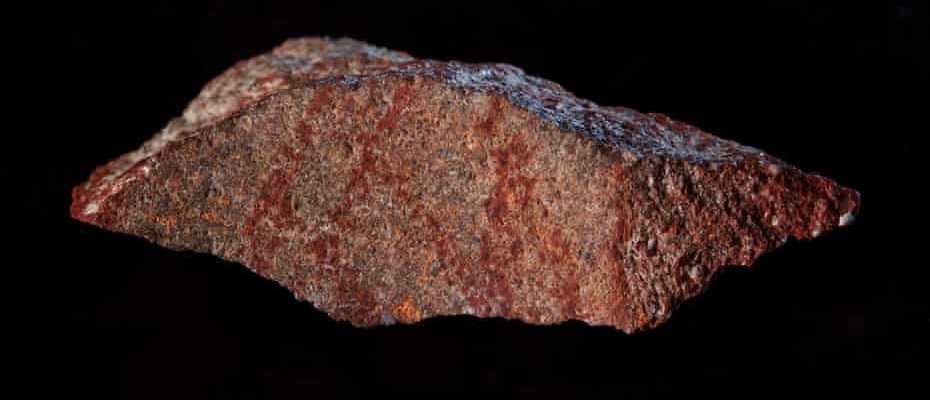
“Archaeologists found the marked stone fragment as they sifted through spear points and other material excavated at Blombos cave in South Africa. It has taken seven years of tests to conclude that a human made the lines with an ochre crayon 73,000 years ago.

“The simple red marks adorn a flake the size of two thumbnails which appears to have broken off a grindstone cobble used to turn lumps of ochre into paint powder. The lines end so abruptly at the fragment’s edges that researchers believe the cross-hatches were originally part of a larger design drawn on the cobble.

“This is first known drawing in human history,” said Francesco d’Errico, a researcher on the team at the University of Bordeaux. “What does it mean? I don’t know. What I do know is that what can look very abstract to us could mean something to the people in the traditional society who produced it.”

guardian

The Codex Rotundus

Great Post on the Codex Rotundus from Book Addiction UK:

Jessica's avatarBookAddiction

Codex Rotundus 3 fac

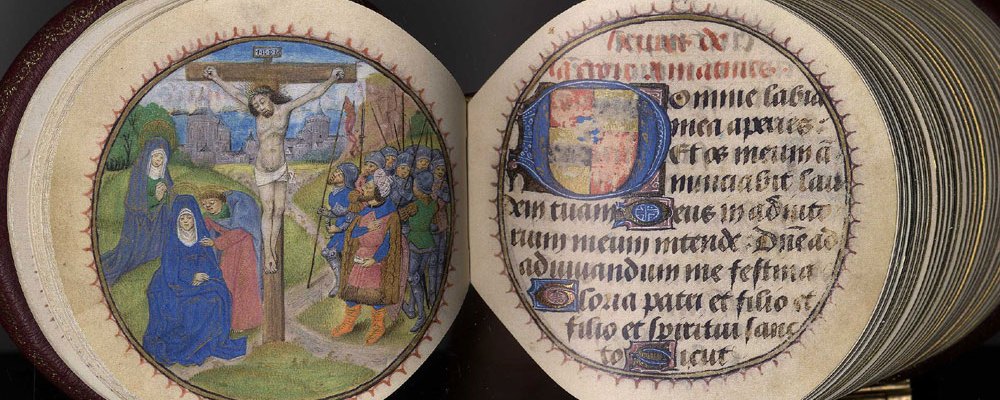
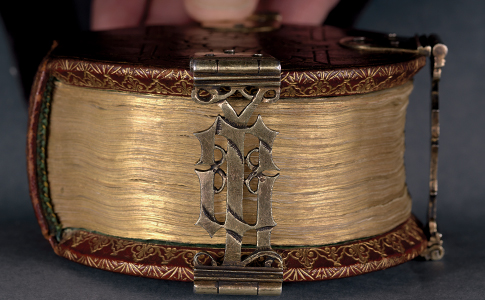
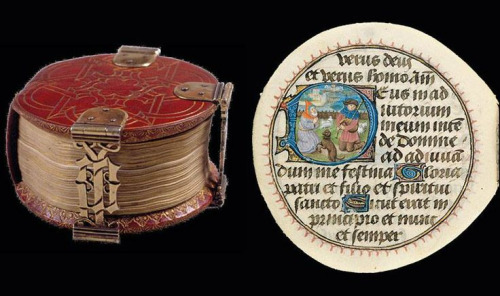
The manuscripts and codices which survive from the late 15th century are often large and lavish affairs and usually conform to certain norms in terms of shape. But this curious and unusual little gem, which takes its name ‘Codex Rotundus’ from its unique shape, measures just over 9 centimeters across and is circular.  Its 266 pages are bound along a spine just 3cm long, so small that three clasps are needed to help keep it closed.  Thought to have been rebound in the 17th century, the original clasps which help hold the tiny codex together, were reused. As so many of the manuscripts from this period, it is a devotional text -a lavishly illuminated Book of Hours in Latin and French.

Codex Rotundus 1 fac

Remnants of a coat of arms, which a subsequent owner appears seems to have tried to obliterate, in the first initial ‘D’ suggests that it was created for Adolf of Cleves…

View original post 253 more words

Project Ethel (27.05.14 – 07.01.16): Pages 18-26

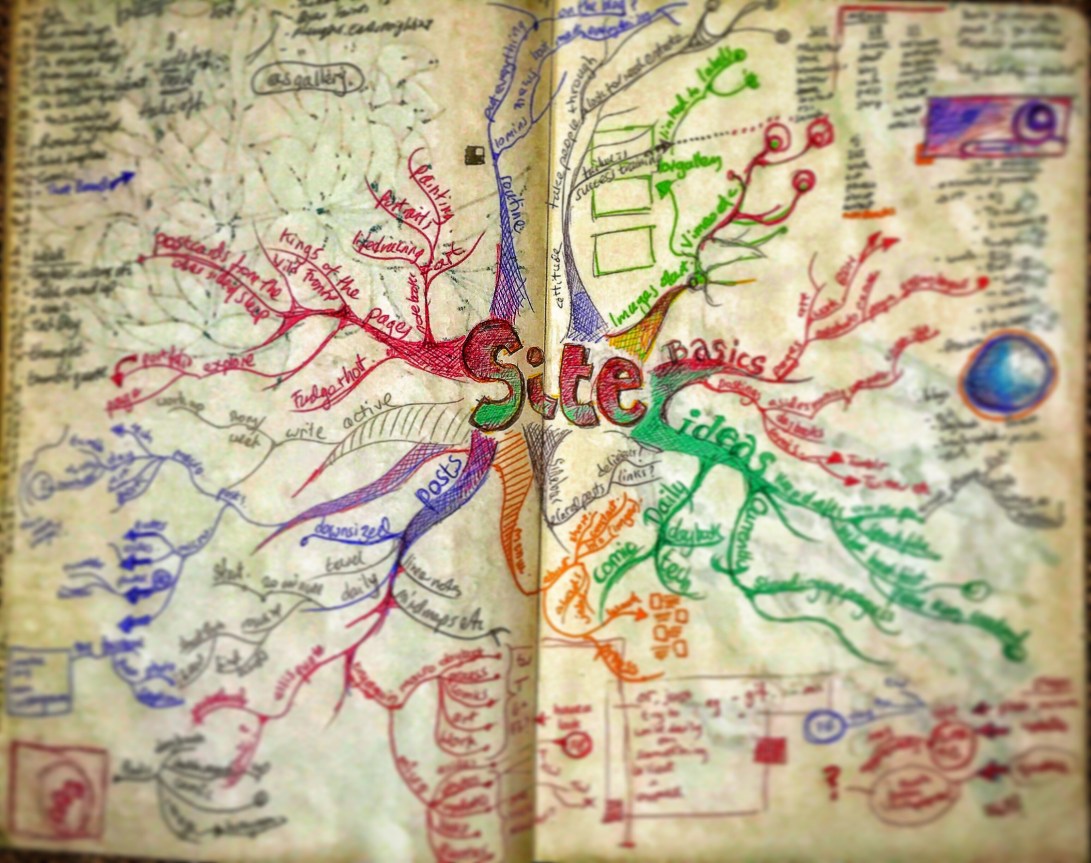
Notebook Ethel, Spread Eighteen. Me trying to mind map and plan my website. You can see the ongoing result at the #linkinbio. A work of art is never finished, apparently. 🕷 📓 🗺
Notebook Ethel, Spread Eighteen. Me trying to mind map and plan my website. You can see the ongoing result. A work of art is never finished, apparently. 🕷 📓 🗺
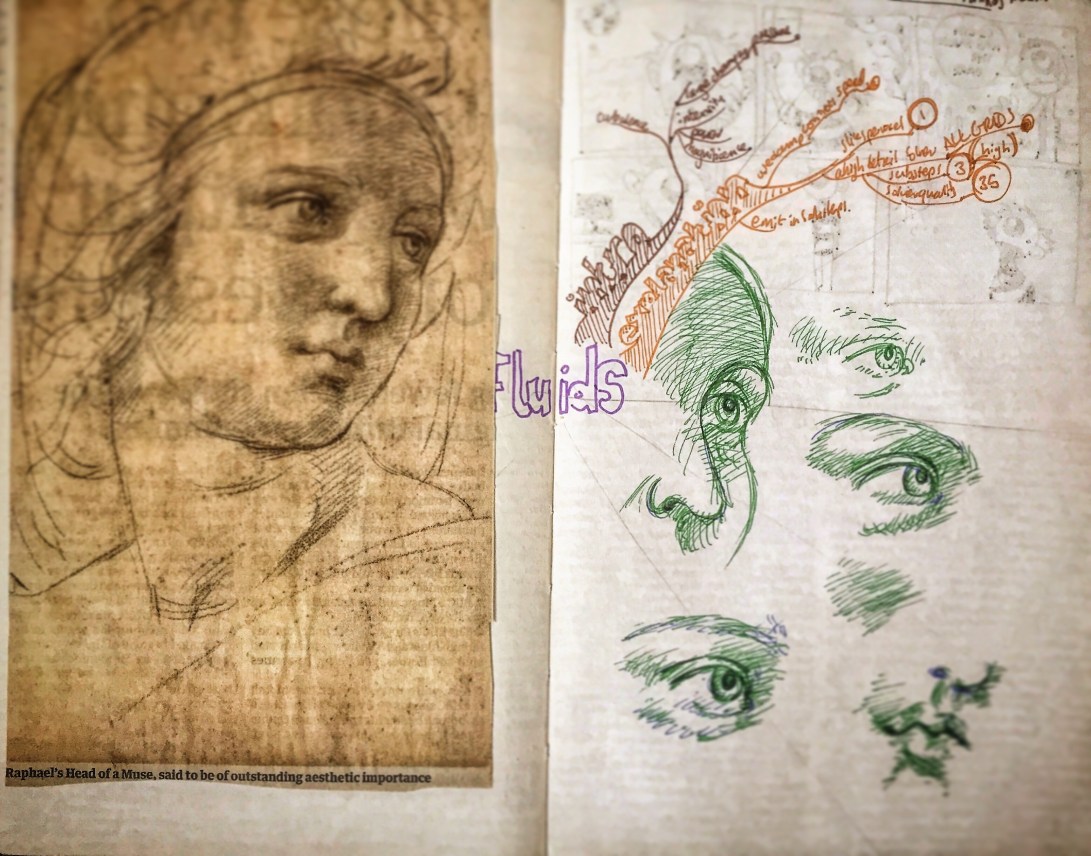
Notebook Ethel, Spread Eighteen. Newspaper clipping of Raphael’s Head of a Muse, some copying of that image and the beginnings of a mind map on fluid dynamics. 👁 📓 🗺
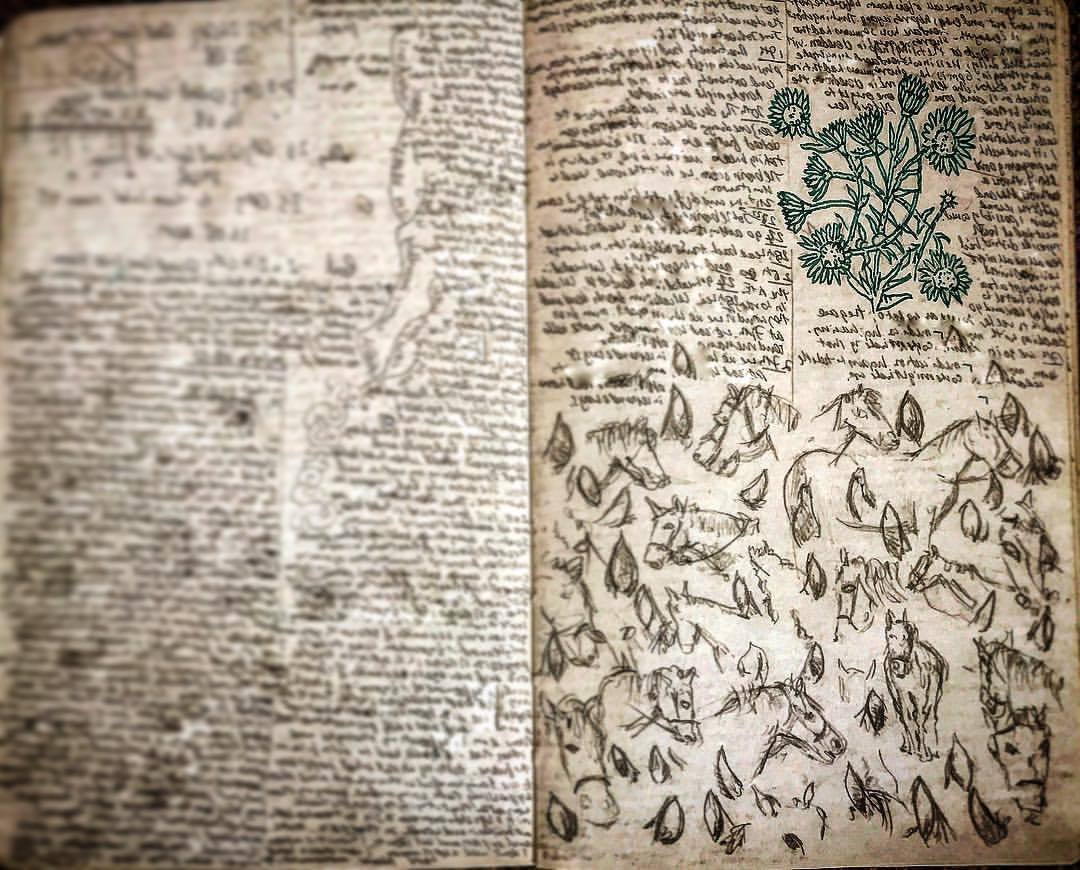
burningfpNotebook Ethel, Spread Nineteen. Horse drawings, daises, diary notes (text obscured). 📓 🐴 🌷
Notebook Ethel, Spread Nineteen. Horse drawings, daises, diary notes (text obscured). 📓 🐴 🌷
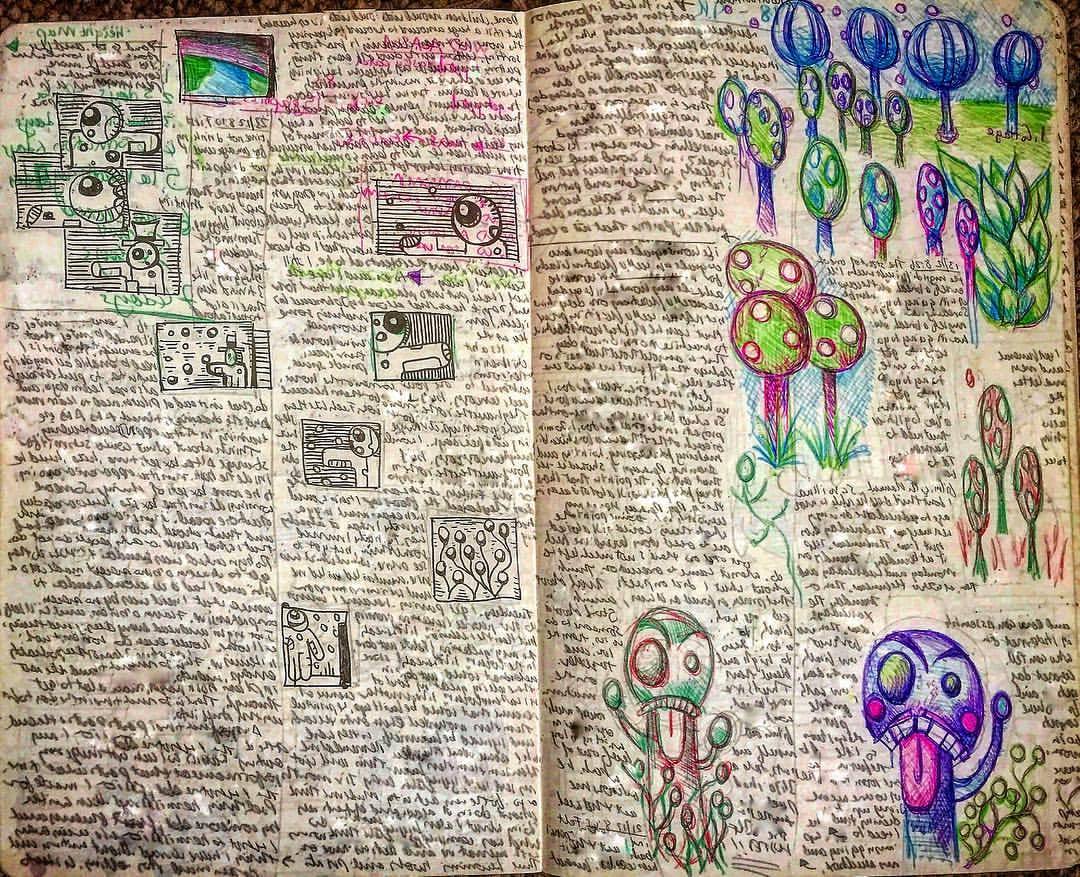
Notebook Ethel, Spread Twenty. Morning Pages writing exercise and drawing my comic book character Fudge (see more of him at #linkinbio). 🌳 👹 ✍️
Notebook Ethel, Spread Twenty. Morning Pages writing exercise and drawing my comic book character Fudge. 🌳 👹 ✍
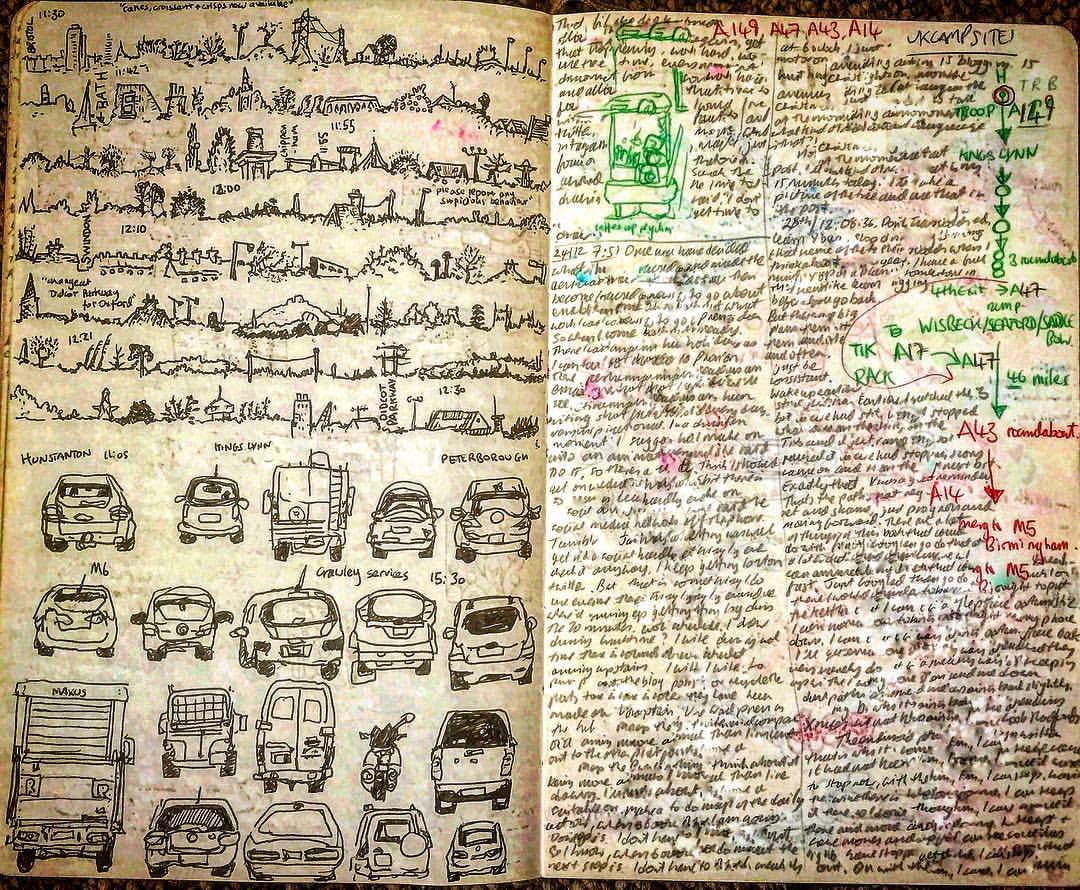
Notebook Ethel, Spread Twenty-One. Documenting a two day journey from the West to the East and back again (full story at #linkinbio). Drawing from the window of a train, cars in traffic, route plan and garbage writing. 🚗 ✍️ 🚂
Notebook Ethel, Spread Twenty-One. Documenting a two day journey from the West to the East and back again. Drawing from the window of a train, cars in traffic, route plan and garbage writing. 🚗 ✍ 🚂
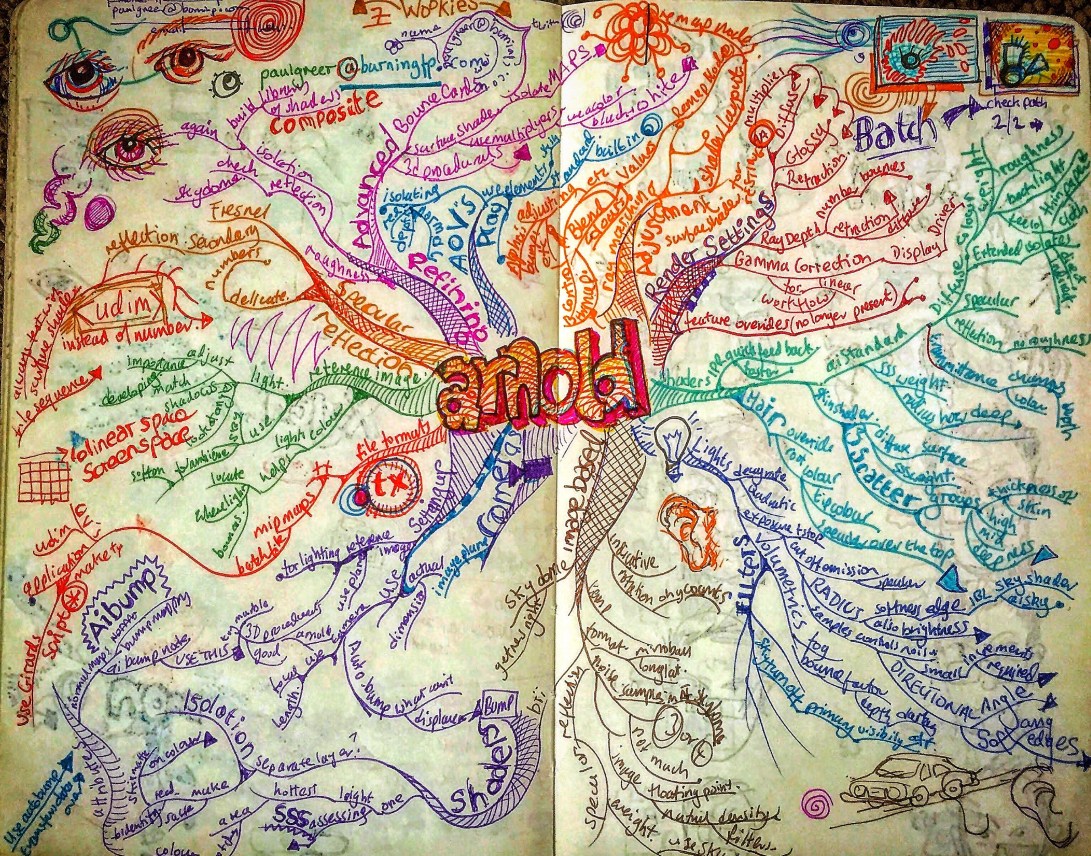
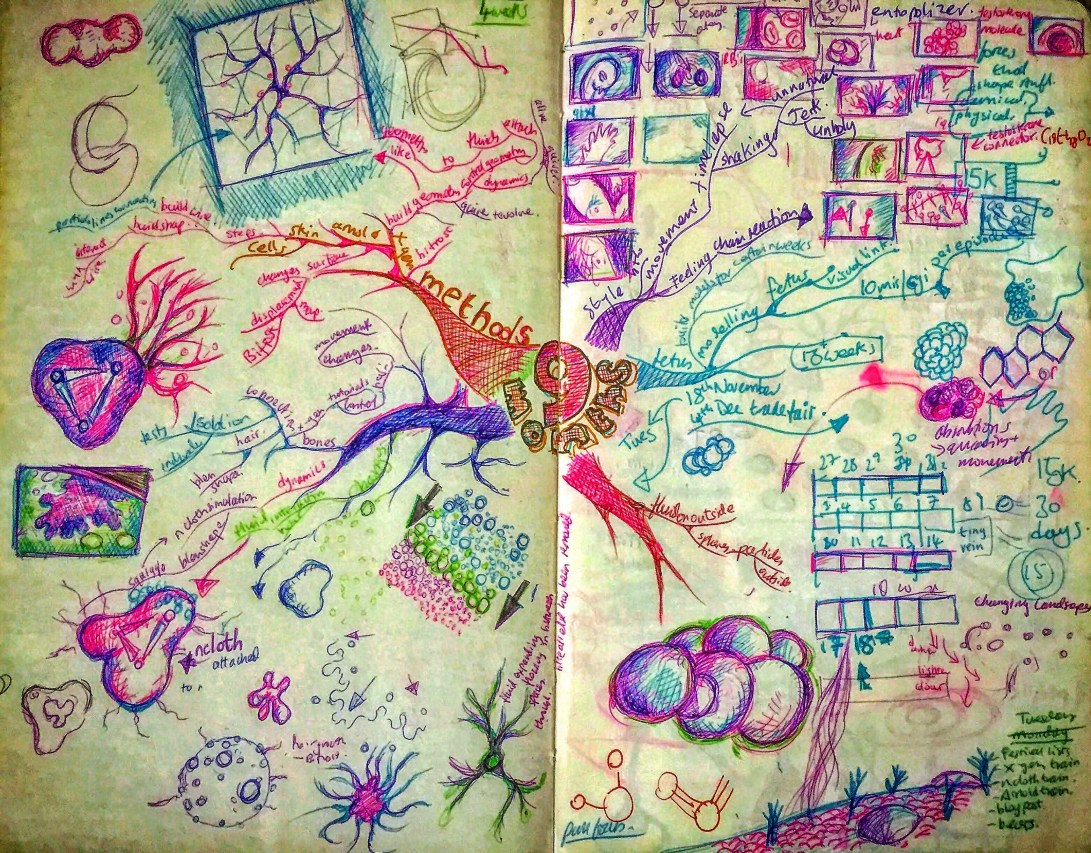
Notebook Ethel, Spread Twenty-Two. Mind map getting to grips with some serious understanding of the render engine #Arnold, soon after we began using it. Also eye doodles. 🕷 👁 🗺
Notebook Ethel, Spread Twenty-Two. Mind map getting to grips with some serious understanding of the render engine Arnold, soon after we began using it. Also eye doodles. 🕷 👁 🗺
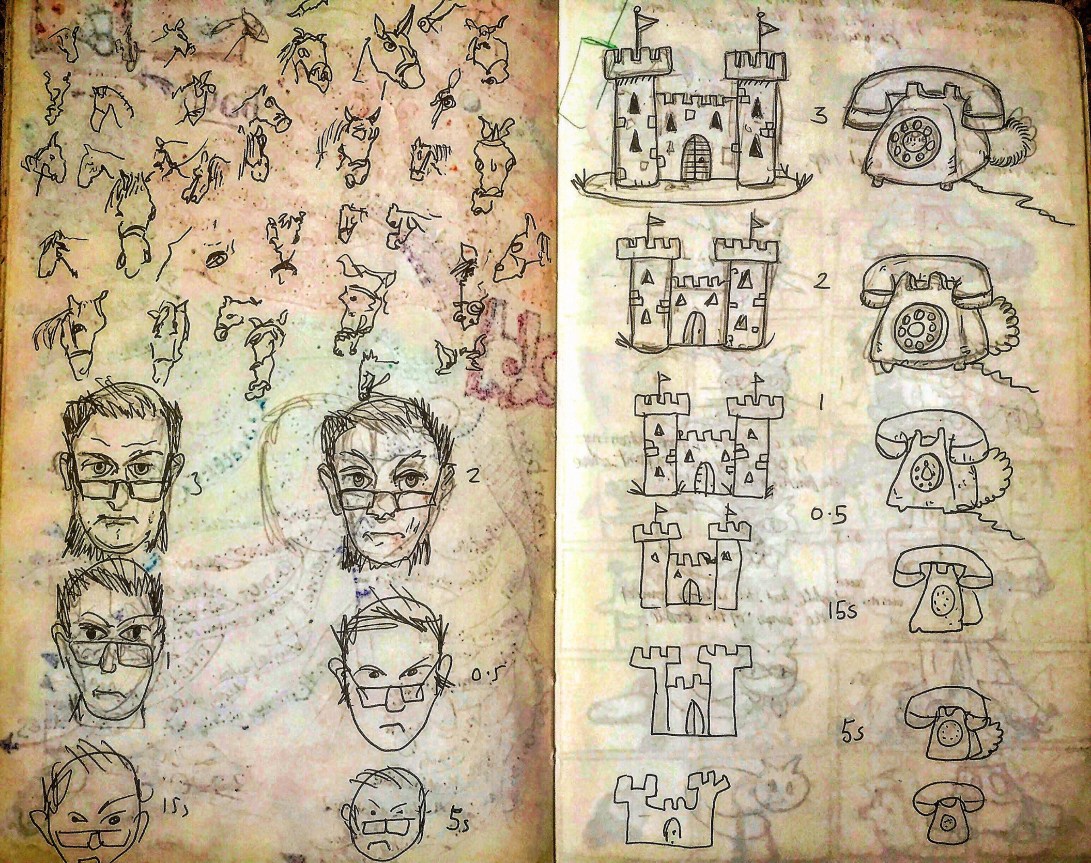
Notebook Ethel, Spread Twenty- Three. More horses, and my attempt at the Ivan Brunetti drawing exercise in his “Cartooning: Philosophy and Practice”, it goes: “Using your sketchbook and a pencil or pen of your choice, spend 3-4 minutes drawing a car. Then, start over and draw it in 2 minutes. Then 1 minute. Then 30 seconds. Then 15 seconds. And then 5 seconds. Draw faster at each step-that is, draw the entire car within the time limit. Repeat this same process for four other subjects: a cat, a castle, a telephone, and self-portrait.” ✍️📓 📞
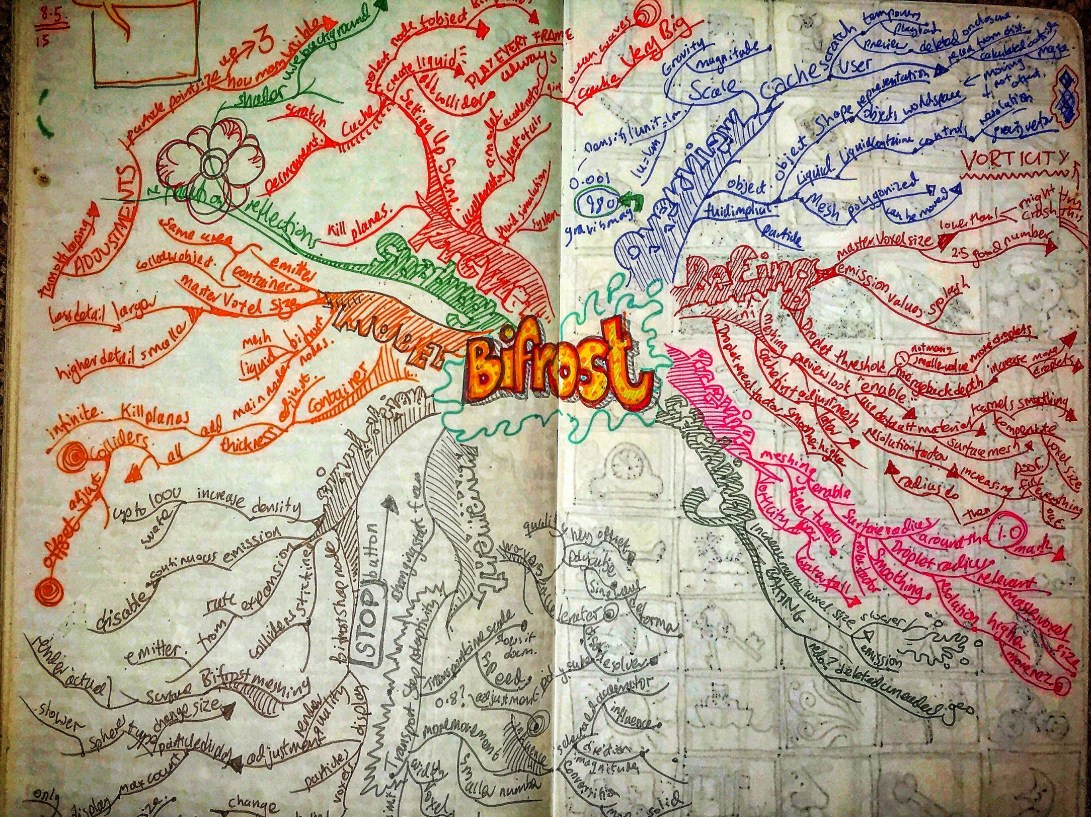
Notebook Ethel, Spread Twenty-Four. Mind map on the Autodesk Maya Bifrost system, dynamic and fluid simulation software. 🌊 🖥 🕷
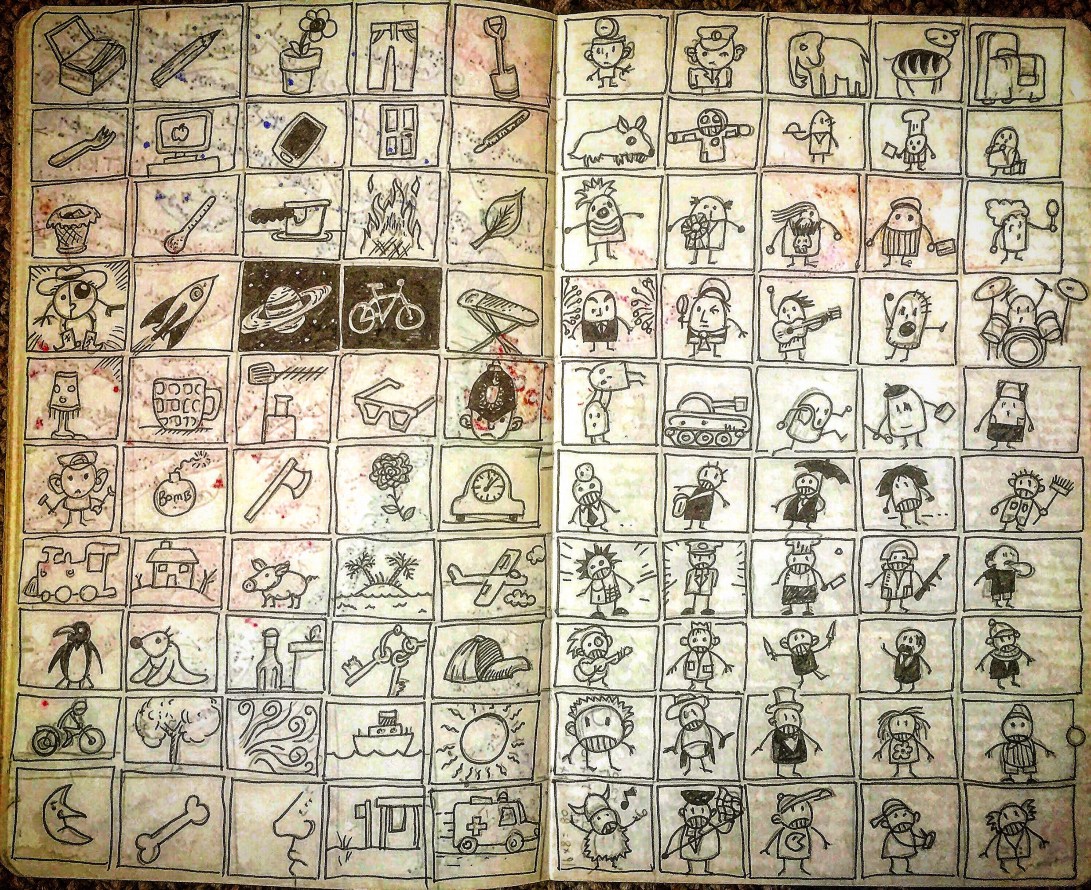
Notebook Ethel, Spread Twenty-Five. Another Ivan Brunetti exercise from “Cartooning: philosophy and practice”: “Pencil out a grid in your notebook, enough to contain 100 small drawings.now spending no more than 5 seconds per drawing, let your stream of consciousness guide you, drawing whatever comes to mind (don’t stop to think about it).” I went back and inked them after. 📓✍️🖼
Notebook Ethel, Spread Twenty-Six. Mind mapping notes for the content graphics of Countdown To Life. Ideas, concepts, storyboards, techniques. 📓 🕷 💓

Project Ethel (27.05.14 – 07.01.16): Pages 9-17

Continuing the project of uploading most pages form Notebook Ethel. As I said before these are from a few years ago now.

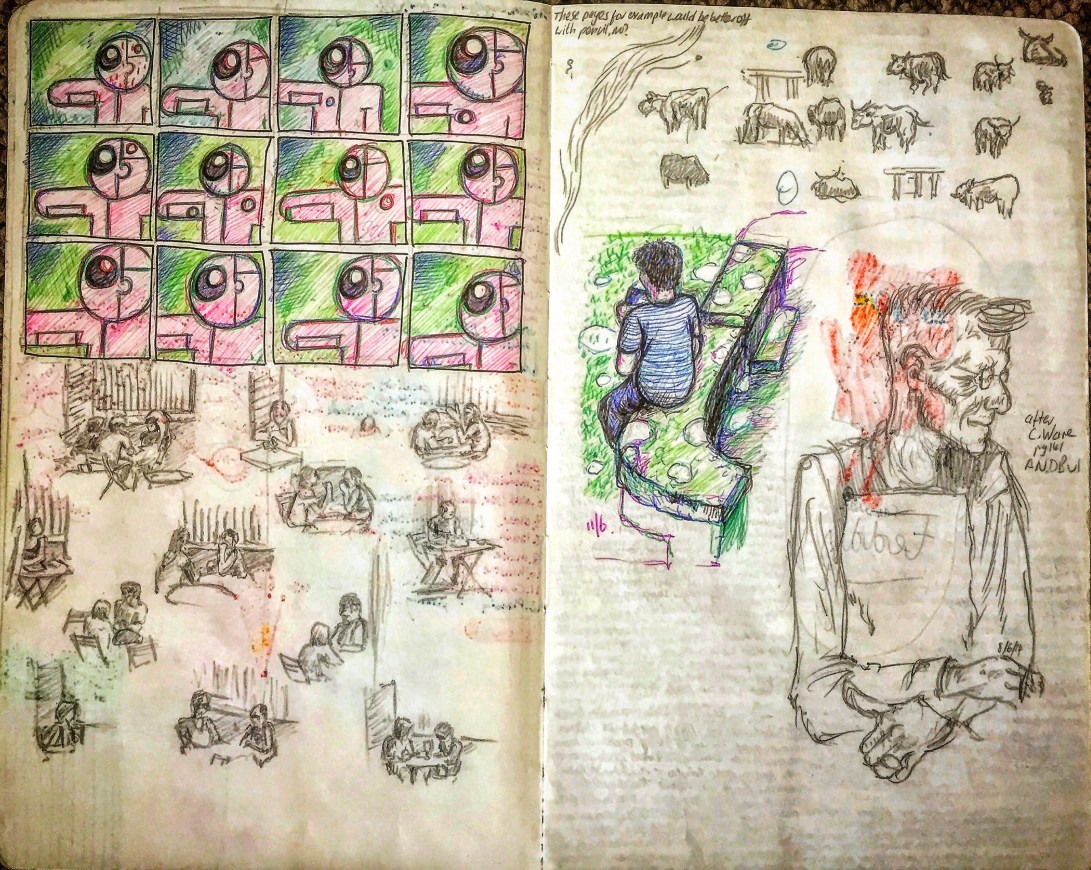
Notebook Ethel: Spread 9. Weird comic strip, drawings of the diners at the cafe over the road, dude eating his sandwich on the wall outside, some cows and a copying of a drawing of an old man by Chris Ware taken from his Acme Novelty Datebook Sketchbook facsimile book thing.
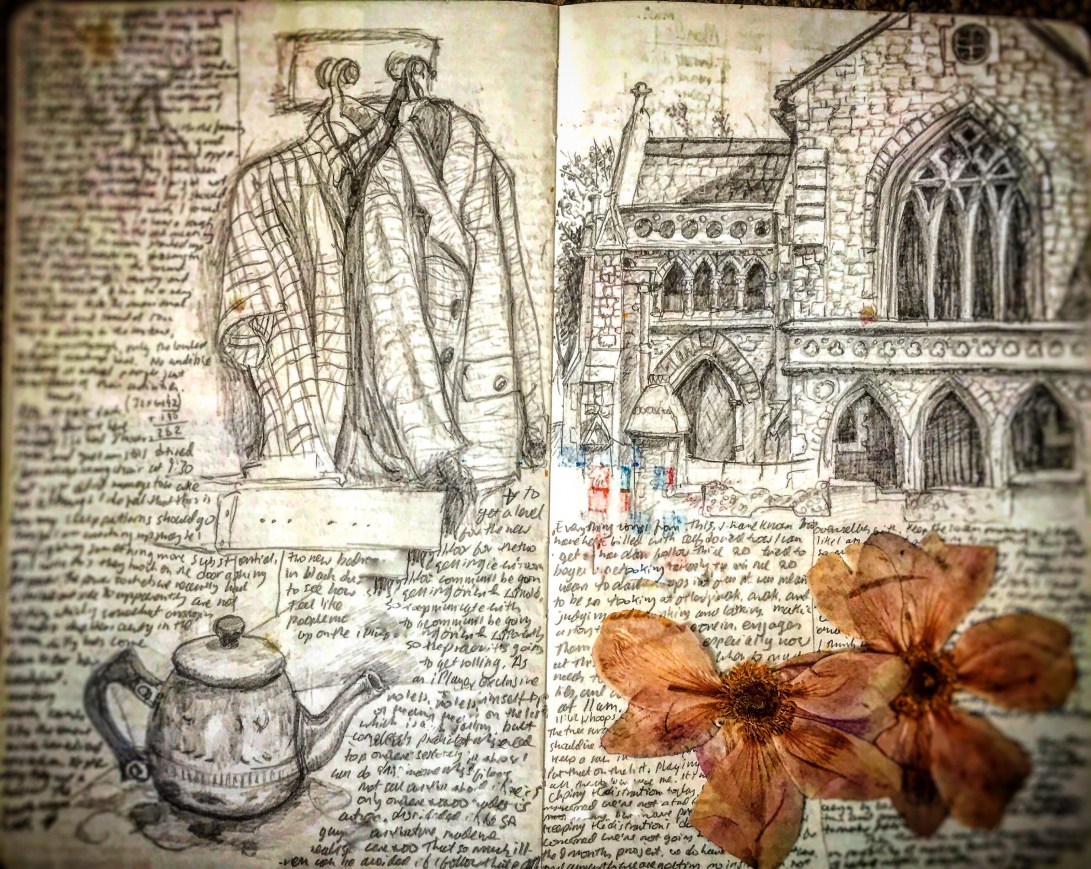
Notebook Ethel: Spread 10. Office coats, vintage teapot, Tyndales Baptist Church, pressed flowers and garbage writing. 📓 ✏ 💐
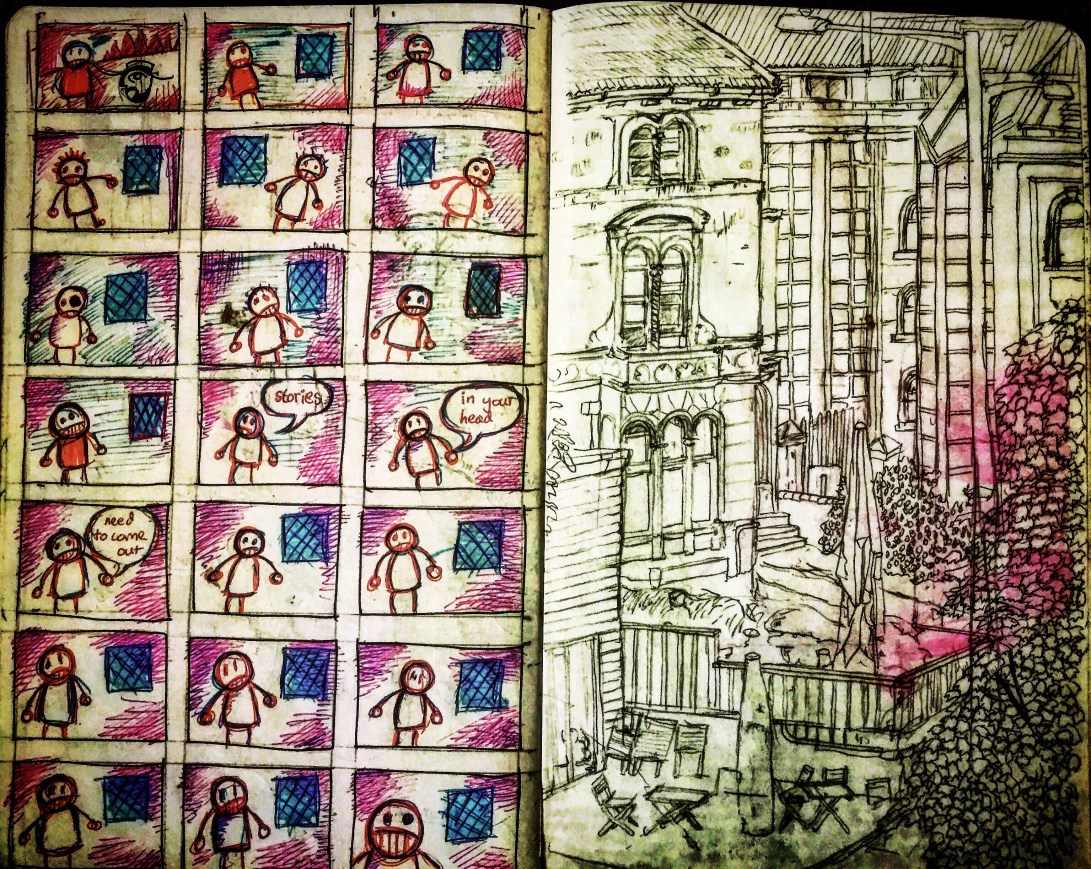
Notebook Ethel Spread: 12. Incoherent comics strip and the view across Whiteladies Road from the window at BDH. ✒📓🏢
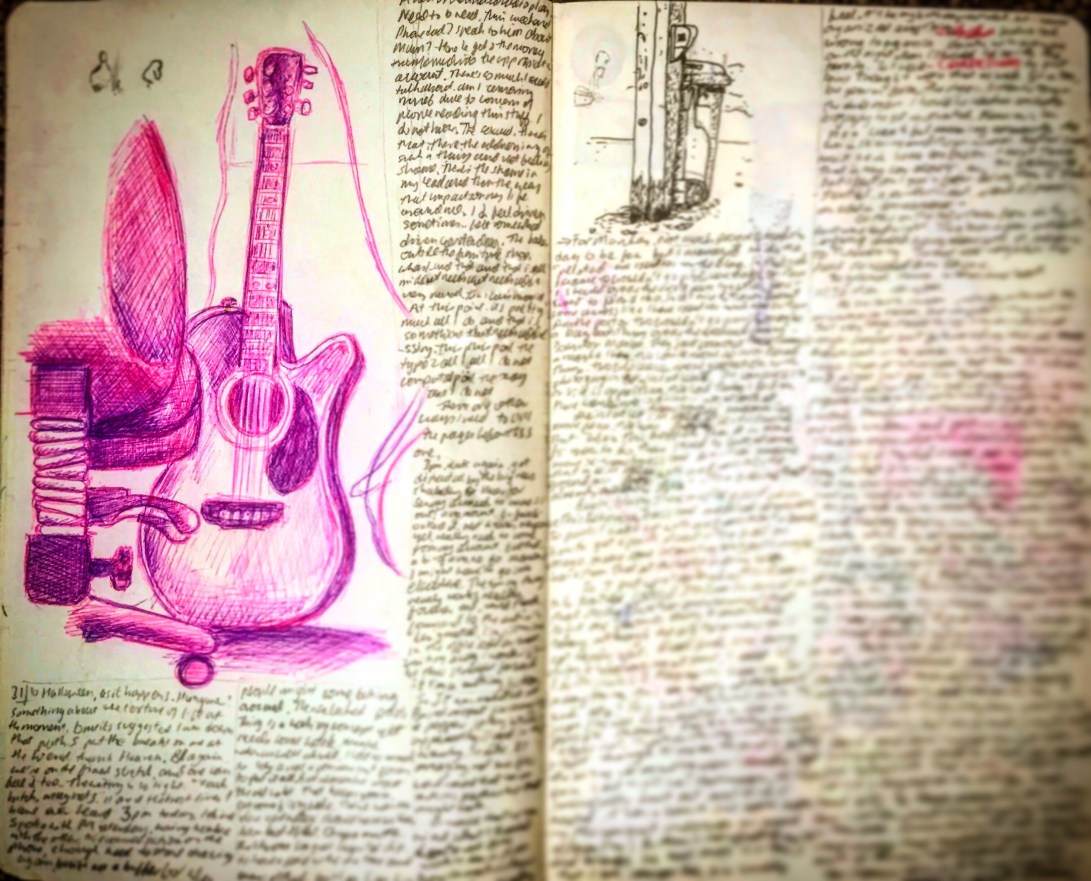
Notebook Ethel, Spread Thirteen. Garbage writing, guitar in the workplace, refuse container. 🎸📓✒
Notebook Ethel, Spread Fourteen. Satellite data coordinates, designing polygon construction, internal combustion engine visualisation, missing render frame numbers, Titan storyboard. 🔨 📓 🎨
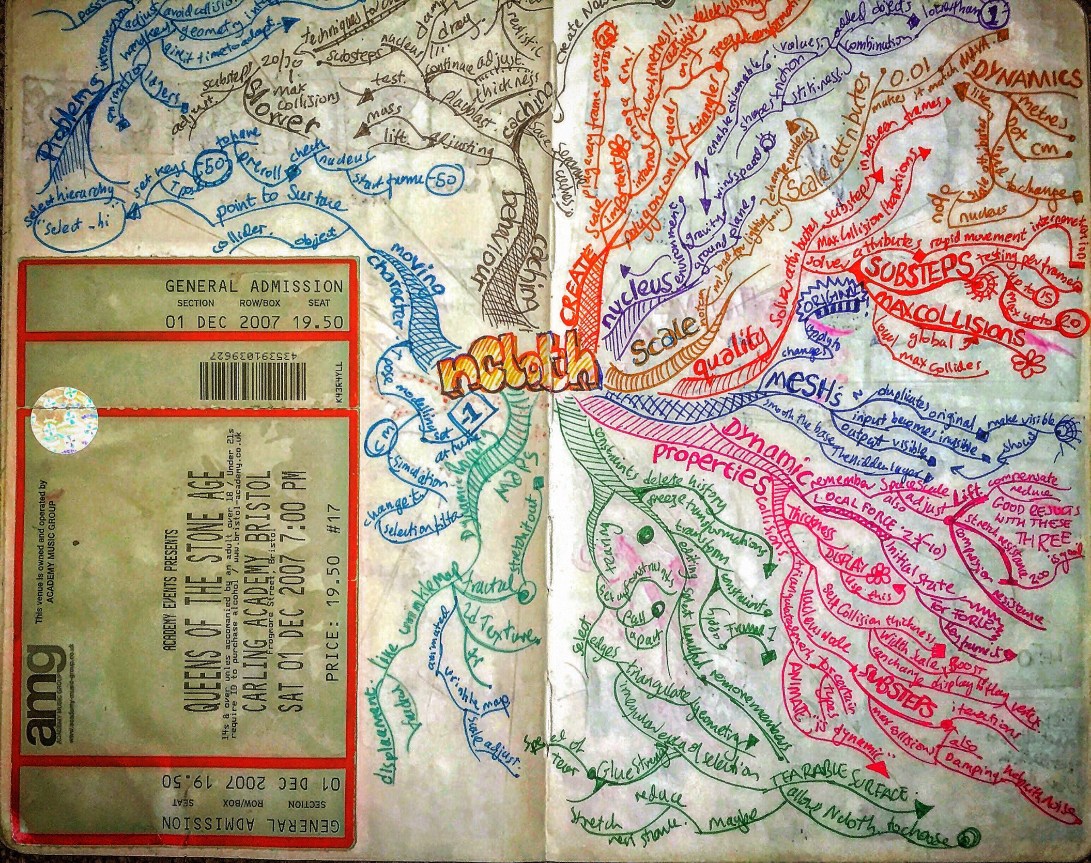
Notebook Ethel, Spread Fifteen. Mind map of the nCloth gynamics system in Maya. Also very old QOTSA concert ticket I found in a shoe box. 🗺 📓 🎸
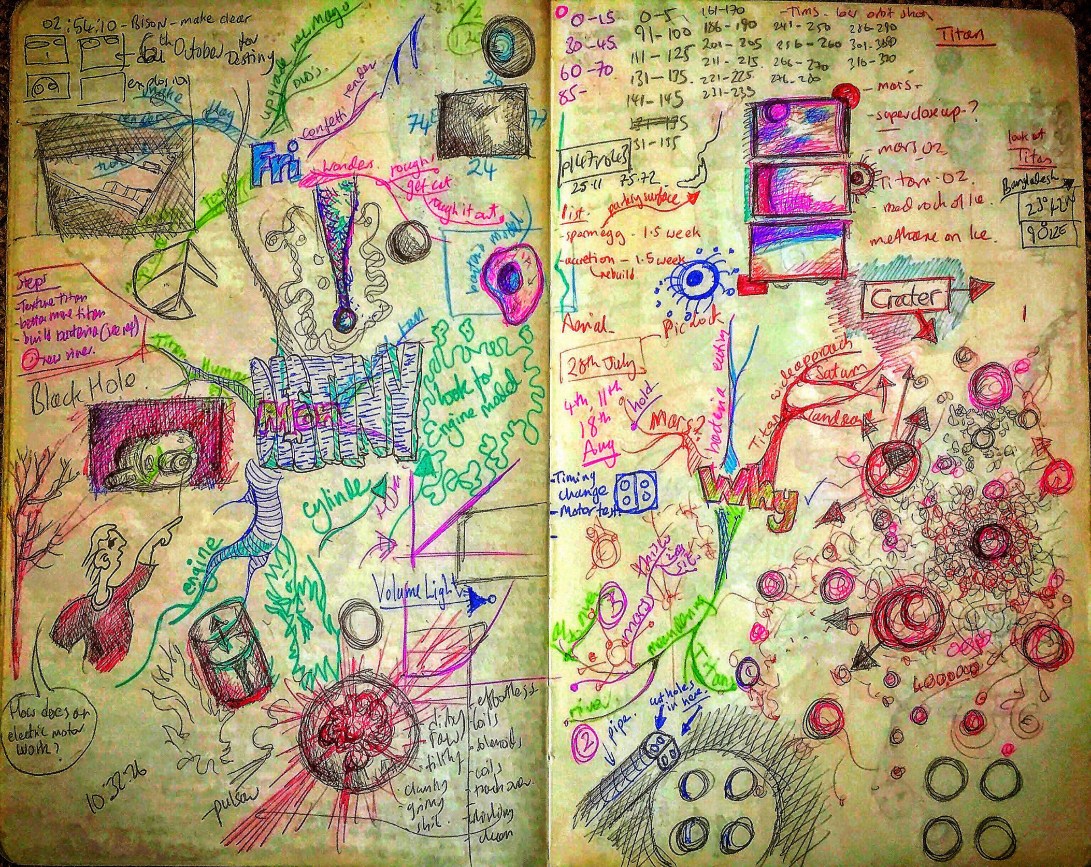
Notebook: Ethel, Spread Sixteen. Mind map for Forces Of Nature, episode “Where”, visualisation of the launch of the Planck rocket, Titan, storyboard, eyeflower comic, timings. 📓 🚀 🌎
Notebook: Ethel, Spread Seventeen. Drawing of injured foot (this is from a while ago), Wacom pen and garbage writing. ✍ 📓 👞

“The Amphitheater of Eternal Knowledge,” Hamburg, 1595.


“The Amphitheater of Eternal Knowledge,” Hamburg, 1595.


“The Amphitheater of Eternal Knowledge,” Hamburg, 1595.


“The Amphitheater of Eternal Knowledge,” Hamburg, 1595.


“The Amphitheater of Eternal Knowledge,” Hamburg, 1595.

“The images, in other words, invite the viewer to engage in a meditation on the nature of the universe and on the links between the earthly and the divine, the corporeal and the spiritual. Of course, such a statement would be equally true of many other instances of early modern alchemical and Hermetic symbolism. I suspect that a lot of the meaning in these images and the text that accompanies them has actually been lost, due to the fact that alchemical practice depended upon face-to-face interactions (like the one between John Dee and Khunrath) which were never recorded. And this was precisely what was intended – the true secrets of early modern alchemy were intended for a small number of the “elect” and were elaborately concealed in complex and often inscrutable language when they were allowed into printed works.”

Benjamin Breen

see more on his excellent blog post.

Notes, writing, diagrams, and index symbols by Walter Benjamin


Walter Benjamin notes


Walter Benjamin notes


Walter Benjamin notes


Walter Benjamin notes


Walter Benjamin notes


Walter Benjamin notes


Walter Benjamin notes


Walter Benjamin notes


Walter Benjamin notes


Walter Benjamin notes

(source)

reblogging austinkleon:

Alan Wall’s reflections on Benjamin:

“Of all writers Benjamin was the most aware of the technologies that made writing possible. Although there had been ‘reservoir pens’ of one sort or another for centuries, the nineteenth century delivered the first true fountain pens (and a little later ball-point pens). These eliminated the need for the nib to be kept in close proximity to an inkpot, thus making the activity of writing more itinerant. And Benjamin was certainly an itinerant writer, writing in apartments, libraries, cafes and bars. He carried his pens and his notebooks around, as he often did copies of some of the images that most engaged him. He was a mobile intelligence unit moving through the streets of a city. ”

On his notation system for The Arcades Project:

“[Benjamin] attempted “to integrate the principle of the montage as an epistemological technique.” Color charts, schemata, and diagrams act as guiding principles to navigate the thicket of excerpts and quotations. Benjamin’s personal color-coding shows an attempt to make order within the vast constellation of his own notes—a tension between an impulse toward structure and the potential of the open field of his interests.”

Paul Thek: Notebooks

Thek [was] an avid keeper of journals, producing over a hundred between 1969 and 1980. Complex and varied, the journals form an intimate and often intense portrait of an energetic mind. Most are written in ordinary school notebooks, with routine accounts of Thek’s days punctuated by emotionally raw passages of self-reflection, analysis of his closest (and, at times, most troubled) personal relationships, and as time progressed, evidence of a growing paranoia. In perfect script, he copied page after page of writings that he admired by Saint Augustine, Ananda K. Coomaraswamy, William Blake, and others. Copying was clearly a meditation for him, a spiritual exercise and, as such, an antidote to anxiety and to what he knew was his own pettiness and anger. But the journals are full of moments of joyful exuberance and artistic bravura as well: celebrations of sex, silly word games, and a range of visual expression, from simple marks and comic sketches to intimate, exquisite watercolors of the sea.”

Adriaen Coenen’s Fish Book (1580)


Adriaen Coenen’s Fish Book (1580)


Adriaen Coenen’s Fish Book (1580)


Adriaen Coenen’s Fish Book (1580)


Adriaen Coenen’s Fish Book (1580)


Adriaen Coenen’s Fish Book (1580)

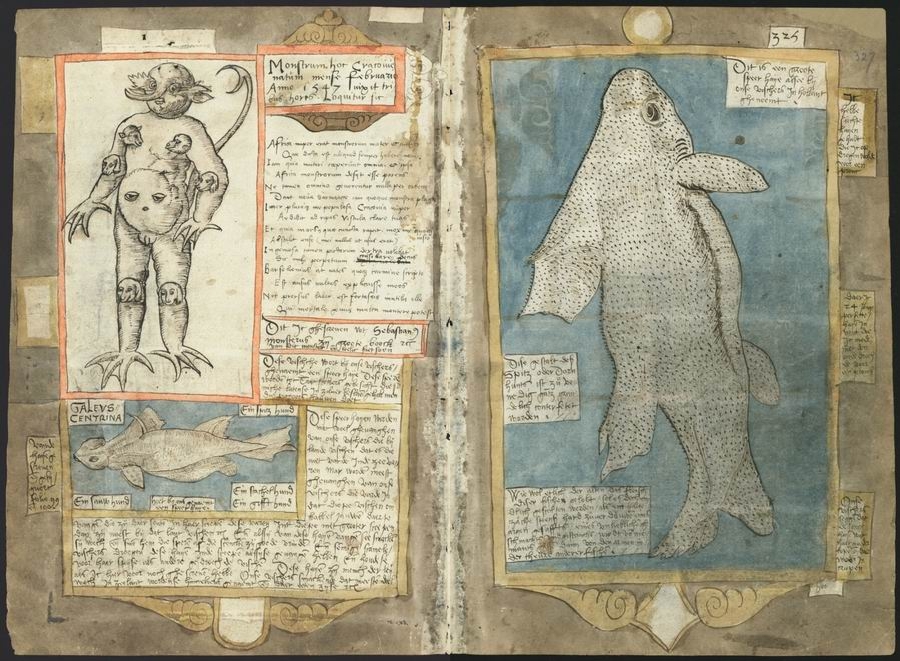
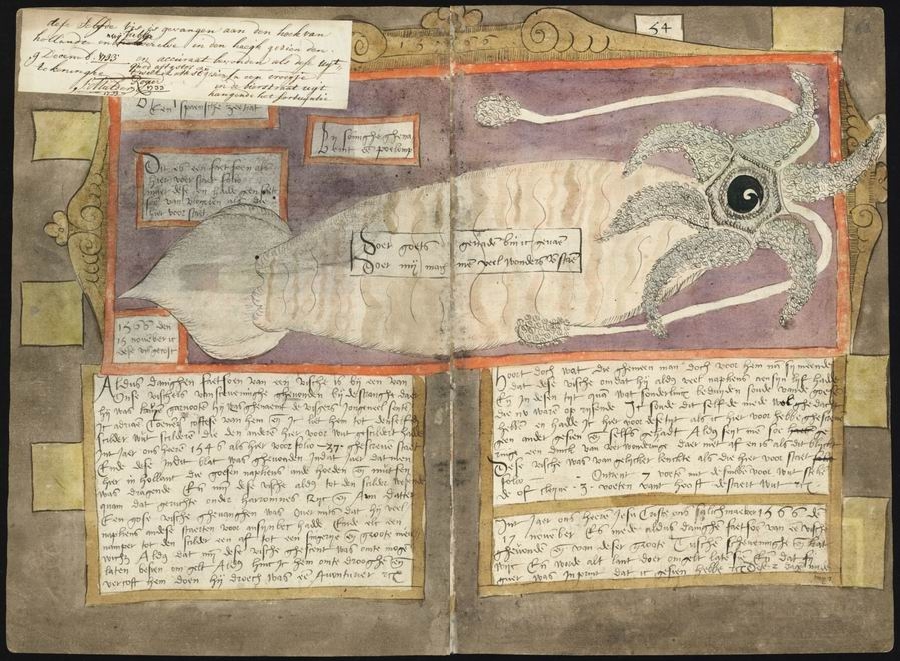
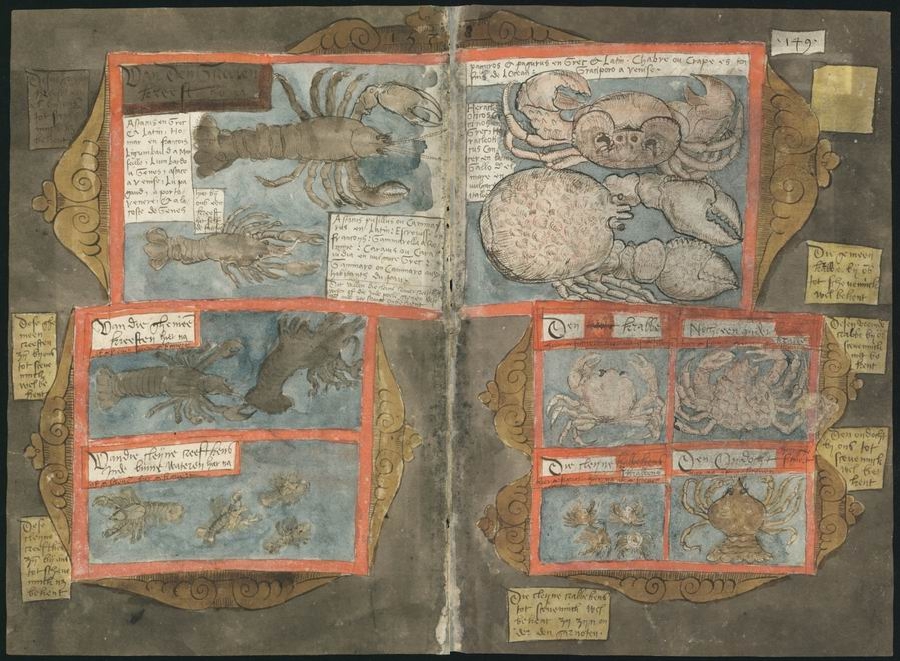
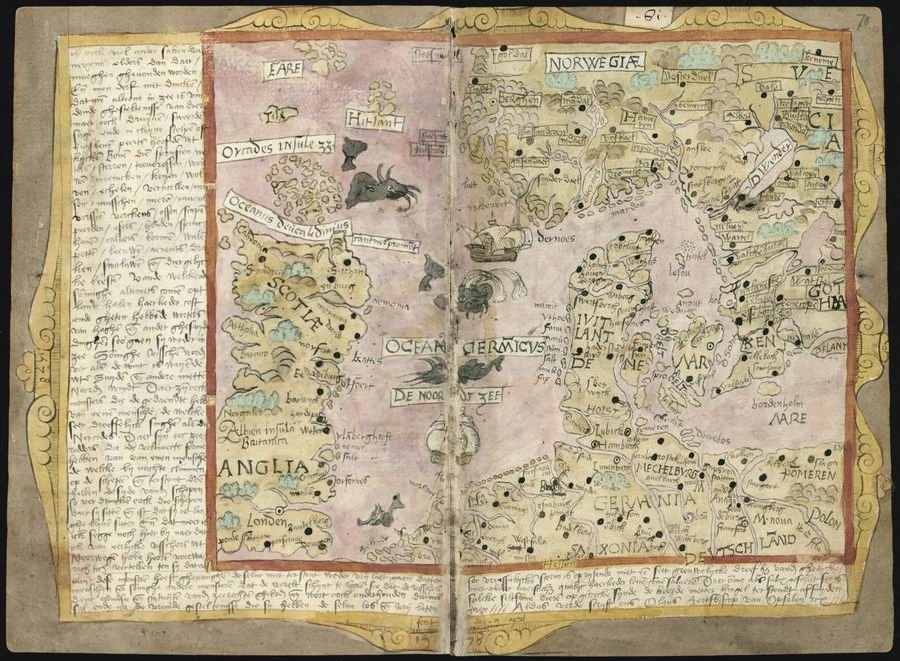
“Selected double-page spreads from Adriaen Coenen’s Visboek (Fish Book), an epic 800+ page tome on all things fish and fish-related. Coenen began work on this unique book in 1577, at the age of 63, and in three years gathered an unprecedented amount of information on the sea and its coasts, coastal waters, fishing grounds and marine animals. The information was largely gathered in the course of Coenen’s daily work in the Dutch sea-side village of Scheveningen as a fisherman and fish auctioneer and, later on, as wreck master of Holland (allowing him access to every strange creature that washed ashore). Coenen was also a well respected authority in academic circles and used this reputation to receive learned works on the sea from The Hague and Leiden, copied extracts from which find their way into his Fish Book.”

Public Domain Review