I dated this because there probably’ll be more than one.
There was a recent rescreening of 1978 interview.
This on writing his first play
I wrote that play totally without calculation. In other words, I started at the top and at a certain point There was a knock at the door and someone came in, and I had absolutely no idea who he was, who he might be, what he might say, and I let it run. I let it happen, and found that he did have a voice, that he was the Landlord, in fact. That was the first chapter.
The two visitors arrived, and I didn’t know what they were on about really, or what they wanted. They were just part of the whole atmosphere.
This on starting:
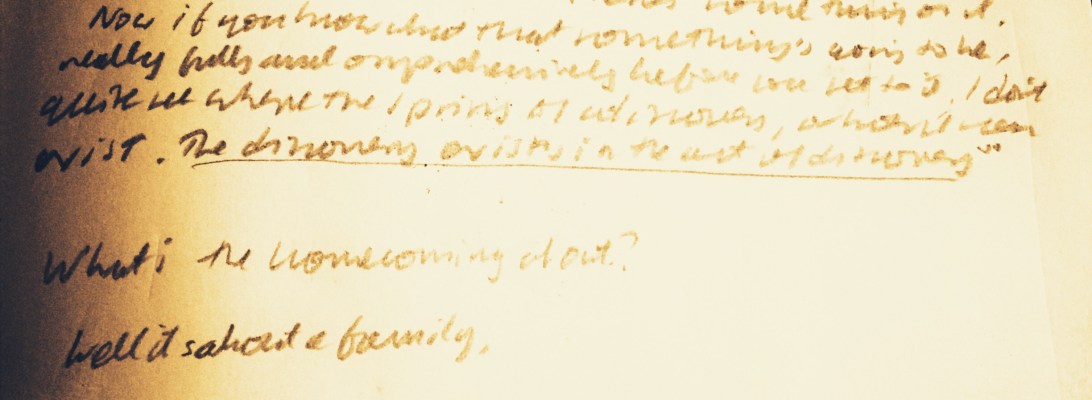
It remains the essential joy of writing, I think. You’ve got a blank page, one moment, there’s nothing on it, and the next moment there’s something on it.
Now if you know what that something’s going to be, really, fully and comprehensively before you get to it, I don’t quite see where the spring of discovery can exist.
The discovery exists in the act of discovery.

reblogging thebodyasconduit:
“”We abide by cultural directives that urge us: clarify each thought, each experience, so you can cull from them their single dominant meaning and, in the process, become a responsible adult who knows what he or she thinks.
“But what I try to show is the opposite: how at every moment, the world presents us with a composition in which a multitude of meanings and realities are available, and you are able to swim, lucid and self-contained, in that turbulent sea of multiplicity.”
Richard Foreman
*
Collaborative Self-Contained-Self-Portrait in That Sea of Multiplicity
2015
film”

Amongst the methonal fumes, corduroy flares and taste of cresta in the pre-star wars seventies there was relatively little of the fantastic to occupy the day dreaming mind of the under 10s. There was occasional Saturday morning Godzilla, there was Flash Gordon and various other assorted grand ideas fitting into a budget.
Valley of Gwangi crashed into my world during this time. At Gran’s house, A creepy pre title, the very western theme music with crashing timpani (by Jerome Morross of Big Country (not that one that one), the promise of cowboys vs dinosaurs. A playfulness of genre unusual until the age when comic books finally took over cinema.
Gwangi was conceived by Willis O’Brien, prime animator of the original King Kong. It was Part of a set of ideas featuring Cowboys and monsters (including Mighty Joe Young and the xxxxx). O’Brien was unable to finish the project and handed it to his apprentice, Ray Harryhausen, who had by then completed many multi creature films which were mostly better t.
The Allosaurus in gwangi was fast moving, tail constantly curling, in a candid moment it scratched it’s nose. It was alive. Many books at that time were still telling us that dinosaurs were sluggish, slow moving cold blooded creatures. But Harryhuasen looked at them with the eye of an animator, seeing how they neeed to move. Consequently he was ahead of many paleantologists and he produced a level of dynamism unmatched until Speilberg got his hands in the Train Set 23 years later.
Showing my children a film such as this is a recipe for heartbreak. They’re raised on hi end 21st century cgi, it’s meaning is lost to them because they don’t get the history and it’s just too old. Sometimes it’s equally devastating revisiting a treasure of childhood, one sees the flaws not perceived at such a young age. Gwangi carries some of that, yet the magic still carries me away.
I had the privilege of meeting Harryhausen about twenty years ago. I managed to mumble about how much I loved the film and had gone through the lasso sequence frame by frame enough times to degrade a VHS. He smiled and told me the story of how they had taken a jeep with a pole, the stunt riders lassoed the pole and the jeep accelerated back and forth pulling the riders off the horses, and then by the “magic of cinema” (his words) they removed the pole and put Gwangi in. I nodded gratefully and crawled back under my stone.
As mentioned The Valley of Gwangi is being shown as an open air screening in Victoria Square, Bedminster, Bristol on August 8th as part of the Bristol Bad Film Club (wtf?) (oh wait, they apologise). I am unable to attend and have nothing but cold, hard envy for all of you who can.
“At the beginning of the twentieth century, Adolf Wölfli, a former farmhand and laborer, produced a monumental, 25,000-page illustrated narrative in Waldau, a mental asylum near Bern, Switzerland. Through a complex web of texts, drawings, collages and musical compositions, Wölfli constructed a new history of his childhood and a glorious future with its own personal mythology. The French Surrealist André Breton described his work as “one of the three or four most important oeuveres of the twentieth century”. Since 1975, our aim is to make Adolf Wölfli’s work known through one-man and group exhibitions as well as publications.”

“Wölfli’s first epic From the Cradle to the Grave runs over 2,970 pages of text and 752 illustrations bound by Wölfli into nine books. It takes the form of a travelogue whose principal hero is a boy called Doufi (a nickname for Adolf). Together with his family, Doufi travels all over the world which is, in the name of progress, duly explored and inventorised. In From the Cradle to the Grave, Wölfli transforms his miserable childhood into a glamorous story of wonderful adventures, discoveries and awesome hazards, all of which are famously overcome. The text, which mixes prose with poetry and extensive lists, is accompanied by colourful maps, portraits and illustrations of events such as combats, collapses and catastrophes. In these drawings one first encounters the form of the “Vögeli“ – a little bird which can be understood as the protector of the ubiquitous Wölfli’s alter ego and simultaneously as a sexual symbol filling in any potential empty space”

“Adolf Wölfli. From the Cradle to the Grave. Bedlam=Walking Wheel, Provisional Map of Both the Kingdom of Spain and Portugal, Dromedary Indian and Vosel Stubborn Donkey Mask, Lea Tantaria, Condor Eggs, Hall of Blacks, London South, Map of the Two Principalities Sonoricije and the West Bzimbzabazaru, Helvetic Cathedral in Northern Amazonian Hall, Atlantic Ocean Waves and Přístaf Cradle Lisbon (top to bottom). 1912.”

“Wölfli’s imaginary autobiography and one-person utopia starts with „From the Cradle to the Grave“ (1908-1912). In 3,000 pages, Wölfli turns his dramatic and miserable childhood into a magnificent travelog. He relates how as a child named Doufi, he traveled „more or less around the entire world,“ accompanied by the „Swiss Hunters and Nature Explorers Taveling Society.“ The narrative is lavishly illustrated with drawings of fictitious maps, portraits, palaces, cellars, churches, kings, queens, snakes, speaking plants, etc.”

“In the second part of the writings, the „Geographic and Algebraic Books“, Wölfli describes how to build the future „Saint Adolf-Giant-Creation“: a huge „capital fortune“ will allow to purchase, rename, urbanize, and appropriate the planet and finally the entire cosmos. In 1916 this narrative reaches a climax as Wölfli dubs himself St. Adolf II.”

“Jean Dubuffet, the French artist and founder of „Art Brut,“ called Wölfli „le grand Wölfli,“ the Surrealist André Breton considered his oeuvre „one of the three of four most important works of the twentieth century,“ and the Swiss curator Harald Szeemann showed a number of his pieces in 1972 at „documenta 5,“ the renown contemporary art exhibition in Kassel, Germany. Wölfli’s writings, which he considered his actual life’s work, only began to be systematically examined and transcribed in 1975 when the Adolf Wölfli Foundation was founded. Elka Spoerri (1924-2002) built up the Adolf Wölfli Foundation and was its curator from 1975 to 1996.”

“Every Monday morning Wölfli is given a new pencil and two large sheets of unprinted newsprint. The pencil is used up in two days; then he has to make do with the stubs he has saved or with whatever he can beg off someone else. He often writes with pieces only five to seven millimetres long and even with the broken-off points of lead, which he handles deftly, holding them between his fingernails. He carefully collects packing paper and any other paper he can get from the guards and patients in his area; otherwise he would run out of paper before the next Sunday night. At Christmas the house gives him a box of coloured pencils, which lasts him two or three weeks at the most.”
— Walter Morgenthaler, a doctor at the Waldau Clinic,

“Naturally enough, the question whether Wölfli’s music can be played is asked again and again. The answer is yes, with some difficulty. Parts of the musical manuscripts of 1913 were analyzed in 1976 by Kjell Keller and Peter Streif and were performed. These are dances – as Wölfli indicates – waltzes, mazurkas, and polkas similar in their melody to folk music. How Wölfli acquired his knowledge of music and its signs and terms is not clear. He heard singing in the village church. Perhaps he himself sang along. There he could see song books from the eighteenth century with six-line staffs (explaining, perhaps, his continuous use of six lines in his musical notations). At festivities he heard dance music, and on military occasions he heard the marches he loved so well. More important than the concrete evaluation of his music notations is Wölfli’s concept of viewing and designing his whole oeuvre as a big musical composition. The basic element underlying his compositions and his whole oeuvre is rhythm. Rhythm pervades not only his music but his poems and prose, and there is also a distinctive rhythmic flow in his handwriting.””

“After Wölfli died at Waldau in 1930 his works were taken to the Museum of the Waldau Clinic in Bern. Later the Adolf Wölfli Foundation was formed to preserve his art for future generations. Its collection is now on display at the Museum of Fine Arts in Bern.”

Information via Magic Transistor, Wikipedia and Adolf Wölfli Foundation.
“The stamp is an important object. Although very small in format, it carries a message. Stamps are a measure of the culture of a country. This tiny, rectangular piece of paper links the hearts of the sender and receiver. It is a bridge between peoples and nations. The stamp knows no borders. It reaches us even in prisons, asylums, and hospitals, and wherever we may be on earth. Stamps should be ambassadors of art and life and not simply soulless proofs of postage paid. The stamp must experience its destiny. The stamp must once again fulfil its purpose, which means it must serve on letters. A true stamp must feel the tongue of the sender moistening its gum. A stamp must be stuck on a letter. A stamp must experience the dark depths of the post box. A stamp must suffer franking. A stamp must sense the hand of the postman handing the letter to the addressee….The stamp is the only work of art that everyone can own, young and old, rich and poor, healthy and sick, educated and ignorant, free or robbed of freedom…“
— Hundertwasser, February 14, 1990


“In 1953 I realized that the straight line leads to the downfall of mankind. But the straight line has become an absolute tyranny. The straight line is something cowardly drawn with a rule, without thought or feeling; it is a line which does not exist in nature. And that the line is the rotten foundation of our doomed civilization. Even if there are certain places where it is recognized that this line is rapidly leading to perdition, its course continues to be plotted. The straight line is godless and immoral.
The straight line is the only uncreative line, the only line which does not suit man as the image of God. The straight line is the forbidden fruit. The straight line is the curse of our civilization. Any design undertaken with the straight line will be stillborn.
Today we are witnessing the triumph of rationalist knowhow and yet, at the same time, we find ourselves confronted with emptiness. An aesthetic void, desert of uniformity, criminal sterility, loss of creative power. Even creativity is prefabricated. We have become impotent. We are no longer able to create. That is our real illiteracy.”

By A. O. SCOTT
NY Times Published: December 9, 2010
“Here is a description of some of the most innovative and important American theater of the last quarter of the 20th century. A man sits at a table and starts talking. If he has props, they are minimal — a spiral notebook, a record player, a box of pictures — and his costume is correspondingly modest, consisting usually of a flannel shirt, blue jeans or chinos, and sneakers. He speaks mostly about himself, digressing from anecdotes about his childhood and professional life into more serious confessional territory, though always with reserve and good humor.
When Spalding Gray, the man at that table, began performing his autobiographical monologues in the late 1970s and early ’80s — first as a member of the Wooster Group, then on his own — they felt radical and revelatory, like bulletins from newly discovered artistic territory. By 2004, when Mr. Gray committed suicide by jumping from the Staten Island Ferry, his work was a familiar and widely appreciated feature of the cultural landscape. He made occasional appearances in movies, television series and conventional plays, but his great role, his great project, was himself.”
via WolfAndFox
Saw “Swimming to Cambodia” when I was quite young and it made a huge impression on me, found & read transcriptions of his other performances (no internet). It hurt me when I found out that he had gone.

 Paul Greer