Brian Eno Interview 1980

“Lyric writing is an embarrassing thing to do because there’s a kind of exposure in writing lyrics that is really more critical than any other kind of exposure I can think of.

Words have such distinct meanings that they pin you down in a sense. So to start writing lyrics is hard. To start writing lyrics when you don’t know quite what to say is even more difficult.

So I began inventing systems the intention of which was to foil the critic in me and to encourage the child in me. I tend to think that one’s mind is mediated by two characters: one is a critical one and the other is playful and childish one. And we’re inclined to let the critic have a bit too much sway in that balance.

And so quite a lot of the procedures I use are intended to catch him off guard for a little while so that the playful person can come out.”

Brian Eno

via

On Painting Machines


Reblogged from ekstasis:

“Anton Perich

Everything has history. Call the above proto-glitch. Here’s Perich describing his artistic process, in this case building a machine to do his painting for him in 1977:

I dreamed of a machine that would paint. No more hand made paintings, but machine made, with sharp electric lines, on and off, like Morse code, short and long. So in 1977/78 I built such a machine, using surplus materials from Canal Street stores. I wired some photocells to the airbrushes on the motorized scanning unit that swept an area of about 10×12 feet, hung a piece of canvas, and made my first digital painting. In his Diaries Warhol said he was terribly jealous. This machine was an early precursor of ink jet printer/scanner. This was the time long before computer and digital art. I had my first show of electric paintings at Tony Shafrazy Gallery in 1979. I am still painting with this machine every day. It keeps breaking and I keep fixing it all the time.

Not “computer generated,” but computer aided. Not mechanistic, but nevertheless mediated by technology, by the digital. “Glitched,” before such a thing was.

The wonderful Joanne McNeil is in charge of Rhizome’s frontpage these days. Compare Perich’s painting from the 70’s to her post, from 2011:

Today’s information and mass media society have brought about a diffused ‘aestheticization’ where artists are mixing political and war images with those proceeding from adds, commercial cinema and entertainment. Be it by hiding images behind layers, making them transparent or pixilated, applying faded colors and thick paint, there is a slowing down of the experience of viewing an image through a hand made, physical rendering. But, besides this ‘slowness’ and physicality that we traditionally associate with painting, the painting medium is also paradoxically going through an ‘acceleration’ process through its newfound relationship with iPhones, scanners, Photoshop, Facebook, satellites, digital cameras, and 3-D programs.

— The Museum voor Moderne Kunst Arnhem (MMKA) description of exhibition The End of History…and The Return of History Painting (via Bruce Sterling)

…Not “computer generated,” but mediated. That “slowness” is the same as Perich’s, a layer between theory and practice. Perich built a piece of bleeding-edge technology inspired by century old Morse code, by a dream, that always breaks and needs repair. It could be contemporary and would still seem avant garde.

The tools have changed, of course, which changes the context. A modified inkjet printer is a throwback now, a modern process made real by an allegedly dying technology, but the principle remains the same. That’s “the end of history,” simultaneously hurtling forward and artificially slowing ourselves, if only so we can make sense of things. Reaching into the past only to find what we thought was new, revolutionary and not being entirely surprised.”

ask on curation & creation


mollybroxton asked: Your comment on the post “math”: I appreciate it so much (as I’m sure you know, we never believe these things to be true about ourselves, believe that anyone is thinking this about us, we long to hear them spoken: “you are good”. I shall say it to you, now: “You are so good.”)! I have been getting a fair amount of positive feedback on photographs lately, which makes me nervous for myself– I already “abuse” photography when I am avoiding other output that takes more out of me, that requres more set-up, patience, affection, interest… I am really easily sucked in by the time-vacuum of social networking, and I promised myself that I would only use tumblr if it helped me create more work and share more output. So far (while it does, indeed, distract me for many more hours than I will readily confess), overall, I feel confident that I can say tumblr is still on the side of “I am inspired by this environment to actually produce and share more things than I would otherwis/ than I was previously”, but, ohhhh, it’s close to breaking even or slipping into too much looking and not enough making. I already feel (and have always felt) that (only for me, I do not feel and would never imply this about others) photography is a cop-out for me, a procrastination device, a lazy way to tell myself “it wasnt a total waste! See! I made something!” when I am avoiding more demanding work. When I get positive feedback on photographs, I feel a terrible mix of joy (of course I’m delighted! I want the vast “you” to like “it”), and shame (I wasn’t trying to deceive you; oh, wait… I was, in fact, trying to deceive you). And of course, the more photographs I make, the more I like them, and the more I start to believe that they are “legitimate”, or that it is legitimately time well spent (I’m exaggerating this, though. I have always enjoyed taking and fooling with photographs, and of course I don’t think that time spent doing something I enjoy is ever wasted. I think it is the passing that output off as art, to others or to myself, that scares me). I also worry that when I get such a quick high from feedback on something that requires so (relatively) little time, that I am kidding myself. But again, I have started to really care about some of the final images– they do make me feel something true, and this, too, makes me nervous. What I’m really saying to you is Thank You. And to myself, I am saying: “You promised yourself you would paint yesterday, and you did not. Stop whining about it and get your ass in gear, dear.”

I can relate to what you say, I tumble too much for my own good, and as my free time is scarce this has a huge impact on any personal animation I might be getting on with.
The photography you make, although not your main squeeze media wise, still exhibits the intelligences you have explored and developed in your painting. Colour theory, composition, story telling, these are all fully evident, although they may lack the attention you lavish on the painting. What I am saying is as a procrastination device, it’s a f***ing good one.
Animation is a similarly convoluted process and there can be so many aspects to it, it can be difficult to know where to begin.
Tumblr can be a huge distraction, but when I first started using it, it was after 3 years of looking after twin babies so I felt my artistic mojo had been erased, and being here and building this scrapbook helped restore that.
I’m not as productive as I would like to be, so many things get in the way, and the mechanisms complex, but seeing your pictures everyday is a huge inspiration and motivation to get my arse in gear.
Thanks.

Also: paint!

(cross posted from Tumblr)

On hard work and patience

“Nobody tells this to people who are beginners, I wish someone told me. All of us who do creative work, we get into it because we have good taste. But there is this gap. For the first couple years you make stuff, it’s just not that good. It’s trying to be good, it has potential, but it’s not. But your taste, the thing that got you into the game, is still killer. And your taste is why your work disappoints you. A lot of people never get past this phase, they quit. Most people I know who do interesting, creative work went through years of this. We know our work doesn’t have this special thing that we want it to have. We all go through this. And if you are just starting out or you are still in this phase, you gotta know its normal and the most important thing you can do is do a lot of work. Put yourself on a deadline so that every week you will finish one story. It is only by going through a volume of work that you will close that gap, and your work will be as good as your ambitions. And I took longer to figure out how to do this than anyone I’ve ever met. It’s gonna take awhile. It’s normal to take awhile. You’ve just gotta fight your way through.”

Ira Glass

(T)

The 6 minute Moleskine

An assembly manual by Burningfp.

6minmoleskine01

1. You will need:

2 sheets good quality A4 paper (150 gsm is good)

1 piece of recycled cardboard (Stella beer box card is thin and strong)

2 standard staples

Scissors, ruler, pencil and stapler.

6minmoleskine02

2. Fold the paper in half, then fold back the other way, this then should make it easy to tear in half with a neat edge.

6minmoleskine03

3. Repeat so, in the end, each sheet bears 4 strips.

6minmoleskine04

4. Repeat on the other sheet so you end up with 8 strips.

6minmoleskine05

5. Fold them all together in half, making booklet.

6minmoleskine06

6. Make sure that crease is nice and sharp.

6minmoleskine07

7. Using the booklet as a guide measure out a rectangle on the card to act as a cover. Give it an extra 5mm in width and 10mm in length to accommodate the edges and spine thickness.

6minmoleskine08

8. Cut out the card.

6minmoleskine09

9. Making sure the edges are equal fold the cover around the booklet.

6minmoleskine10

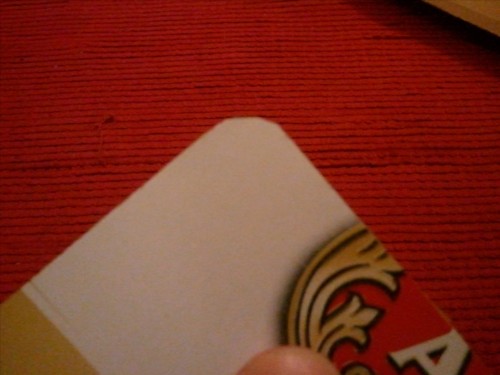
10. Using a thick carpet or plasticine as a base push two staple through the spine. Turn the book over and carefully bend the staples over as they should be, but use a tool, like a knife or something so you don’t damage your beautiful fingers.
6minmoleskine11

11. You can even cut the corners rounded just to look classy.

6minmoleskine12

12. Bingo, it’s flexible so will fit nicely in a back pocket, and is the perfect receptacle for notes on your next novel, concepts of social theory, life sketching, mind maps, crudely drawn genitalia etc etc.

(If this is a bit low rent for you, may I recommend the excellent Linda Boucher’s elegantly decorated actual moleskines available here.)

Enjoy!

bfp

x

(cross posted from my tumblr)

“I bought a really flashy piano that I couldn’t play at all.”

“I read an interview with Tom Waits, around the time of his album “Rain Dogs,” in which he talked about how you come to a point on an instrument where you have to stop playing it and find another instrument that you don’t know what you’re doing with. Part of songwriting is having that naïve excitement about not quite realizing why you’re getting off on it, because you haven’t had time to pull it apart yet. Songwriting relies on not pulling things apart: the best ideas are the simple ideas.”

Thom Yorke
via

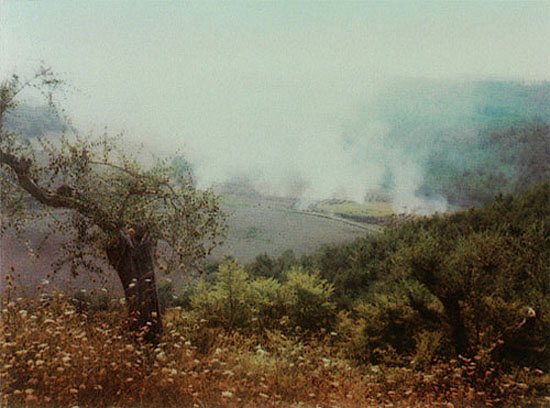
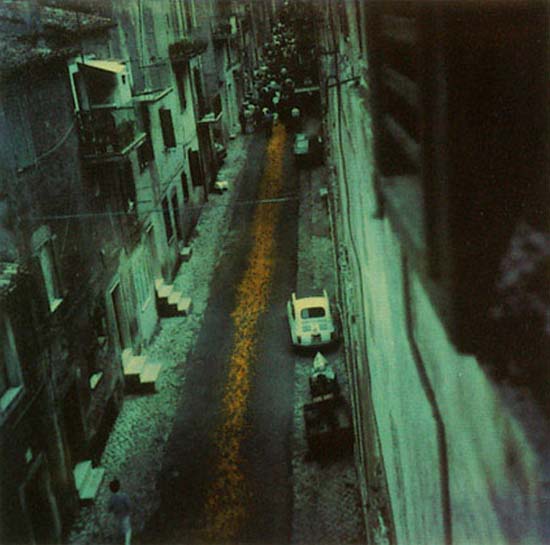
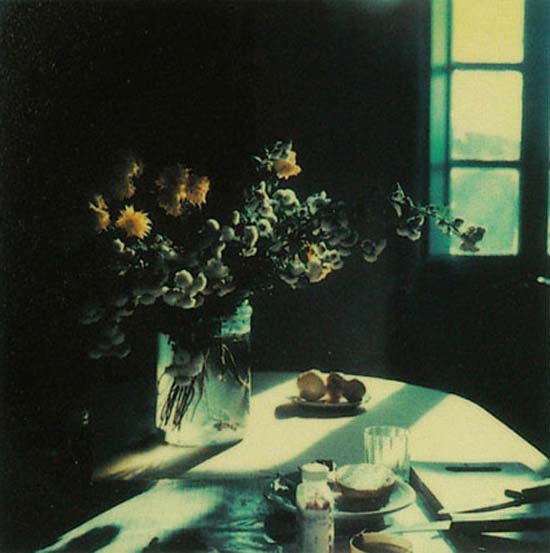
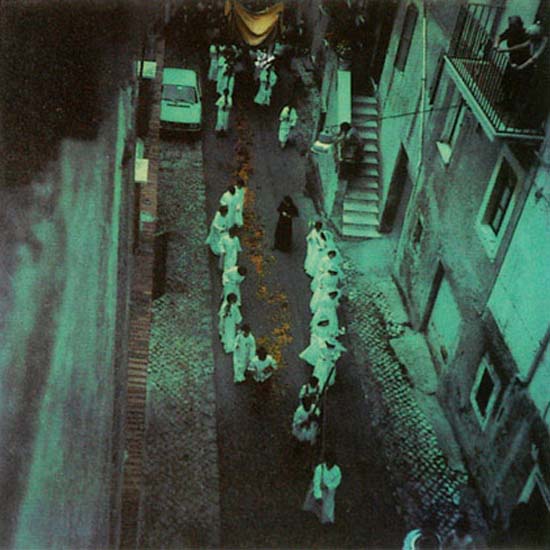
Las Polaroid de Tarkovsky


HTML tutorial

“No es muy conocido que Tarkovsky, cuyas películas parecen estar compuestas a veces por un montaje de fotografías estáticas, se dedicó durante algún tiempo, efectivamente, a tomar fotos con una Polaroid. Estas fotos, a pesar de sus imperfecciones técnicas, atestiguan la misma forma de mirar y el mismo mundo visual de sus grandes films.”


Las Polaroid de Tarkovsky


Las Polaroid de Tarkovsky


Las Polaroid de Tarkovsky

more at: Poemas del río Wang