3 x notes on notes and sketch pages

Lynda Barry:


Notes on notes and sketch pages

Guillermo Del Toro:

Among Guillermo del Toro’s most prized possessions is a leather-bound journal that he carries with him at all times. It is where he sketches and writes down his ideas and muses for future films. In this particular notebook was four years worth of ruminations that would eventually become Pan’s Labyrinth. The movie almost never came to be, as del Toro had exited a London cab one evening and neglected to take with him his notebook. The cab driver found the notebook, as well as a scrap of paper with a hotel logo on it. Recognising the logo, the cab driver returned the notebook and del Toro was so elated with its return that he rewarded the cab driver $900.
Among Guillermo del Toro’s most prized possessions is a leather-bound journal that he carries with him at all times. It is where he sketches and writes down his ideas and muses for future films. In this particular notebook was four years worth of ruminations that would eventually become Pan’s Labyrinth. The movie almost never came to be, as del Toro had exited a London cab one evening and neglected to take with him his notebook. The cab driver found the notebook, as well as a scrap of paper with a hotel logo on it. Recognising the logo, the cab driver returned the notebook and del Toro was so elated with its return that he rewarded the cab driver $900. via


Joan Didion:


Joan Didion


Why did I write it down? In order to remember, of course, but exactly what was it I wanted to remember? How much of it actually happened? Did any of it? Why do I keep a notebook at all? It is easy to deceive oneself on all those scores. The impulse to write things down is a peculiarly compulsive one, inexplicable to those who do not share it, useful only accidentally, only secondarily, in the way that any compulsion tries to justify itself. I suppose that it begins or does not begin in the cradle. Although I have felt compelled to write things down since I was five years old, I doubt that my daughter ever will, for she is a singularly blessed and accepting child, delighted with life exactly as life presents itself to her, unafraid to go to sleep and unafraid to wake up. Keepers of private notebooks are a different breed altogether, lonely and resistant rearrangers of things, anxious malcontents, children afflicted apparently at birth with some presentiment of loss.”

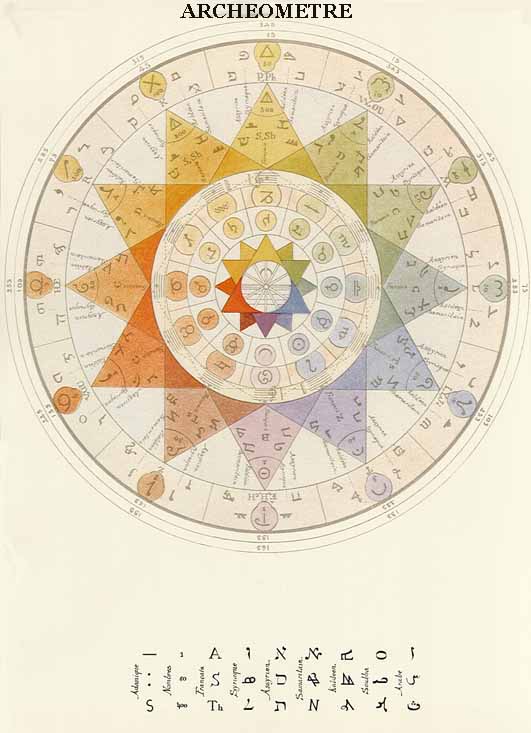
Archeometre by Alexandre Saint-Yves d’Alveydre


HTML tutorial

The term “Archeometre” originates from the Greek and means “the measure of the principle”. The system refers also to a series of symbols and meanings, which refer to the federal drawer.

‘Archeometre’ is it the measurement of the ‘Archee’ (Universal Cosmic Force) of which the Hermetists speaks. Is it a process, a ‘key’ which makes it possible to penetrate the Mysteries of the Word. It is a measuring instrument of the first (primary) principles of the manifested universe.

Alexandre Saint Yves d’Alveydre’s Archeometre shows the original Atlantean alphabet translates into the material the word, form, color, smell, sound and taste, the key to all religions and the sciences of antiquity.

Etienne-Jules Marey and his Chronophotographic Gun


Marey, Etienne-Jules (1830 - 1904)

A polymorphic scientific, Etienne Jules Marey explored numerous techniques and disciplines, obsessed by one unique concept: movement. First interested in flight, he studied birds and imagined mechanical devices capable of flying. From 1878, he focused on movement within human beings and, inspired by Edward Muybridge he had met in 1881, used photography to document his research. He thus imagined, in 1882, a camera entitled photographic gun that enabled him to capture a moving subject in twelve poses. Etienne Jules Marey thus decomposed the gestures of men practicing sports, animals in motion, everyday tasks precisely observed and even the migration of air. He also invented the chonophotography that would be the precursor of cinema. Photography in its early days was the ultimate accomplice of reality but with Etienne Jules Marey (and Edward Muybridge), photography suddenly also captured the invisible.”


Marey, Etienne-Jules (1830 - 1904)

Marey started by studying blood circulation in the human body. Then he shifted to analyzing heart beats, respiration, muscles (myography), and movement of the body. To aid his studies he developed many instruments for precise measurements. For example, in 1859, in collaboration with the physiologist Auguste Chauveau and the watch manufacturer Breguet, he developed a wearable Sphygmograph to measure the pulse. This sphygmograph was an improvement on an earlier and more cumbersome design by the German physiologist Karl von Vierordt.[3] In 1869 Marey constructed a very delicate artificial insect to show how an insect flies and to demonstrate the figure-8 shape it produced during movement of its wings. Then he became fascinated by movements of air and started to study bigger flying animals, like birds. He adopted and further developed animated photography into a separate field of chronophotography in the 1880s. His revolutionary idea was to record several phases of movement on one photographic surface. In 1890 he published a substantial volume entitled Le Vol des Oiseaux (The Flight of Birds), richly illustrated with photographs, drawings, and diagrams. He also created stunningly precise sculptures of various flying birds.”


Marey, Etienne-Jules (1830 - 1904)

Marey studied other animals too. He published La Machine animale in 1873 (translated as “Animal Mechanism”). The English photographer Eadweard Muybridge carried out his “Photographic Investigation” in Palo Alto, California, to prove[dubious – discuss] that Marey was right when he wrote that a galloping horse for a brief moment had all four hooves off the ground. Muybridge published his photos in 1879 and received some public attention.”


Marey, Etienne-Jules (1830 - 1904)

Marey’s chronophotographic gun was made in 1882, this instrument was capable of taking 12 consecutive frames a second, with all the frames recorded on the same picture. Using these pictures he studied horses, birds, dogs, sheep, donkeys, elephants, fish, microscopic creatures, molluscs, insects, reptiles, etc. Some call it Marey’s “animated zoo”. Marey also conducted the famous study about cats always landing on their feet. He conducted very similar studies with a chicken and a dog and found that they could do almost the same. Marey also studied human locomotion. He published another book Le Mouvement in 1894.”

The Smithsonian Collection of Newspaper Comics edited by Bill Blackbeard


The Smithsonian Collection of Newspaper Comics

“As an undergraduate student and aspiring cartoonist, the book laid open most often on my drawing table was Blackbeard and Williams’ weighty Smithsonian Book of Newspaper Comics. For years I’d been led to believe by various comic book aficionados that the zenith of achievement for the medium were the EC comic books of the 1950s, but after discovering the Smithsonian book, it became all too clear to me that the real original geniuses of the medium were the pre-cinema cartoonists of the throwaway Sunday supplements of a half century prior. As a general history, the book evenly balanced a necessary all-inclusivity with an otherwise gently insistent esthetic sophistication, which was something of a virtuosic tightrope act of curation: covering everything while still allowing the greats to shine. Choosing a few representative examples of Krazy Kat and Little Nemo is hard enough, but what about introducing Gasoline Alley and Polly and Her Pals to a brand-new readership, to say nothing of uncovering the obscure efforts of George Luks and Lyonel Feininger? Even better, the strips were presented in a warm, large, full-color format which at the time must have been extraordinarily expensive, but allowed their complicated and intricate compositions to be truly re-appreciated; earlier histories of comics had tended towards text-clotted black-and-white tour schedules, amputating single panels and freeze-drying them in black and white as little more than passing souvenirs of an outmoded 19th and early 20th century naïveté. (As an aside, one of the deciding reasons I agreed to design the “Krazy and Ignatz” series was that Mr. Blackbeard was its acting editor, and I considered it a personal honor to be asked to contribute.) By devoting his life to the preservation and location of these near-extinct supplements and sections, Bill Blackbeard saved an American art from the certain peril of trash men, librarians and ultraviolet light so that we, the generations to come, could appreciate their unprepossessing, unpretentious and uproarious beauty. The comic strip may have been disposable, but Bill Blackbeard’s founding contribution to the understanding of it as an art was, and always will be, timeless.”

Chris Ware
via Austin Kleon

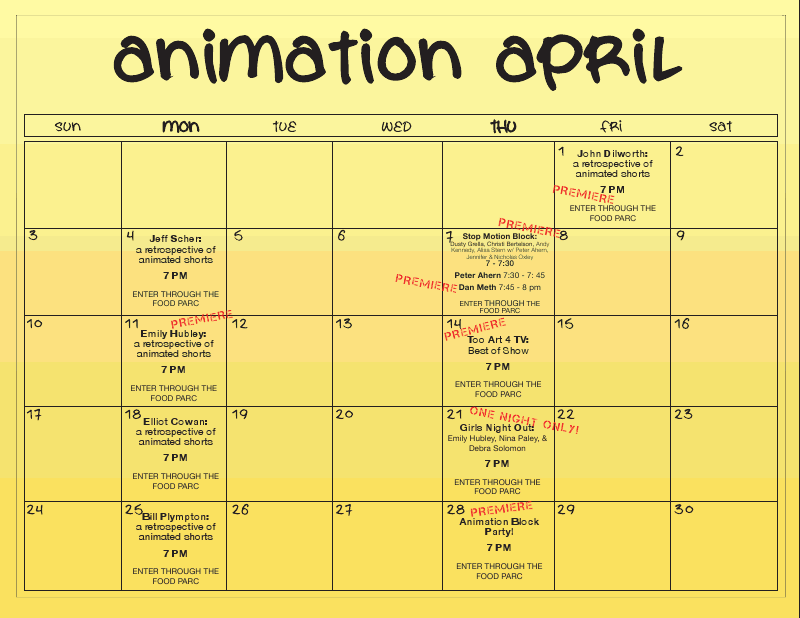
Too Art for TV’s Experimental Film Exhibit Retrospective.

thebsp:

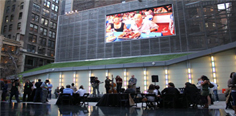
The Big Screen Project is pleased to present:Too Art for TV’s Experimental Film Exhibit Retrospective.

Opening reception TODAY April 14th 2011, 7pm.  Indoor viewing at Food Parc and Public Plaza – 851 6th AveOutdoor viewing at 6th Ave Bet. 29th and 30th Streets

Big Screen Project (Chelsea, NY), in collaboration with Too Art for TV, is proud to host Too Art for TV: Experimental Film Exhibit Retrospective. 11 artists – some of whom have exhibited with Too Art for TV in the past, and some who are presently part of the exhibit Too Art for TV 5 (Williamsburg, Brooklyn), will screen together for one hour on Big Screen Project’s large open air screen in Chelsea, NY.

Too Art for TV is an annual fine art show for the animation industry. Experimental film has been part of Too Art’s vision since the exhibit started in 2006, but due to the crowded openings, Too Art’s film content can often times be difficult to experience. With Big Screen’s presentation of Too Art for TV’s Experimental Film Exhibit Retrospective, Too Art’s artists can enjoy a larger-than-life vehicle for their film and animation musings.

FEATURING:
Forest
by Eric Leiser

Roz
by Brad Mossman

Teenage Lovesong
by Conor O’Kelly Lynch

Spare Time
by Edmond Hawkins

OK I’ll Let You Go
by Greg Condon

Animated Journal
by Paul Greer

Erodium II
by David Montgomery

Aesthetic Species Maps
by David Montgomery

A Self Portrait 1981 – 2009
by Jimmy Calhoun

The Bellows March
by Eric Dyer

Arithmetic
by Laurie O’Brian

That’s tonight, Brooklyn people. They’ll be showing the Animated Journal amongst some other probably more excellent work.

If you’re in the neighbourhood please check it out.

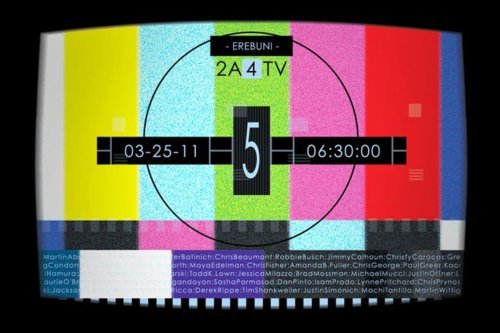
Too Art for TV – 5


Too Art for TV – 5


New York’s Fifth Fine Art Exhibit for the Animation Industry Group Exhibition
March 25th through April 23rd, 2011


Opens Friday March 25th, 6:30pm-9:30pm


at EREBUNI, 158 Roebling Street, Brooklyn, NY 11211 VIEWING HOURS: FRI 4-8pm, SAT & SUN 2-8PM
(via bunnycutlet)

featuring:
Martin Abrahams
Liz Artinian
Amanda Baehr-Fuller
Jennifer Batinich
Chris Beaumont
Robbie Busch
Jimmy Calhoun
Greg Condon
Kelly Denato
John R. Dilworth
Maya Edelman
Chris Fisher
Chris George
Paul Greer
Kaori Hamura
Jen Hill
KaNO
Christy Karacas
Peter J. Lazarski
Todd K. Lown
Richard Mather
Jessica Milazzo
Brad Mossman
Michael Mucci
Justin Offner
Laurie O’Brien
Chris Palesty
Deo Pangandoyon
Sasha Parmasad
Dan Pinto
Isam Prado
Lynne Pritchard
Chris Prynoski
Reject
Michael Ricca
Derek Rippe
Tim Shankweiler
Justin Simonich
Machi Tantillo
Martin Wittig

Unfortunately, I can’t make the opening night (got stuck in wrong continent), but I assure you it’ll be worth a visit if you are in the vicinity.

The Animated Journal will be showing sometime somewhere.

(cross posted from the Tumblr)