‘This Chansonnier, named by Knud Jeppesen as the perhaps most interesting and valuable medieval music handwriting in the Royal Library, occupies a special position among the relatively few manuscripts that surrender the French-Burgundian Chansons repertoire from the late 1400s. The script contains text and nodes for 33 three-star songs. A song – “Iactens secours” – was added in the 16th century. In conclusion, there are a number of “modulation exercises.”‘
micro
“Rotary Signal Emitter – Side A & Side B” by (2010) by Dan Hayhurst and Reuben Sutherland
New Brooklyn to New York via Brooklyn Bridge, no. 2 Sept. 22, 1899. Edison Manufacturing Co.
The Netherlands diary

Entry from ‘Albrecht Dürer and his Legacy’ BM exh. cat. 2002, no.103:
‘This woodcut design for ornament is one of six ‘knots’, as Dürer referred to them in his Netherlands diary (see Goris and Marlier, p. 81) copied after six engravings of c. 1490-1500 thought to be designed by Leonardo da Vinci
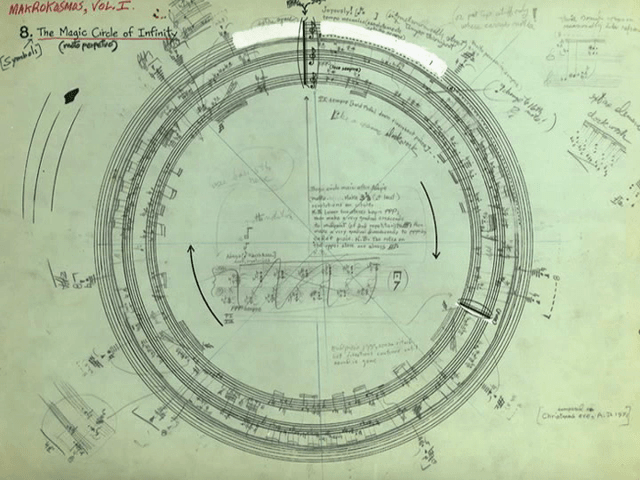
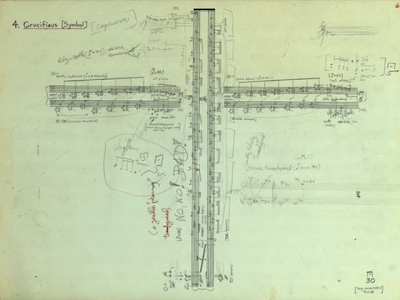
GEORGE CRUMB MAKROKOSMOS I & II: SCORES (2004)
“Notation naturally underwent the same ruptures that its signified did throughout the 20th century, not only in the attempt to find technically suitable illustrations for unprecedented forms of sonic expression, but also, as it was often the case, as a deliberate attack on the conventions of the graphic representation of sound. In the process, scores became increasingly idiosyncratic, more conscious about their arbitrary (i.e. semiotic) nature, and concomitantly assumed the status of art objects in themselves.”
— Eye Of Sound
“Bendito Machine I – Everything you need” by Jossie Malis (2010)
“If you could see the you that I see, when I see you seeing me, you would see yourself so different, believe me.”
(T)
“Harpya” by Raoul Servais (1979)
Servais animated the film using 35mm color front-projection of his characters onto a multiplane filmed, black velvet background.
The Harpy, with its human torso and facial features, can be aligned to Freud’s primal uncanny and Kristeva’s notion of the abject in cinema. The film can also be read as a modern retelling of the femme fatale archetype story – a warning to men captivated by the allure of a dangerous female.
On What Comics Can Do
“If Art Spiegelman’s MAUS had been filmed first, it would have had an audience of maybe three people at Sundance. Because the moment everyone trooped on wearing their mouse masks, any larger audience would have lost it and left giggling. Only in the space of cartooning could that conceit work. Not least because we’re already aware, when we come to cartooning, that we’re looking at someone’s processed and hermetic perception of the world. The great success of MAUS is that the mouse faces make us let our guard down, and so we’re hit by the horrible truth of that book from an unprotected angle.”
“..a curling, snarling Peter Kuper piece can sear the page with its anger in a way that no photorealistic artist will ever be able to communicate. A room drawn by Eddie Campbell will be more real than any snapshot, because his line is almost like handwriting, and has human breath upon it. Dash Shaw’s work may look rough on first look, but stay with it, look at how he conveys the essence of an idea in every panel, and you’ll realise how hard he sometimes works to evoke an entire world with so few elements.”
“This is a field that combines, on the one hand, the novel and the poem and the slogan and the news story, and on the other hand every stop from pointillism to cave painting. Understand comics as the marriage of word and picture, as simple as that, and you’ll get a sense of how broad the medium’s reach really is.”