- Pattern Sniff
- Experiment, Guess and Conjecture
- Organize and Simplify
- Describe
- Tinker and Invent
- Visualize
- Strategize, Reason and Prove
- Connect
- Listen and Collaborate
- Contextualize, Reflect and Persevere
micro
C&C
“The thing I have come to love about Tumblr is that it’s not just writing in community. It’s reading and thinking and inspiring discipline and teaching in community. Some of the best things I’ve read anywhere have been on Tumblr by people I can email later that night. And correspondingly, I think some of the better things I’ve written this year were fleshed out and finished and offered up publicly because I know that would mean something to a community of not just friends but writers. I knew I would receive thoughtful feedback (when the writing warranted it) and might even prime the pump for someone else—returning the favor they’d done me with their piece I couldn’t stop reading the month before. And if my writing is flat—contrived or lazy or some flimsy imitation—well, I’ll know that through them too.
Writing in this community is life-giving and adds a fuel and urgency I haven’t felt in more static, one-dimensional platforms.
The book itself is a community of a different sort. Sometimes I envision it as a lit up apartment building, and I am standing across the street at night. I live across the hall from these people, quite literally, our stories are housed together but I don’t know most of these people yet. There’s a bundle of kinetic excitement I drag into each new story I read. A bundle of anticipation of new stories I’ll hear from writers I already love and all the moments I’ll meet from people I am related to but not in relation with.”
–
Erica, Coming & Crying: C&C Contributors, part 12
via meaghano
“Gigantic” by Pixies (1988)
“Ammæli” by The Sugarcubes (1987)
Top of Mt. Vesuvius – (Campi Phlegraei)

“Sir William Hamilton (1730-1803), perhaps best-known today as the husband of Emma Hamilton, mistress of Admiral Lord Nelson, was in his own right a skilled diplomatist, a celebrated connoisseur and collector, and a respected natural historian. In his own time he was honoured in particular for his contributions to the study of volcanoes, acquiring the title ‘the modern Pliny’ for his studies of Vesuvius.”
vi BibliOdyssey
Gustav Klimt. Philosophy (1899).

“Philosophy was the first of the three pictures presented to the Austrian Government at the seventh Vienna Secession exhibition in March 1900. It had been awarded a gold medal at the World Exhibition in Paris, but was attacked by those in his own country. Klimt described the painting as follows: “On the left a group of figures, the beginning of life, fruition, decay. On the right, the globe as mystery. Emerging below, a figure of light: knowledge.” Critics were disturbed by its depiction of men and women drifting in an aimless trance. The original proposal for the theme of the painting was “The Victory of Light over Darkness”, but what Klimt presented instead was a dreamlike mass of humanity, referring neither to optimism nor rationalism, but to a “viscous void””
“Klimt came under attack for ‘pornography’ and ‘perverted excess’ in the paintings. None of the paintings would go on display in the university.
In May 1945, it is contended that all three paintings were destroyed by retreating SS forces.”
“Long afloat on shipless oceans” – Song to the Siren x2
The Nebra Sky Disk (1600 BC)
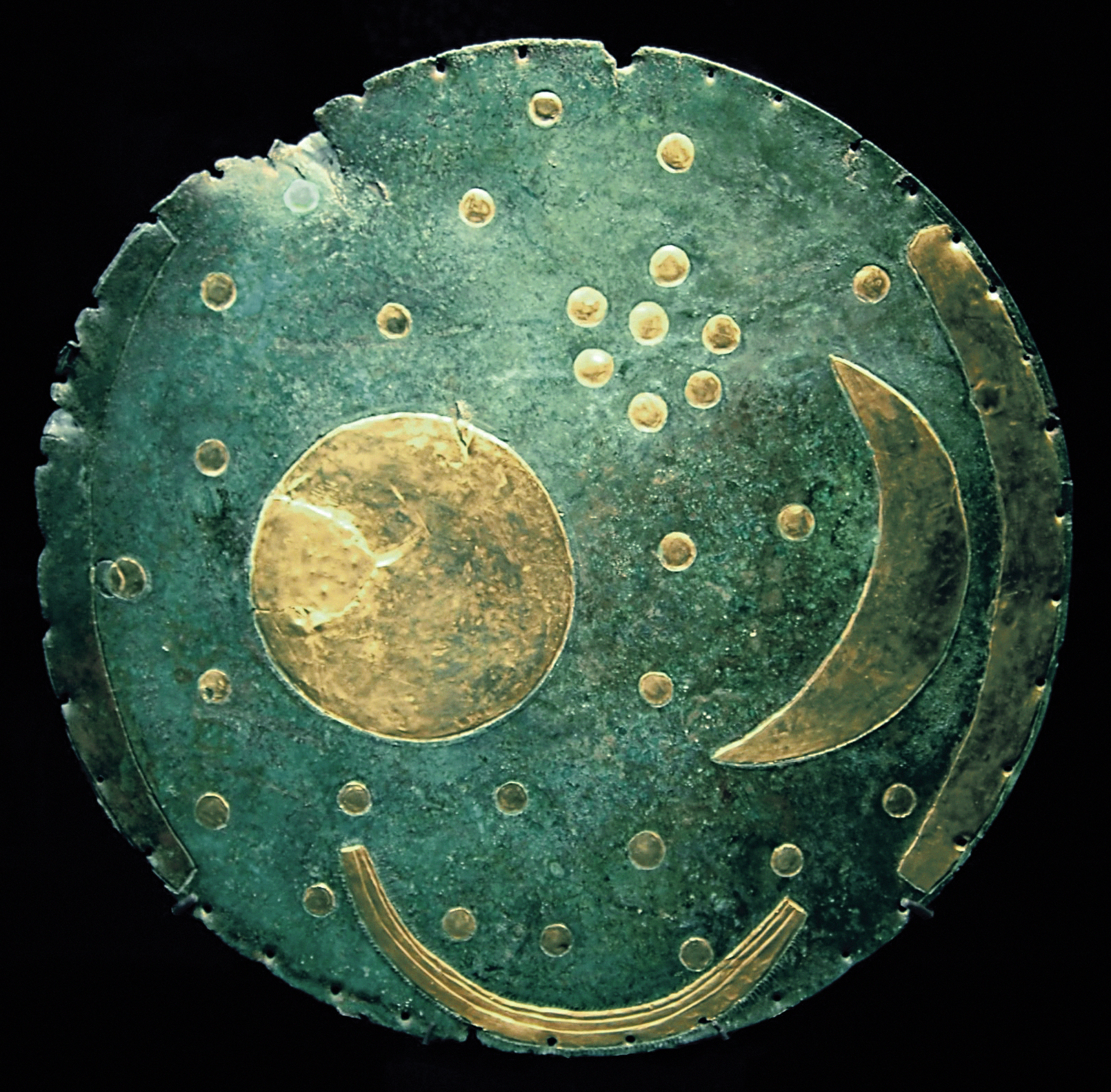
“The Nebra sky disk is a bronze disk of around 30 centimeters (12 in) diameter and a weight of 2.2 kilograms (4.9 lb), with a blue-green patina and inlaid with gold symbols. These are interpreted generally as a sun or full moon, a lunar crescent, and stars (including a cluster interpreted as the Pleiades). Two golden arcs along the sides, marking the angle between the solstices, were added later. A final addition was another arc at the bottom surrounded with multiple strokes (of uncertain meaning, variously interpreted as a Solar Barge with numerous oars, as the Milky Way, or as a rainbow).”
“The disk may be an astronomical instrument as well as an item of religious significance. The blue-green patina of the bronze may have been an intentional part of the original artifact. The find is regarded as reconfirming that the astronomical knowledge and abilities of the people of the European Bronze Age included close observation of the yearly course of the Sun, and the angle between its rising and setting points at summer and winter solstice. While much older earthworks and megalithic astronomical complexes such as the Goseck circle and Stonehenge had already been used to mark the solstices, the disk is the oldest known “portable instrument” to allow such measurements. Pásztor, however, sees no evidence that the disk was a practical device for solar measurements.”
via trixietreats
Falling from Space.
A camera strapped aboard a Space Shuttle booster rocket.
Listen to the sound on this one, you won’t regret it.
Things start happening about 2 minutes in.
via @girlonetrack
 Paul Greer