How we made the sound for “Toad”

I haven’t been well the last few days, mostly sleeping and dreaming.

One day I was remembering an old friend of ours, who still is very dear to us, but to whom we haven’t spoken for a long time.

Around the time we hung out, I was trying to make a film about a Toad that sat underneath a giant tap to keep itself alive.  I needed a soundtrack, so I stealthily rigged up the old Juno and programmed it up with a crazy organ noise. S’ was out at the previously mentioned friends house and came back in a rather chilled mood. Unprompted, she sat at the keyboard and straight out played this, I had the 4-track ready to go and caught it.

Many years later I finished the film, and here it is.

I watched it a few days ago and realised that behind the toad thing it’s a concealed love letter from us, to our dear friend.

This post is for her.

Animated Journal (Long Version)

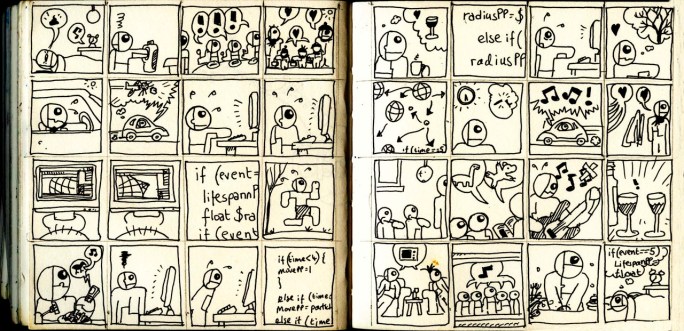
I’ve been keeping an Animated Journal over the last year.

I’ve always liked the picture a day format, video diaries etc, and animation is, traditionally a long drawn out, painful process, this is me trying to free it up and make it a bit more ephemeral.

Stan Brakhage said that he considered what he did to be his home movies and these follow a similar vein.

I generally capture whats going on around me and funnel it into 250 frames.

Art doesn’t have to be a career objective, or a total obsession, or something you make money from, or even something that other people will like.  It can be just something you make for yourself, in the cracks of your life, and if you put it up somewhere and other people connect with it, then that’s cool.

It’s made using a variety of software & techniques including Maya, flip book drawings, After Effects, old cameras, roll film, digital photography and so on.

Journal Whisper

Journal Light

Journal Rose

Animated Journal on Vimeo by Paul Greer

Still From Animated Journal No.4

Animomento No 3 270709

Still From Animomento No.1 030709

Still from Animated Journal


“I have a horror of copying myself.”

“The artist is a receptacle for emotions that come from all over the place: from the sky, from the earth, from a scrap of paper, from a passing shape, from a spider’s web. That is why we must not discriminate between things. Where things are concerned there are no class distinctions. We must pick out what is good for us where we can find it – except from our own works. ”

Pablo Picasso

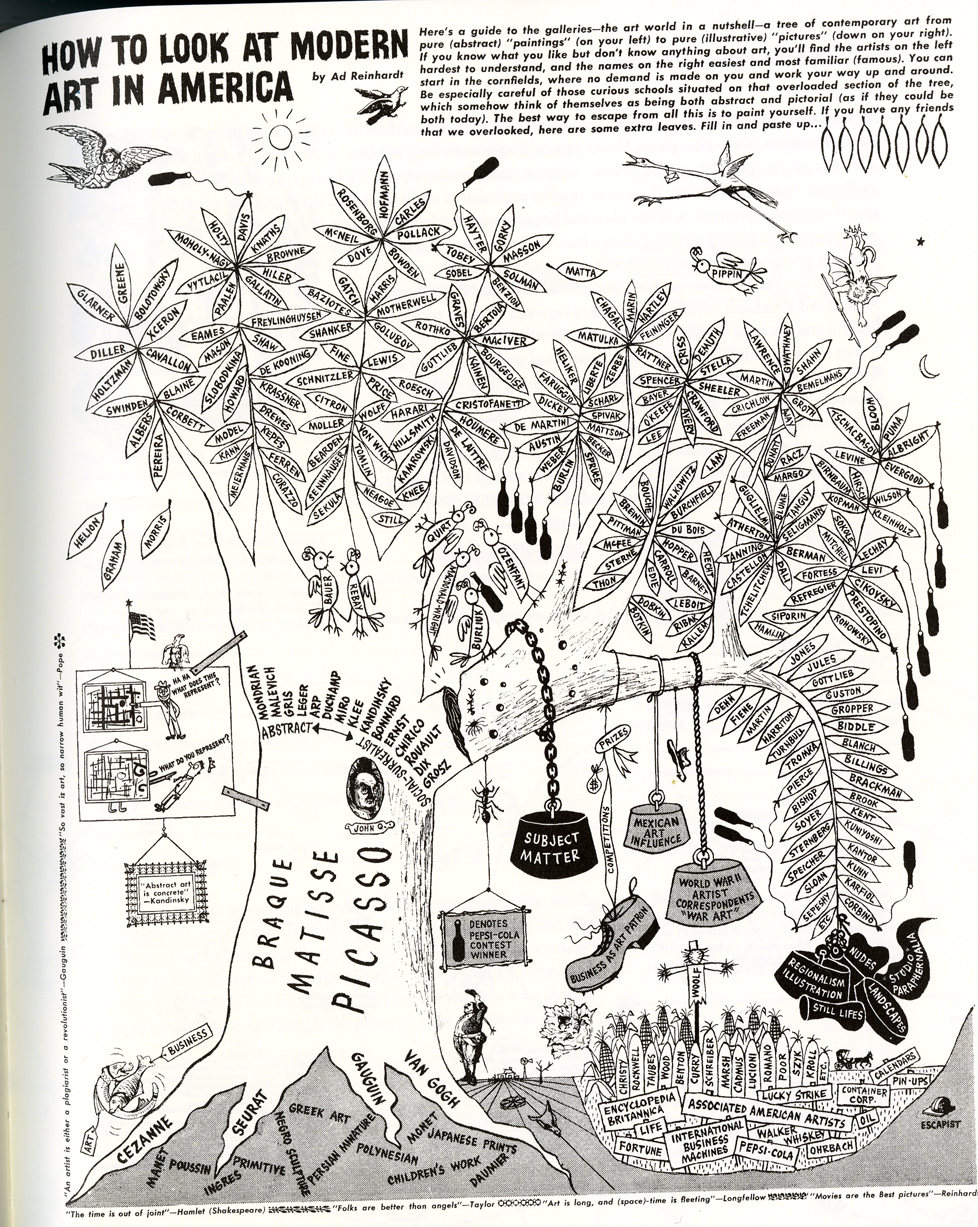
How to Look at Modern Art by Ad Reinhardt


HTML tutorial


In this famous cartoon of 1946 Ad Reinhardt tried to encapsulate the essence of the artistic modernism with its history and inherent conflicts within the American context. The tree of modern art has its roots deep in history – the Greeks are here, and so are Persian miniatures and Japanese prints. The roots represent the four pillars of Post-Impressionism: Vincent Van Gogh, George Seurat, Paul Cezanne, and Paul Gauguin. The tree is burdened by the weights of “subject matter” and “business as art patron,” and a cartoon within the cartoon mocks the perpetual debate of representation versus abstraction. By juxtaposing business and art, Reinhardt aptly comments on the situation of the avant-garde in the United States, where the public and, more importantly, the patrons were rather biased against the abstract art, often calling it “degenerate” and “subversive.””

— (via)

Pablo Picasso

What do you think an artist is? An imbecile who only has eyes, if he is a painter, or ears if he is a musician, or a lyre in every chamber of his heart if he is a poet, or even, if he is a boxer, just his muscles? Far from it: at the same time he is also a political being, constantly aware of the heartbreaking, passionate, or delightful things that happen in the world, shaping himself completely in their image. How could it be possible to feel no interest in other people, and with a cool indifference to detach yourself from the very life which they bring to you so abundantly? No, painting is not done to decorate apartments. It is an instrument of war.”

The Berlin Reunion

“Earlier this week, 1.5 million people filled the streets of Berlin, Germany to watch a several-day performance by France’s Royal de Luxe street theatre company titled “The Berlin Reunion“. Part of the celebrations of the 20th anniversary of the fall of the Berlin Wall, the Reunion show featured two massive marionettes, the Big Giant, a deep-sea diver, and his niece, the Little Giantess. The storyline of the performance has the two separated by a wall, thrown up by “land and sea monsters”. The Big Giant has just returned from a long and difficult – but successful – expedition to destroy the wall, and now the two are walking the streets of Berlin, seeking each other after many years apart. I’ll let the photos below tell the rest of the story.

via Katie West