writing
/ˈrʌɪtɪŋ/
noun
1. the activity or skill of writing.
“parents want schools to concentrate on reading, writing, and arithmetic”
2. the activity or occupation of composing text for publication.
“she made a decent living from writing”
Martin Landau on Process
- If you were to tell me, right now.
- What’s the most important thing?
- That? Yeah.
- OK. That’s good……………Trust.
- Huh.
- Talent is one thing. But to trust your talent. It’s a hard thing to do. To trust your choices. To use the rehearsals in ways that you’re not watching yourself.
- Right. Self conscious.
- Well, more than that. It’s the director in you. Leave the director outside. When you break down a script and make choices on a scene or a character, there’s an objective part of you that looks at stuff. You make a choice that’s conscious. Then either trust that to your subjectivity or don’t…..Now if you do, let it take you where it will. If it does what you hope it will, it will end the scene.
- Ohhh.
- …as opposed to your deciding to end the scene.
- Right…I get it.
- It’s hard to explain.
The Idea—the Origin of Everything
“Is the starting point of an animated film the time when the project is given the go-ahead and production begins? Is it at that point that you, as the animator, first go over your ideas for that story? No, that isn’t the starting point. Everything begins much earlier, perhaps before you even think of becoming an animator. The stories and original works—even initial project planning—are only triggers.
“Inspired by that trigger, what rushes forth from inside you is the world you have already drawn inside yourself, the many landscapes you have stored up, the thoughts and feelings that seek expression.
“When people speak of a beautiful sunset, do they hurriedly riffle through a book of photographs of sunsets or go in search of a sunset? No, you speak about the sunset by drawing on the many sunsets stored inside you—feelings deeply etched in the folds of your consciousness of the sunset you saw while carried on your mother’s back so long ago that the memory is nearly a dream; or the sunset-washed landscape you saw when, for the first time in your life, you were enchanted by the scene around you; or the sunsets you witnessed that were wrapped in loneliness, anguish, or warmth.
“You who want to become animators already have a lot of material for the stories you want to tell, the feelings you want to express, and the imaginary worlds you want to bring alive. At times these may be borrowed from a dream someone related, a fantasy, or an embarrassingly self-involved interior life. But everyone moves forward from this stage. In order for it not to remain merely egotistical, when you tell others about your dream you must turn it into a world unto itself. As you go through the process of sharpening your powers of imagination and technique, the material takes shape. If that shape is amorphous, you can start with a vague yearning. It all begins with having something that you want to express.
“Say a project has been decided on and you have been inspired by something. A certain sentiment, a slight sliver of emotion – whatever it is, it must be something you feel drawn to and that you want to depict. It cannot solely be something that others might find amusing, it must be something that you yourself would like to see. It is fine if, at times, the original starting point of a full-length feature film is the image of a girl tilting her head to the side.
“From within the confusion of your mind, you start to capture the hazy figure of what you want to express. And then you start to draw. It doesn’t matter if the story isn’t yet complete. The story will follow. Later still the characters take shape. You draw a picture that establishes the underlying tone for a specific world. Of course, what you have drawn will not be your final product. At times, your work may be rejected entirely. When I mentioned earlier that you must have the will to go to any length, this is what I meant. When you draw that first picture, it is only the beginning of an immense journey. This is the start of the preparation stage of the film.
“What kind of world, serious or comedic; what degree of distortion; what setting; what climate; what content; what period; whether there is one sun or three; what kinds of characters will appear; what is the main theme…? The answers to all of these questions gradually become clearer as you continue to draw. Don’t just follow a ready-made story. Rather, consider a possible development in the story, or whether a particular kind of character can be added. Make the tree trunk thicker, spread its branches further – or go to the tips of the small branches (this could be the starting point of the idea), and on to the leaves beyond as the branches grow and grow.
“Draw many pictures, as many as you can. Eventually a world is created. To create one world means to discard other inconsistent or clashing worlds. If something is very important to you, you can keep it carefully stored in your heart for use at another time. Those who have experienced an outpouring of an amazing number of pictures from inside themselves can feel it. They feel that the fragment of a picture they envisioned, the other trunk of a story that was thrown out while piecing together a narrative, the memory of pining for a girl, the knowledge about a subject gained as they delved deeply into a hobby – all of these play a role and become entwined into one thick strand. The scattered material within you has found its direction and started to flow.”
How to compose a successful critical commentary
-
You should attempt to re-express your target’s position so clearly, vividly, and fairly that your target says, “Thanks, I wish I’d thought of putting it that way.
-
You should list any points of agreement (especially if they are not matters of general or widespread agreement).
-
You should mention anything you have learned from your target.
-
Only then are you permitted to say so much as a word of rebuttal or criticism.
Modes of Processing: Notes from a Comics Roundtable
Processing words and images together is like looking at a person’s face while listening to them speak. Amazing! This makes me think about how reading comics is like living in the world; there are multiple modes of processing required of us. There’s so much information being communicated in a person’s face when they speak. But sometimes the person’s face communicates information that, juxtaposed with what they are saying, changes the meaning. Like when my mom and I say “Hate you” instead of “Love you,” there’s a certain facial expression that goes with the words that makes “Hate you” = “Love you.” I guess I’ve always liked modes of communication that are less direct than they appear.
I draw because I couldn’t communicate in the usual ways growing up. I was too shy, or weird, or something. Drawing has never been private for me; it was always the only non-private thing. I never made comics as a hobby; I chose the medium consciously, as an adult, when my parents and teachers and classmates stopped being the right audience for my drawings, and I needed an audience and a more concrete medium I could plug into. I wouldn’t write a story I didn’t want to share.
– Liana Finck (Twitter)
My artistic advice to someone just getting started is: Don’t worry what other people are doing, or what they think you should do; just have fun. Practice. Experiment. If you haven’t found your personal style yet, don’t worry, it will come to you. You need to make a lot of shit before you start making gold, and even when it’s gold, it’ll probably still look like shit to you sometimes. Also: Don’t expect comics to make you rich, or even make you a living. Not saying it can’t happen, but it’s about as likely as winning the lottery.
– Mari Naomi (website)
“I think the enemy of creativity in the world today is that so much thinking is done for you. The environment is so full of television, party political broadcasts and advertising campaigns, you hardly need to do anything. We’re just drowning under manufactured fiction, which satisfies our need for fiction – you scarcely need to go and read a novel.”
“Cyril Connolly, the 50s critic and writer, said that the greatest enemy of creativity is the pram in the hall, but I think that was completely wrong. It was the enemy of a certain kind of dilettante life that he aspired to, the man of letters, but for the real novelist the pram in the hall is the greatest ally – it brings you up sharp and you realise what reality is all about. My children were a huge inspiration for me. Watching three young minds creating their separate worlds was a very enriching experience.”
–- JG Ballard (via austinkleon)
Roald Dahl in his writing Chair
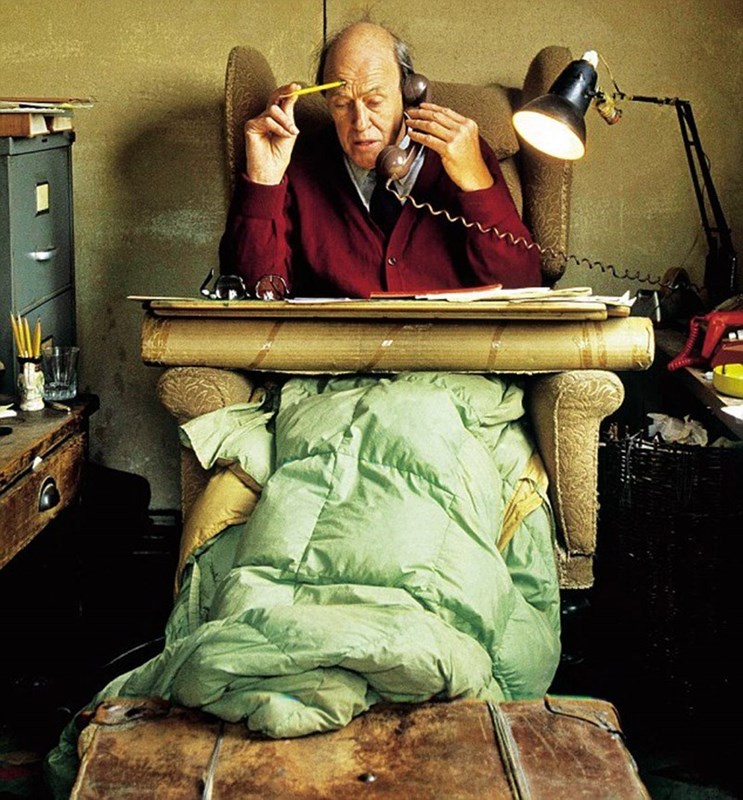
via AnOther
Disciplines for the Aspirant
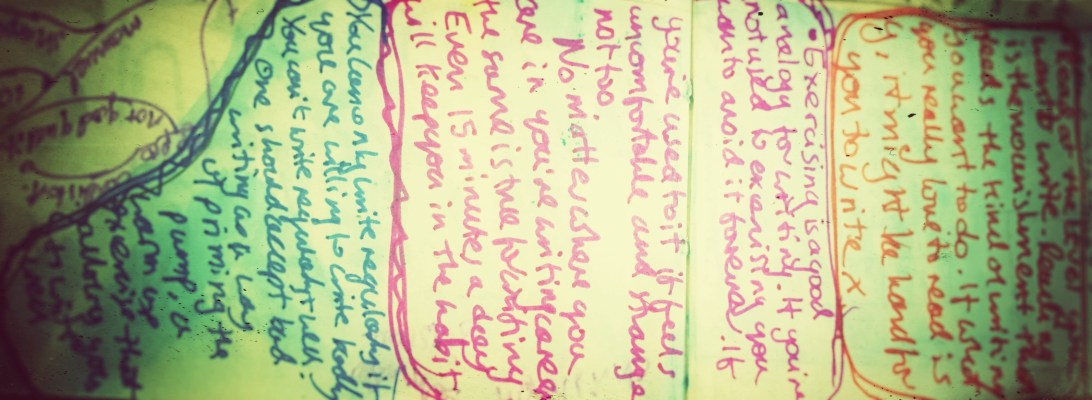
-
Read at the level at which you want to write. Reading is the nourishment that feeds the kind of writing you want to do. If what you really love to read is y, it might be hard for you to write x.
-
Exercising is a good analogy for writing. If you’re not used to exercising you want to avoid it forever. If you’re used to it, it feels uncomfortable and strange not to. No matter where you are in your writing career, the same is true for writing. Even fifteen minutes a day will keep you in the habit.
-
You can only write regularly if you’re willing to write badly. You can’t write regularly and well. One should accept bad writing as a way of priming the pump, a warm-up exercise that allows you to write well.
– Jennifer Egan – Why We Write
via Brain Pickings
Ballard.Text.Collage.c.1958

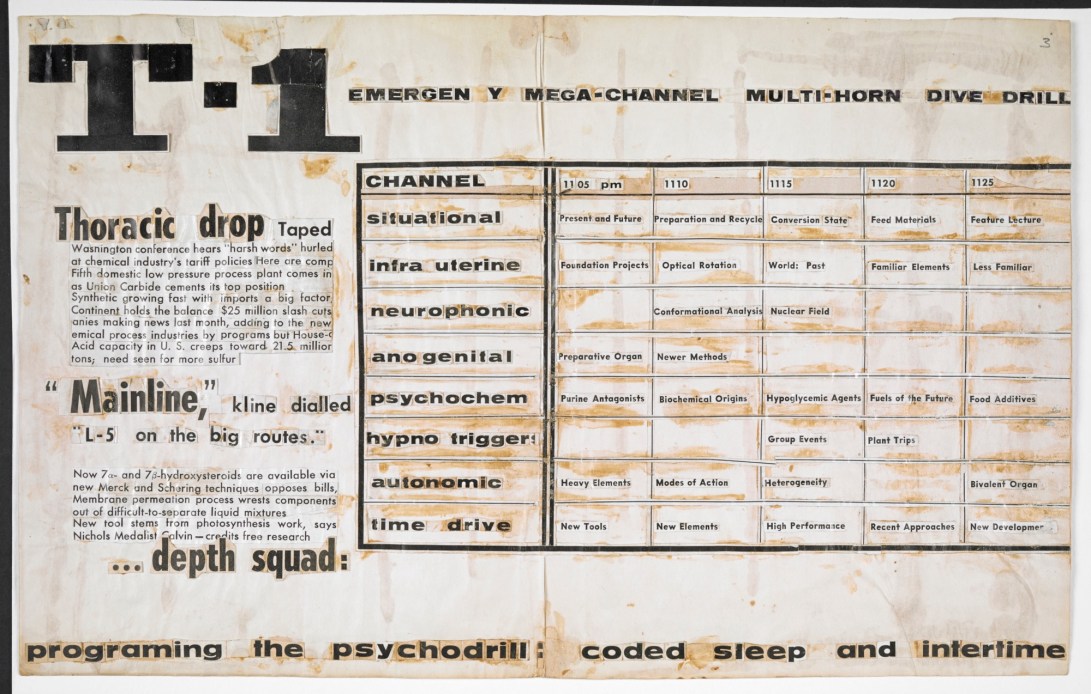
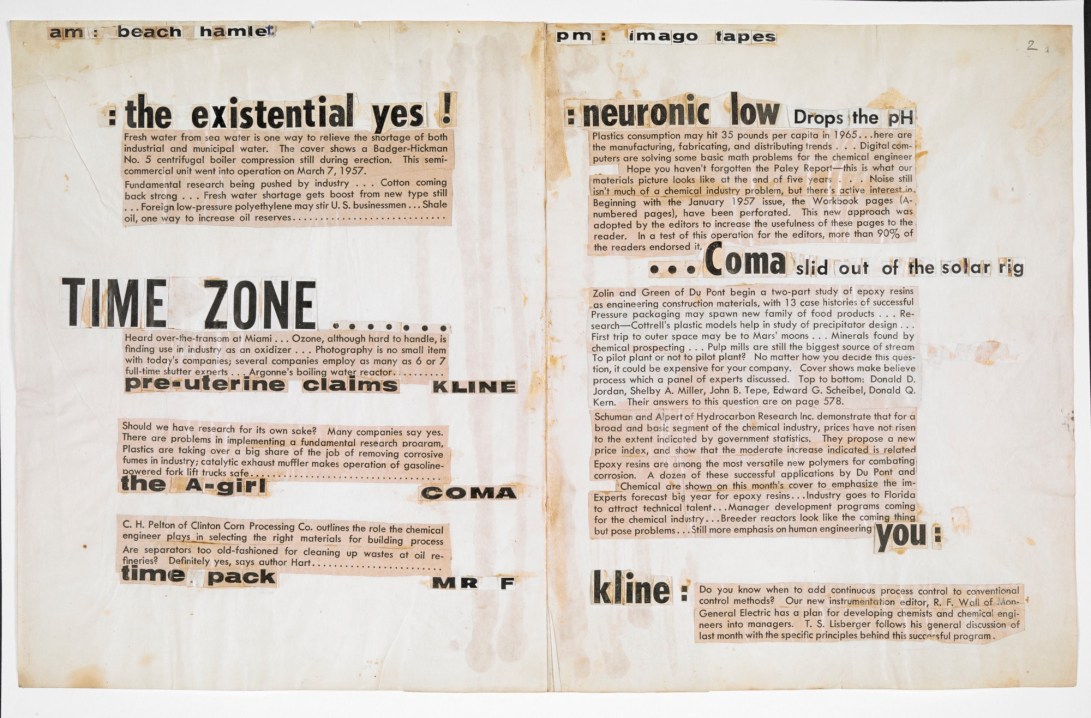

Ballard formed the ‘novel’ from scientific and technical material cut from professional literature such as Chemical and Engineering News (Ballard then worked for the journal of the Society of Chemical Industry). Letters, words and sentence fragments are pasted onto backing sheets with glue. Their design visually references everyday media, with headlines, body text and double-page spreads suggesting a magazine layout. Originally Ballard planned to display the work on billboards, as if it was a public advertisement.
From the British Library.
Found via @derekbeaulieu & @johnbrissenden.
 Paul Greer