My name is Paul Greer, I work full time at BDH, making computer animation for the telly.
This is a scrapbook where I gather, research and organise things I see, find or am shown.
“Suppose, if you will, that I am part of a silent Martian invasion and that my intention is slowly to destroy the whole culture of the human race. Where would I start? I would naturally start where thought first grows. I would start with children’s television. My policy would be to give the children only the sort of thing that they ‘already know they enjoy’, like a fizzing diet of manic jelly-babies. This would no doubt be exciting, but their hearts and their minds would receive no nourishment, they would come to know nothing of the richness of human life, love and knowledge, and slowly whole generations would grow up knowing nothing about anything but violence and personal supremacy. Is that a fairytale? Look around you.”
“Beside a garden wall
When stars are bright
You are in my arms
The nightingale tells his fairy tale
of paradise where roses grew
Though I dream in vain
In my heart it will remain
My stardust melody
The memory of love’s refrain”
Attempting to explain the song’s “eternal popularity,” Carmichael biographer Richard M. Sudhalter credits “some combination of young Carmichael’s heartland upbringing, Bix’s uniquely bardic sensibility, and the unself-conscious emotional directness that characterizes much non-urban American pop music.”
In Casino Royale, novelist Ian Fleming has René Mathis, one of James Bond’s fictional fellow secret agents, make a remark about Bond looking like Hoagy Carmichael. Later in the novel, after looking at his reflection in a mirror, Bond disagreed.
“Fail early and get it all over with. If you learn to deal with failure, you can raise teenagers. You can abide in intimate relationships. And you can have a worthwhile career. You learn to breathe again when you embrace failure as a part of life, not as the determining moment of life.”
“Every August, as Japanese spirits return en masse from the otherworld, Tokyo’s Zenshoan temple (map) exhibits a spine-chilling collection of 19th-century ghost scroll paintings.”
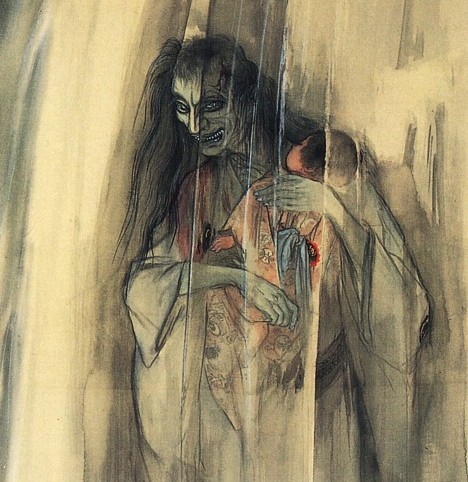
Kaidan Chibusa Enoki: The Ghostly Tale of the Wet Nurse Tree
“This painting by Ito Seiu, the godfather of Japanese bondage (kinbaku), depicts a scene from Kaidan Chibusa Enoki, an old horror story in which the ghost of a dead painter returns to protect his baby from his murderer, a wandering samurai who fell in love with his wife while he was away painting. This scroll shows the ghost holding the baby while standing under a waterfall at Juniso (where Tokyo’s Shinjuku Chuo Park is now located).”
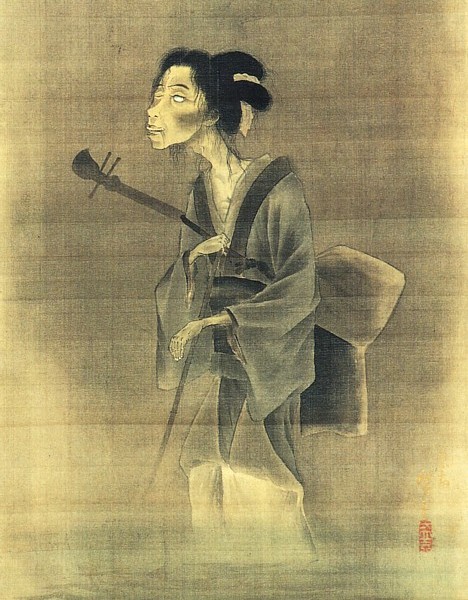
The Ghost of a Blind Female Street Singer
“Utagawa Hiroshige’s “Ghost of a Blind Female Street Singer” portrays the restless spirit of a street performer, one white unseeing eye wide open, carrying a shamisen as she drifts above the surface of a river on the way to her next performance.”
1. Write a play instead
2. Do the title first
3. Read it to people
4. Forget the three-act structure
6. Don’t write excuse notes
7. Avoid the German funk trap
8. Do a favourite bit
9. Cast it in your head
10. Learn to love rewrites
11. Don’t wait for inspiration
12. Celebrate your invisibility
13. Read, read, read, read, read
Ogata Gekko (1859 – 1920) Urashima Leaving the Palace Under the Sea, from Gekko’s Miscellaneous Drawings, 1894. Oban.
“Urashima Taro was a fisherman of the fifteenth century who rescued a young turtle from some bullying children. The following day a huge turtle approaches him and tells him he has saved the daughter of the Emperor of the Sea. As a reward the fisherman is gifted magical gills and taken to the palace beneath the waves. Whilst there he is given a beautiful box and told never to open it.
On his return three days later he finds that three hundred years have elapsed and everyone he knew has died. In distress he opens the box and instantly withers and dies in a pile of dust, the voice of the sea princess saying to him: “I said never to open the box; inside it is your old age”. Incidentally, the hair of the turtle is actually a long fronded algae that grows on the backs of turtles’ shells off the coast of Japan.”


 Paul Greer