Interview with Darren Walsh – Bob Creator


reblogging 12foot6blog:

insideencounters:

Interview with Bob Creator – Darren Walsh

We were very lucky yesterday to catch Darren Walsh preparing to live animate Bob in the Arnofini. Here he talks about how Bob came about, how he’s animate and how he thinks the animation will go.

Be sure to see the live animation every day in the ground floor of the Arnofini, it’s free to watch!

Cristina Cretu and Alice Corner

A great short interview with Darren Walsh about the process involved in creating Bob_On_Life. He’ll be animating Bob LIVE today! If you’re in Bristol this is a must-see.

Rule By The Rich

“The oligarchs are smart. They have realized that the global economy is starting to die. It’s short on resources, and the costs for what remains are skyrocketing. The prospects for rapid economic growth in the real economy, and for sustained high-level “surplus value,” are sharply diminished. So, many of the wealthy are coming to the view that they will no longer seek business growth, per se. More and more of them are seeking political control as a way of gaining economic expansion. They can squeeze out more by controlling the political process—toppling unions, gaining subsidies, cutting their taxes, gaining offshore havens—and, perhaps most of all, by privatizating services like education, transportation, the military, security, Medicare and Social Security, health services, and many aspects of the natural commons, like fresh water. That’s their big new market: commodification of the commons.” [quoting from retired businessman Jack Santa Barbara]

Republicans and especially Tea Partiers are now also advocating for privatizing whole government agencies, even those providing welfare services, for example. It represents a very profound shift in corporate/state/oligarch strategy, and is potentially much more pervasive and dangerous. All of it has been made necessary by the reality of declining resources and the stunted growth potential of the usual means of wealth expansion. Through campaign contributions, this class of super-rich already “owns” many of the U.S. state houses and legislatures, the House of Representatives, and, as we said, an alarming number of U.S. senators. The election of 2012 has a fair chance to also bring them control of the Senate, and quite conceivably the presidency. If so, we should probably start calling it neofeudalism. A privatized country.

Jerry Mander

— via jhnbrssndn

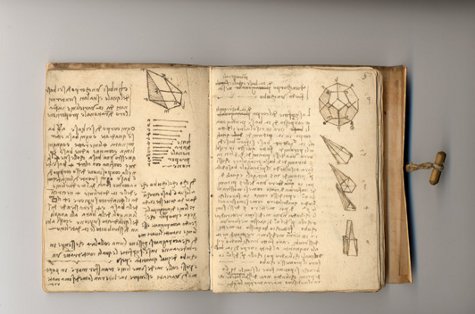
on Leonardo


He frequently wrote on loose sheets of paper that he kept barely organized; he made his own “notebooks” by folding the sheets and wrapping them in fabric. But when he turned thirty he also began writing in leather-bound journals. And he carried small bound notebooks with him at all times. He kept these tiny 3.5X2.5 notebooks tied to his belt, always at the ready for his thoughts, observations, drawings, and ideas.”

“Talent Is Nothing Without Focus and Endurance”

“Fortunately, these two disciplines—focus and endurance—are different from talent, since they can be acquired and sharpened through training. You’ll naturally learn both concentration and endurance when you sit down every day at your desk and train yourself to focus on one point. This is a lot like the training of muscles I wrote of a moment ago. You have to continually transmit the object of your focus to your entire body, and make sure it thoroughly assimilates the information necessary for you to write every single day and concentrate on the work at hand. And gradually you’ll expand the limits of what you’re able to do. Almost imperceptibly you’ll make the bar rise. This involves the same process as jogging every day to strengthen your muscles and develop a runner’s physique. Add a stimulus and keep it up. And repeat. Patience is a must in this process, but I guarantee results will come.”

Haruki Marukami

Table of Physiological Colors Both Mixt and Simple by Richard Waller, 1686

Richard Waller Tabula colorum physiologica … [Table of physiological colors] Philosophical Transactions of the Royal Society of London, 1686

This table is one of the earliest known color charts. Waller created it as a tool for describing plants and animals. Collectors and scientists could compare their specimens to this table and use the names provided to identify the colors of leaves, bark, flowers, feathers, plants, and animals.”