“The role of the imaginative writer has flipped in our time.
Previously the imaginative writer was supposed to produce fictions; however, we are now completely surrounded by fictions. We’re surrounded by advertisements, by artificial environments.
The role of the author now is to create realities, to discover realities perhaps.”
micro
Charles Darwin’s reading list
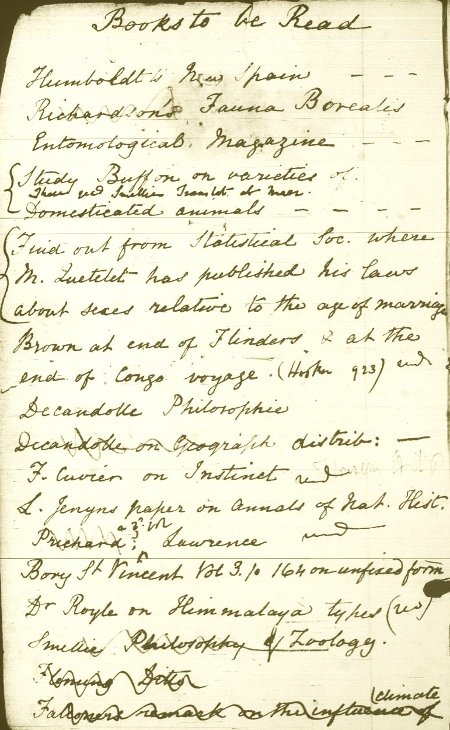
via proustitute
One size does not fit all: Context matters greatly, for Conscientious Extended, July 2012.
“We all know that all photography is fiction: as a photographer you make choices, which influence the photograph enough for it to be more of a fiction than a fact. That’s photography for you. That’s just the way it is. But the photojournalist’s task, no actually the photojournalist’s duty is to minimize the amount of fiction that enters her/his photography. We are quite aware of the problem in the news context – this is, after all, the context where the problems with image manipulation come up regularly – so we expect photographs in this context to be as truthful as they can be. The problem with InstaHip in this particular context is it adds a huge amount of fiction to photography, simply by its aesthetic.”
—Joerge Colbert
— via fette
London 2012: opening ceremony saw all our mad dreams come true
“With reality comes responsibility. Pretty well everyone feels some reservation about the Games – the money, the missiles, the McDonald’s. For me, the issue was Dow’s sponsorship of the stadium wrap. Dow are – to use a value-neutral word – connected to the terrible Bhopal disaster. Whatever the legal position, it was insensitive and tawdry to take their money. This isn’t the place or the day – given the gorgeous experience we’ve been through – to go into the details of why this seemed so very wrong. You can look it up.
Danny set a meeting with Sebastian Coe, who graciously fixed up for Amnesty to speak to Locog’s lawyers. But time was accelerating, and everyone was busy. Besides, something else was happening now: the volunteers.
Back in our studio, we had imagined flying bikes and rocketing chimneys. We never imagined the power of the volunteers. They were creative, courageous, convivial, generous. The press was full of stories of the greed and incompetence of our leaders, but our studio was full of people doing things brilliantly for nothing – for the hell of it, for London, for their country, for each other.”
vis jnbrssndn
John Cleese on Creativity
(linked fixed 2018)
from “Sentences and Paragraphs.” (1931)
“Sentences are made wonderfully one at a time. Who makes them. Nobody can make them because nobody can what ever they do see.
All this makes sentences so clear I know how I like them.
What is a sentence mostly what is a sentence. With them a sentence is with us about us all about us we will be willing with what a sentence is. A sentence is that they cannot be carefully there is a doubt about it.
The great question is can you think a sentence. What is a sentence. He thought a sentence. Who calls him to come which he did.
…What is a sentence. A sentence is a duplicate. An exact duplicate is depreciated. Why is a duplicated sentence not depreciated. Because it is a witness. No witnesses are without value.”
“I Can’t Hardly Stand It” by Charlie Feathers (1956) and The Cramps (1984)
“Golden Hair” by Syd Barrett (1970)
(added 2018: )
‘In ‘Golden Hair’, culled from Chamber Music, a slim verse Joyce wrote in 1907, a troubadour yearns for a Rapunzel locked in a tower. With simple barre chords, Barrett conjured a solemn air akin to a medieval madrigal. Its cadence is pure plainsong, chanted words over bare chords, with the first of his thrilling downward octave leaps at the end.‘
— (Syd Barrett and Pink Floyd – Dark Globe by Julian Palacios)
via byronsmuse
Pablo Picasso: Portrait of Igor Stravinsky, May 24, 1920 – pen
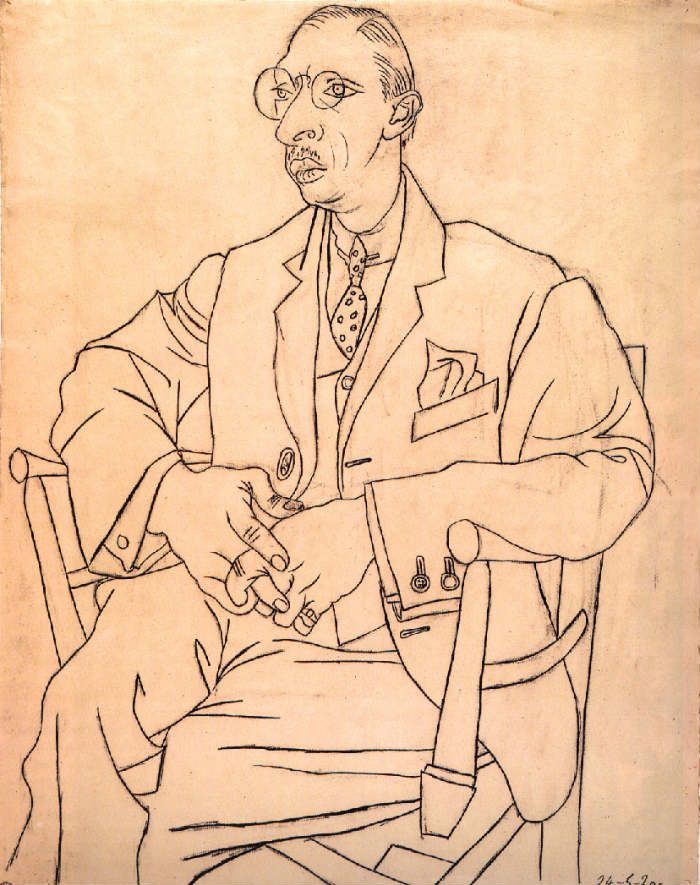
In 1917, Stravinsky met the great artist Pablo Picasso in Italy. While visiting him, Picasso drew a picture of Stravinsky. Igor packed it in his luggage to bring back to Switzerland.
When the customs officer inspected the suitcase, he thought the portrait was a spy plan. Their conversation went like this:
“What is this sketch?”
“My portrait drawn by Picasso.”
“Nonsense. It must be a plan.”
“Yes – the plan of my face.”
via cmuse
 Paul Greer