Stuart Hall and the Rise of Cultural Studies

“Culture, after all, is a matter of constructing a relationship between oneself and the world. “People have to have a language to speak about where they are and what other possible futures are available to them,” he observed, in his 1983 lectures. “These futures may not be real; if you try to concretize them immediately, you may find there is nothing there. But what is there, what is real, is the possibility of being someone else, of being in some other social space from the one in which you have already been placed.” He could have been describing his own self-awakening.”

Hua Hsu


Making Sense of Language – Mr. Rogers Set of Rules for Talking to Children

Rogers was extraordinarily good at imagining where children’s minds might go. For instance, in a scene in which he had an eye doctor using an ophthalmoscope to peer into his eyes, he made a point of having the doctor clarify that he wasn’t able to see Rogers’s thoughts. Rogers also wrote a song called “You Can Never Go Down the Drain” because he knew that drains were something that, to kids, seemed to exist solely to suck things down.”

  1. “State the idea you wish to express as clearly as possible, and in terms preschoolers can understand.” Example: It is dangerous to play in the street. ​​​​​​

  2. “Rephrase in a positive manner,” as in It is good to play where it is safe.

  3. “Rephrase the idea, bearing in mind that preschoolers cannot yet make subtle distinctions and need to be redirected to authorities they trust.” As in, “Ask your parents where it is safe to play.”

  4. “Rephrase your idea to eliminate all elements that could be considered prescriptive, directive, or instructive.” In the example, that’d mean getting rid of “ask”: Your parents will tell you where it is safe to play.

  5. “Rephrase any element that suggests certainty.” That’d be “will”: Your parents can tell you where it is safe to play.

  6. “Rephrase your idea to eliminate any element that may not apply to all children.” Not all children know their parents, so: Your favorite grown-ups can tell you where it is safe to play.

  7. “Add a simple motivational idea that gives preschoolers a reason to follow your advice.” Perhaps: Your favorite grown-ups can tell you where it is safe to play. It is good to listen to them.

  8. “Rephrase your new statement, repeating the first step.” “Good” represents a value judgment, so: Your favorite grown-ups can tell you where it is safe to play. It is important to try to listen to them.

  9. “Rephrase your idea a final time, relating it to some phase of development a preschooler can understand.” Maybe: Your favorite grown-ups can tell you where it is safe to play. It is important to try to listen to them, and listening is an important part of growing.

    via Maxwell King

More in #lists:

On Base and Superstructure

A great thread here on artist production and it’s place in the modern world. Worth reading the whole lot (click on through). 🔽🔽🔽

Everyday All Day

“Is there something you do every day that builds an asset for you?

Every single day?

Something that creates another bit of intellectual property that belongs to you?

Something that makes an asset you own more valuable?

Something that you learn?

Every single day is a lot of days. It’s easy to look at the long run and lull yourself into skipping a day now and then.

But the long run is made up of short runs.”

The Daily|Seth’s Blog

Making Infinity Comprehensible – Eco

“The list is the origin of culture. It’s part of the history of art and literature. What does culture want? To make infinity comprehensible. It also wants to create order — not always, but often. And how, as a human being, does one face infinity? How does one attempt to grasp the incomprehensible? Through lists, through catalogs, through collections in museums and through encyclopedias and dictionaries. There is an allure to enumerating how many women Don Giovanni slept with: It was 2,063, at least according to Mozart’s librettist, Lorenzo da Ponte. We also have completely practical lists — the shopping list, the will, the menu — that are also cultural achievements in their own right.”

Umberto Eco

other lists:

The Blog Garden

“In some ways this would be a return to what I did a few years ago with my Gospel of the Trees site, which arose because what I wanted to say about trees just couldn’t be made to fit into a book, in part because it refused to become a linear narrative or argument and in part because it was so image-dependent and book publishers don’t like the cost of that. But the advantage of a tag over a standalone site is that each post can have other tags as well, which lead down other paths of reflection and information, in a Zettelkasten sort of way.”

Ayjay

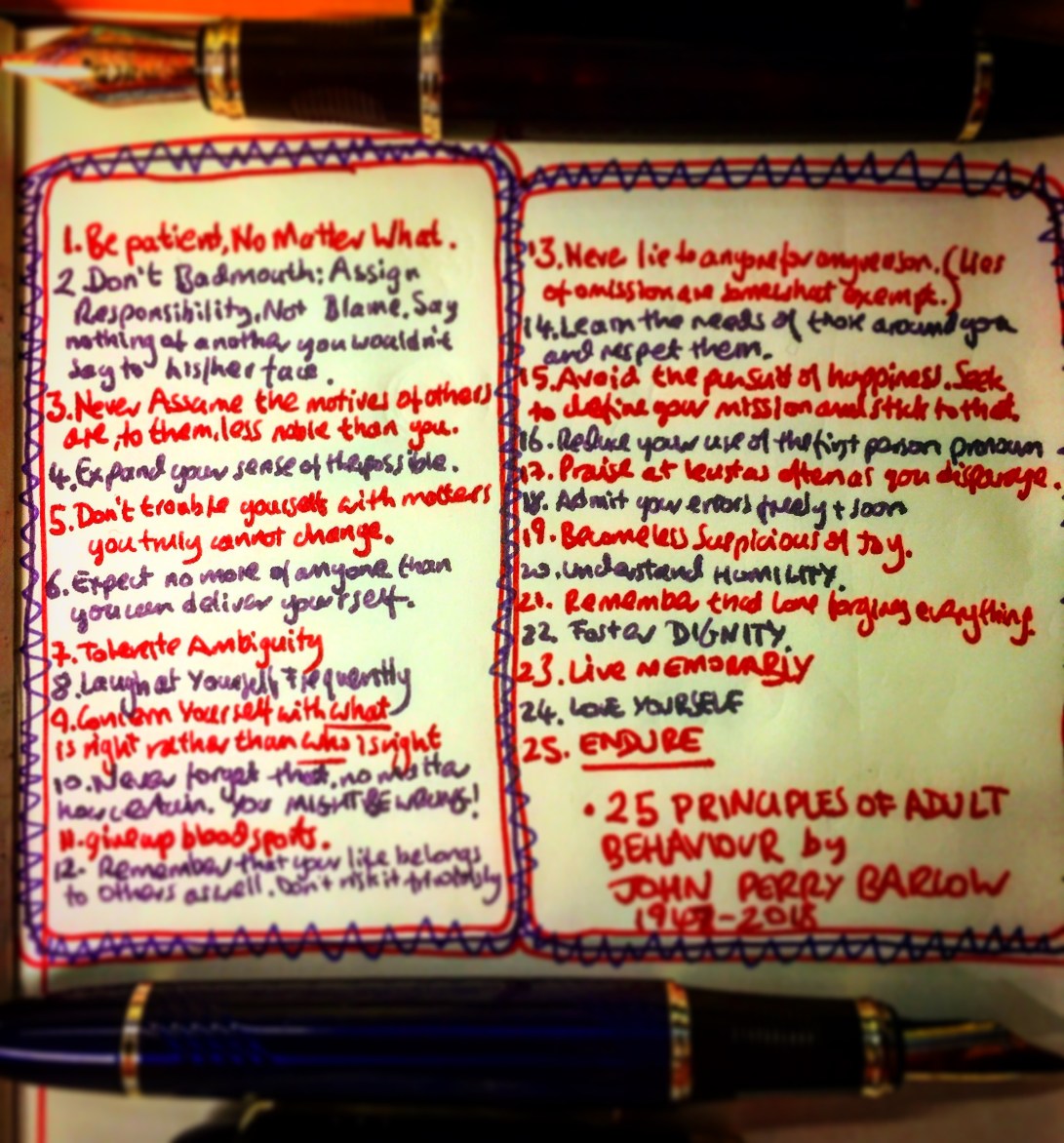
25 Principles

25_Principles

There’s a few “Rules of Life” knocking around at the moment. Here’s a few worth writing down:
1. Be patient. No matter what.
2. Don’t badmouth: Assign responsibility, not blame. Say nothing of another you wouldn’t say to him.
3. Never assume the motives of others are, to them, less noble than yours are to you.
4. Expand your sense of the possible.
5. Don’t trouble yourself with matters you truly cannot change.
6. Expect no more of anyone than you can deliver yourself.
7. Tolerate ambiguity.
8. Laugh at yourself frequently.
9. Concern yourself with what is right rather than who is right.
10. Never forget that, no matter how certain, you might be wrong.
11. Give up blood sports.
12. Remember that your life belongs to others as well. Don’t risk it frivolously.
13. Never lie to anyone for any reason. (Lies of omission are sometimes exempt.)
14. Learn the needs of those around you and respect them.
15. Avoid the pursuit of happiness. Seek to define your mission and pursue that.
16. Reduce your use of the first personal pronoun.
17. Praise at least as often as you disparage.
18. Admit your errors freely and soon.
19. Become less suspicious of joy.
20. Understand humility.
21. Remember that love forgives everything.
22. Foster dignity.
23. Live memorably.
24. Love yourself.
25. Endure.”

— 25 Principles of Adult Behaviour by John Perry Barlow, 03/10/1947-07/02/2018