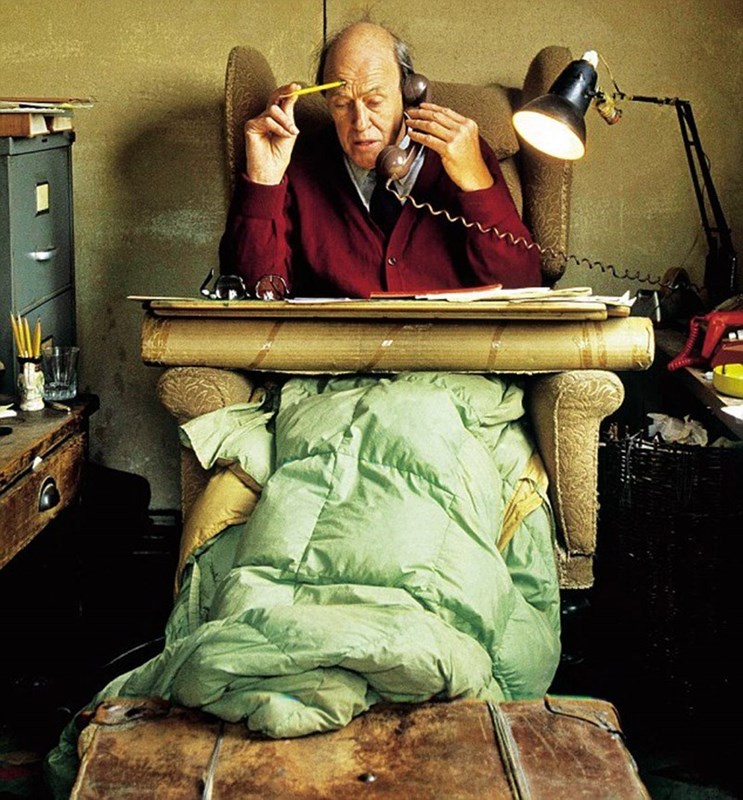
via AnOther
via AnOther
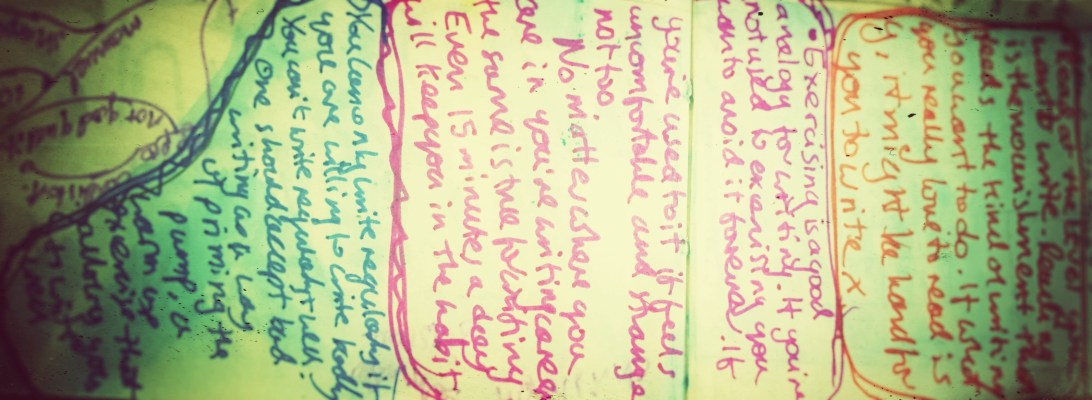
Read at the level at which you want to write. Reading is the nourishment that feeds the kind of writing you want to do. If what you really love to read is y, it might be hard for you to write x.
Exercising is a good analogy for writing. If you’re not used to exercising you want to avoid it forever. If you’re used to it, it feels uncomfortable and strange not to. No matter where you are in your writing career, the same is true for writing. Even fifteen minutes a day will keep you in the habit.
You can only write regularly if you’re willing to write badly. You can’t write regularly and well. One should accept bad writing as a way of priming the pump, a warm-up exercise that allows you to write well.
– Jennifer Egan – Why We Write
via Brain Pickings

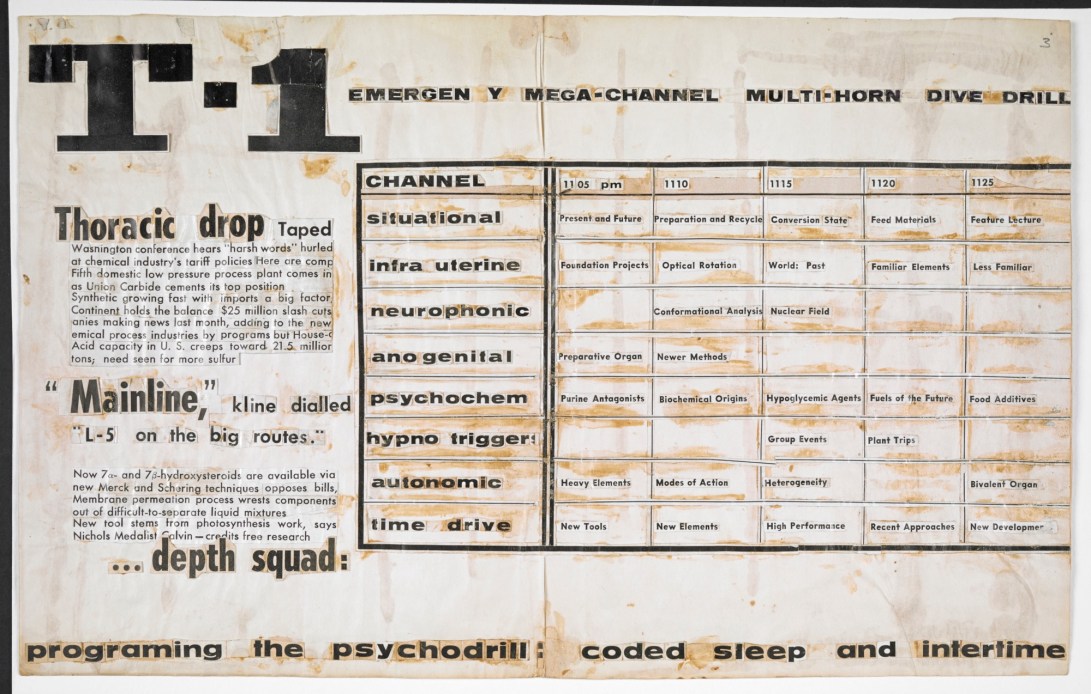
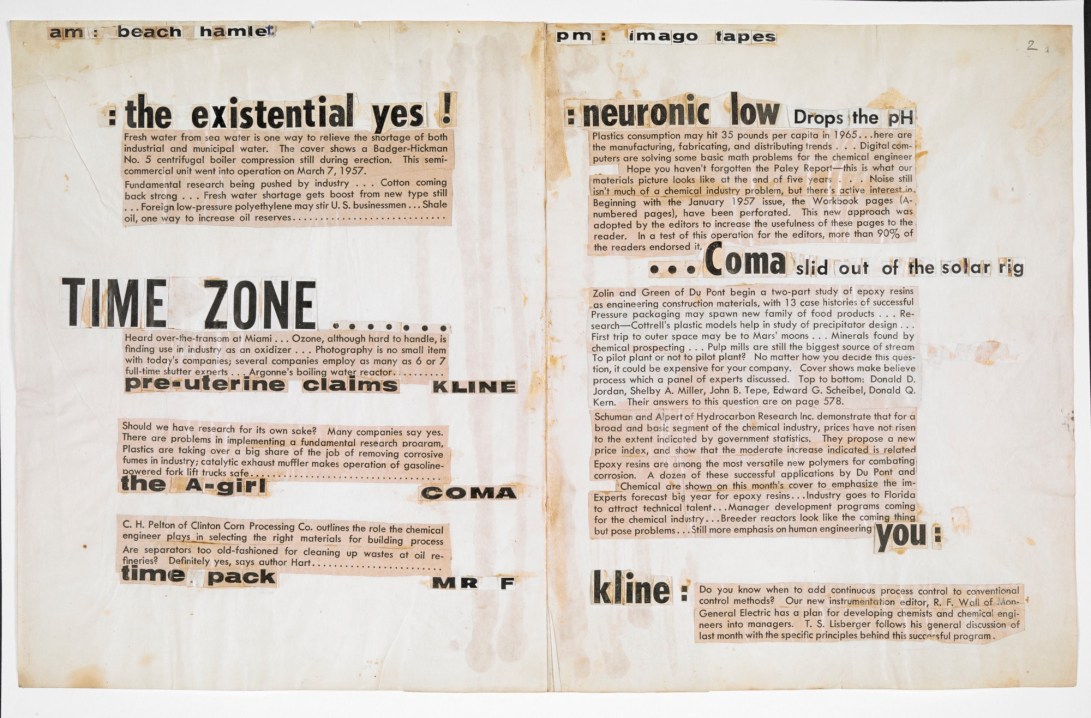

Ballard formed the ‘novel’ from scientific and technical material cut from professional literature such as Chemical and Engineering News (Ballard then worked for the journal of the Society of Chemical Industry). Letters, words and sentence fragments are pasted onto backing sheets with glue. Their design visually references everyday media, with headlines, body text and double-page spreads suggesting a magazine layout. Originally Ballard planned to display the work on billboards, as if it was a public advertisement.
From the British Library.
Found via @derekbeaulieu & @johnbrissenden.
I was extremely honoured to have my drawings mentioned in this Susannah Breslin piece on self negotiation and naming one’s inner critics:
“There’s Hypochron, whose superpower is overreacting to everything and also catastrophizing. Let’s not forget Lay-Ze-Bonez, which is quick to pronounce any lag in productivity a testament to one’s laziness. And, finally, we’ve got I’m Thirsty. I’m Thirsty is a head-only it-thing that lives at the bottom of a glass that is barely filled with water. It’s always thirsty. Despite the water. I hope you enjoyed meeting my new friends! It’s actually been sort of interesting and effective to think of the voices in this way. It makes them easier to be rational in relationship to. Let’s face it, these guys suck. As Ury writes: ‘Self-judgment may be the greatest barrier to self-understanding.’ “
The Dinner Party, Susannah Breslin
Do not upgrade yet to El Capitan OS if you use After Effects a lot. When working on networked files it slows to an unworkable speed.
I’ve been on it for a while, but have only just noticed this as I’ve only been working in Maya recently and that is fine.
It appears to be a major issue involving smb sharing and whatnot. There’s some people discussing it here.
I’m just downloading an upgrade for AE now so will keep you informed.
“I generally have four or five books open around the house—I live alone; I can do this—and they are not books on the same subject. They don’t relate to each other in any particular way, and the ideas they present bounce off one another. And I like this effect. I also listen to audio-books, and I’ll go out for my morning walk with tapes from two very different audio-books, and let those ideas bounce off each other, simmer, reproduce in some odd way, so that I come up with ideas that I might not have come up with if I had simply stuck to one book until I was done with it and then gone and picked up another.”
(See also “This is how I read” and “the tyranny of belief in linear time.” (via robertogreco)
I dated this because there probably’ll be more than one.
There was a recent rescreening of 1978 interview.
This on writing his first play
I wrote that play totally without calculation. In other words, I started at the top and at a certain point There was a knock at the door and someone came in, and I had absolutely no idea who he was, who he might be, what he might say, and I let it run. I let it happen, and found that he did have a voice, that he was the Landlord, in fact. That was the first chapter.
The two visitors arrived, and I didn’t know what they were on about really, or what they wanted. They were just part of the whole atmosphere.
This on starting:
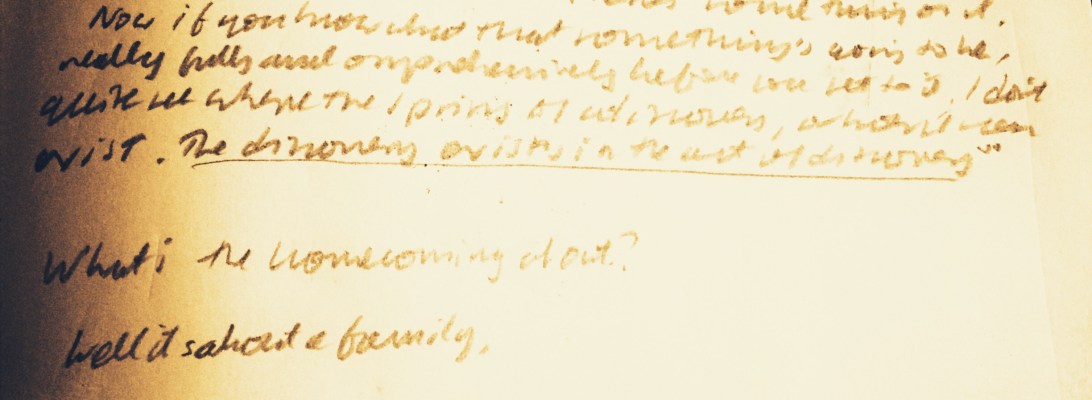
It remains the essential joy of writing, I think. You’ve got a blank page, one moment, there’s nothing on it, and the next moment there’s something on it.
Now if you know what that something’s going to be, really, fully and comprehensively before you get to it, I don’t quite see where the spring of discovery can exist.
The discovery exists in the act of discovery.
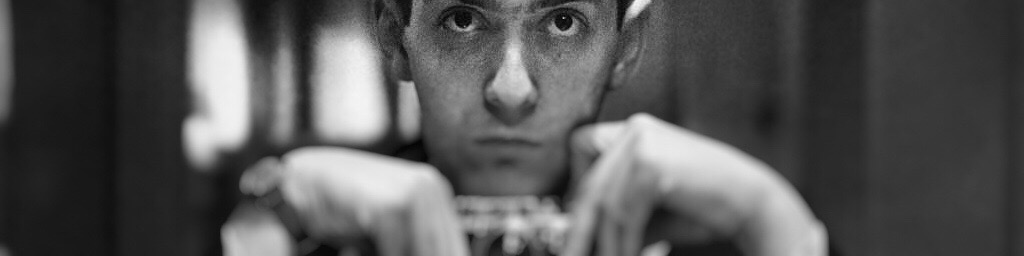
“A short documentary about the early life and feature films of the great Stanley Kubrick, as narrated by himself. The narration was pulled from interviews that took place in 1966 with Jeremy Bernstein. Bernstein was writing a profile on the director and used these recordings as a chance to gather information. As it turns out the tapes themselves were a rare and incredibly interesting insight into the mind of Kubrick. Its also a glimpse at the director before his “masterpieces” such as ‘2001 : A Space Odyssey’ and ‘The Shining’ had been made. The films mentioned are as follows :
1968 – 2001: A Space Odyssey
1964 – Dr. Strangelove or: How I Learned to Stop Worrying and Love the Bomb
1962 – Lolita
1960 – Spartacus
1957 – Paths of Glory
1956 – The Killing
1955 – Killer’s Kiss
1953 – Fear and Desire
1951 – Day of the Fight (Documentary short)
1951 – Flying Padre (Documentary short)”
 Paul Greer